
 Back
Back





THE HIGH COURT OF JUDICATURE AT MADRAS
P.B.BALAJI, J.
Meenakshi – Appellant
Versus
Vasanthi @ Vasantha Devi – Respondent
A.S.No.100 of 2024 & CMP.No.3325 of 2024
Decided On : 13-02-2026
| Table of Content |
|---|
| 1. facts regarding property ownership from partition. (Para 2 , 3) |
| 2. trial court's issues and decisions. (Para 4 , 6) |
| 3. arguments from both counsel on property rights. (Para 9 , 10) |
| 4. court's comprehensive review of arguments. (Para 11 , 12 , 13) |
| 5. determination of property rights based on admissions. (Para 14 , 15 , 16) |
| 6. final decision on appeal and costs. (Para 17 , 18) |
JUDGMENT :
P.B.BALAJI, J.
The defendants in a suit for partition are the appellants in this appeal suit.
2. Pleadings:
The plaint in brief:
(a) The suit properties were held in common by the sons of late Ramasamy Gounder, namely Palanisamy Gounder, Kumarasamy and Muthusamy. Subsequently, in and by a partition before the Panchayat on 17.02.1972, the properties have been divided and a deed has also been registered in Doc.No.266/1972. Schedule A was allotted to Palanisamy Gounder and B Schedule property was allotted to Muthusamy under the said partition deed and they have taken possession of their respective allotments and have in separate possession and enjoyment of the same.
(b) Palanisamy Gounder, in and by a registered power of attorney dated 05.12.2007, has appointed one K.Somasundaram as his duly constituted agent, pursuant to which, the said K.Somasundaram executed a sale deed on 06.02.2009 in favour of the 1st plaintiff for a consideration of Rs.3 lakhs. The 1st plaintiff has taken possession of A Schedule property and has been in absolute possession and enjoyment of the same ever since. Palanisamy Gounder died in the year 2014. His wife, the 1st defendant and the daughter, the 2nd defendant and the son-in-law, the 3rd defendant, despite the alienation made by the Palanisamy Gounder even during his lifetime, suppressing the same, attempted to alienate the property belonging to the 1st plaintiff. The attempts to meddle with the rights of the plaintiffs were thwarted by the plaintiffs.
(c) In so far as B Schedule property, which is described as Schedule C in the partition deed dated 17.02.1972, the allottee of the suit Schedule B property, namely Ramasamy Gounder’s son Muthusamy, in and by a settlement deed dated 10.02.1997 settled it on the plaintiffs 1 and 2. The 2nd plaintiff was a minor, represented by his mother, as natural guardian, on the date of the settlement deed. The registered settlement deed has been acted upon and the plaintiffs are in absolute possession and enjoyment of the Schedule B property as well. Even in respect of Schedule B property, the defendants attempted to interfere with the right and interest of the plaintiffs. Hence, the plaintiffs seek for the relief of declaration that they are the rightful owners of the suit properties and for a permanent injunction to restrain the defendants from interfering with their peaceful possession and enjoyment.
3.Written Statement of the defendants in brief:
The plaintiffs are not entitled to the relief of declaration and permanent injunction. The fact that the property belong to Palanisamy Gounder is not disputed. However, it is denied that Palanisamy Gounder executed a power of attorney. It is contended by the defendants that subsequent to the demise of Palanisamy Gounder, his wife and daughter being defendants 1 and 2 are entitled to 50% each and in fact, in an oral family arrangement, the daughter has given up her right in favour of the mother, the 1st defendant. The defendants plead ignorance of the alleged power of attorney executed by Palanisamy Gounder in favour of K.Somasundaram. The deceased Palanisamy did not have any right to execute the power of attorney in respect of the entire property in which the 2nd defendant, daughter had 50% right, A Schedule property being ancestral property and any such alienation was therefore not valid in the eye of law. The 2nd defendant has also filed a suit for partition in O.S.No.191 of 2020 and the same is pending. The defendants 1 and 2 are not concerned with B Schedule property. Therefore, the defendants seek dismissal of the suit.
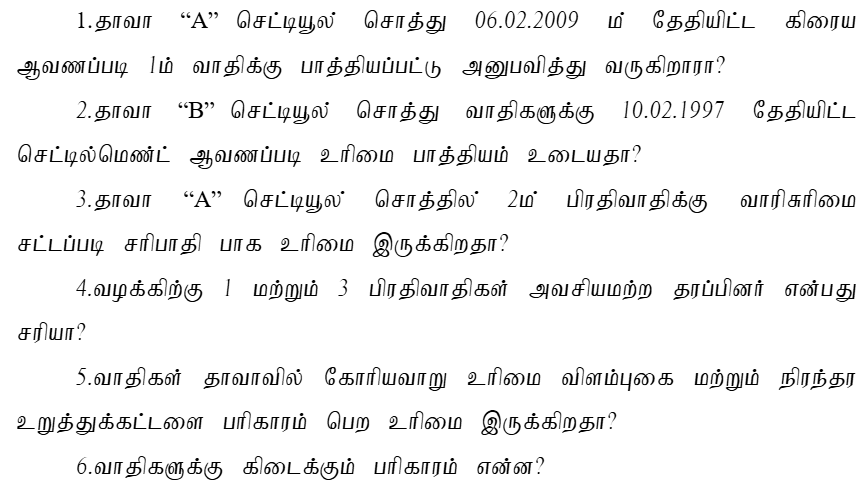
4.Issues fr
AI
The court affirmed the validity of a power of attorney and subsequent sale of property, rejecting claims of ancestral rights that conflicted with established ownership documents.

The burden of proof lies on the Plaintiff to establish the properties as joint family property and the purchase of specific items from joint family income. The Plaintiff is bound by the acts of the 1....
Proof of an unregistered Will is sufficient if established by other means, while a power of attorney coupled with consideration survives the principal's death.
Properties claimed as self-acquired were determined to be ancestral; the appeal for partition was dismissed due to lack of joint possession evidence and non-joinder of necessary parties, also barred ....

The necessity to provide evidence of entitlement to ancestral property and the importance of including all relevant parties in a partition suit.
In a partition suit, registered documents act as constructive notice, initiating the limitation period. Prolonged exclusive possession of ancestral property by a co-owner establishes ouster. Addition....

(1) Partition of property – It is not always necessary for a plaintiff in a suit for partition to seek cancellation of alienations.(2) Power of Attorney – Ordinarily, a Power of Attorney is to be con....



An indispensable Tool for Legal Professionals, Endorsed by Various High Court and Judicial Officers
Please visit our Training & Support
Center or Contact Us for assistance

Scan Me!
India’s Legal research and Law Firm App, Download now!


For Daily Legal Updates, Join us on :



 Back to top


