
 Back
Back





BEFORE THE MADURAI BENCH OF MADRAS HIGH COURT
G.K. Ilanthiraiyan, R. Poornima, JJ.
Mohandass - Appellant
Versus
State by The Inspector of Police - Respondent
Crl.A(MD)Nos. 449 & 576 of 2022 & Crl.R.C(MD)No.941 of 2022
Decided On : 11-02-2026
| Table of Content |
|---|
| 1. overview of criminal appeals and case background. (Para 1 , 2 , 3) |
| 2. details about the deceased's marital issues and threats received. (Para 4 , 5 , 6 , 7) |
| 3. describes the incident leading to the deceased's death. (Para 8 , 9) |
| 4. trial court's conviction of the accused based on evidence. (Para 11 , 12 , 13) |
| 5. defensive arguments regarding the validity of evidence. (Para 14 , 15 , 16 , 17 , 19 , 20 , 21) |
| 6. observations on the prosecution's evidence and credibility. (Para 28 , 31 , 60) |
| 7. court's final decision to acquit the accused. (Para 62 , 64 , 65) |
JUDGMENT :
G.K. ILANTHIRAIYAN, J.
Crl.A(MD)Nos.449 and 576 of 2022 are directed as against the Judgment passed in Sessions Case No.19 of 2017 dated 12.04.2022 on the file of the Sessions Judge, Mahalir Neethimandram, Madurai, thereby convicting the appellants for the offences punishable under Sections 120-B and 302 of I.P.C.
2. Crl.R.C(MD)No.941 of 2022 is filed by P.W.1 for enhancement of punishment in Sessions Case No.19 of 2017 dated 12.04.2022 on the file of the Sessions Judge, Mahalir Neethimandram, Madurai.
3.The case of the prosecution is that the deceased married the first accused and gave birth to three children. While so, the first accused became suspicious of the conduct of the deceased, and as a result, misunderstanding arose between them. Hence, the deceased left the matrimonial home of the first accused and went to her parents' house along with the three children.
4.Thereafter, the deceased filed a petition for divorce in H.M.O.P. No. 406 of 2014 on the file of the Family Court, Madurai, in which she also filed a petition seeking interim maintenance for herself and the children.
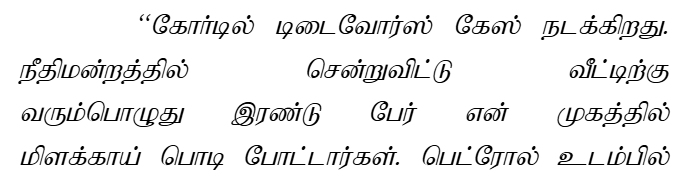
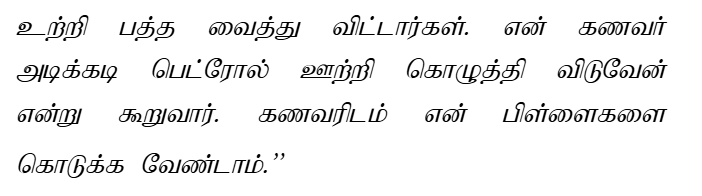
5.Consequently, the first accused developed aversion and motive against the deceased on the grounds that she had failed to cooperate with him in their family life and had also obtained an order of interim maintenance against him. Hence, the first accused frequently threatened the deceased by stating that he would pour petrol on her and set her on fire in order to compel her to withdraw the divorce petition.
6.However, the deceased did not withdraw the divorce case, and as such, the first accused conspired with the second and third accused to do away with the life of the deceased. The second accused is the driver of the first accused, and the third accused is a friend of the first accused.
7.While being so, on 03.05.2016 at about 9.30 a.m., the deceased came to the Family Court to attend the hearing and thereafter returned to her house. When she proceeded to her house at about 11.45 a.m. and attempted to open the door, the second and third accused arrived in a motorcycle.
8.At the instigation of the first accused, the second accused threw chilli powder on the face of the deceased and poured petrol on her from a silver bucket, and the third accused also threw a burning torch upon the deceased. As a result, the deceased caught fire and screamed.
9.At that juncture, the first accused also shouted at the deceased to die. Thereafter, all the accused fled away from the scene of occurrence. Immediately, the deceased was taken to the Government Rajaji Hospital, Madurai, by her father. However, she succumbed to her injuries on 03.05.2016 at about 8.30 p.m. 10.Based on the complaint, the respondent registered the F.I.R in Crime No.518 of 2016 for the offences punishable under Sections 109 , 120(B), 302 read with 34 of IPC and Section 4 of TNPHW Act . After completion of the investigation, a final report was filed and the same was taken cognizance by the Trial Court.
11.In order to bring the charges to home, the prosecution examined P.W.1 to P.W.30 and marked Exs.P1 to P31. The prosecution also produced Material Objects M.O.1 to M.O.17. On the side of the accused, marked Ex.D.1 to Ex.D.5 and no witnesses were examined before the Trial Court.
12.On perusal of the oral and documentary evidence, the trial Court found the first accused guilty for the offences punishable under Sections 120-B and 302 of I
Convictions based primarily on dying declarations are deemed unsafe without corroborative evidence, especially where doubts about the reliability of such statements exist.

Dying declarations can serve as the sole basis for conviction if they are consistent and credible; however, inconsistencies and lack of corroborative evidence can lead to reasonable doubt and acquitt....

A conviction based on inconsistent dying declarations is unsafe without corroborative evidence; discrepancies create reasonable doubt undermining the prosecution's case.

Dying declarations can be relied upon for conviction if consistent and free from blemishes, even in the absence of further corroborative evidence.


Dying declarations may serve as the sole basis for conviction if deemed voluntary, consistent, and credible; inconsistencies must be assessed in light of surrounding facts.

[A dying declaration can serve as the sole basis for conviction if it is found to be voluntary, coherent, and made in a fit mental state, even in the presence of minor inconsistencies.]

Where there are more than one statement in the nature of dying declaration, one first in point of time must be preferred. Of course, if the plurality of dying declaration could be held to be trustwor....

Inconsistent dying declarations cannot suffice for conviction without corroborating evidence, especially when procedural guidelines for a fair trial are not met.
The court reiterated the principles governing the admissibility and evidentiary value of dying declarations, emphasizing the need for careful scrutiny to ensure their genuineness and reliability.



An indispensable Tool for Legal Professionals, Endorsed by Various High Court and Judicial Officers
Please visit our Training & Support
Center or Contact Us for assistance

Scan Me!
India’s Legal research and Law Firm App, Download now!


For Daily Legal Updates, Join us on :



 Back to top


