
 Back
Back





IN THE HIGH COURT OF JUDICATURE AT MADRAS
M.DHANDAPANI, J.
Mrs. Renuga Anandkumar – Petitioner
Versus
The Union of India, rep. By its Secretary Ministry of Health & Family Welfare Department – Respondent
W.P. NO. 44471 OF 2025
Decided On : 10-12-2025
| Table of Content |
|---|
| 1. petitioner's surrogacy process was initiated prior to new age restrictions. (Para 2 , 3 , 4) |
| 2. supreme court ruled that retrospective application of age limits violates constitutional rights. (Para 5 , 6 , 8) |
| 3. right to initiate surrogacy is preserved despite amendments to the law. (Para 11 , 12 , 16) |
ORDER :
M.DHANDAPANI, J.
1. The petitioner has come before this Court seeking a direction to the respondents to issue a “Certificate of Essentiality” u/s 4 of the surrogacy (Regulation) Act, 2021 (for short ‘the Act’) to permit the petitioner to complete the process of surrogacy without applying the age restrictions, which, as per the judgment of the Apex Court in Vijayakumari & Anr. – Vs – Union of India (2025 INSC 1209) cannot be applied retrospectively, as otherwise it would be violative of the fundamental rights of the petitioner guaranteed under Articles 14 and 21 of the Constitution of India.
2. It is the case of the petitioner that she was married to one Late V.Anandkumar on 15.7.2002 and inspite of a long, affectionate and happy marital relationship, she was not able to conceive naturally. It is the further case of the petitioner that between 2004 and 2020, she underwent extensive fertility treatments, including multiple cycles of ovulation induction, IUI, IVF and surgical procedures, all of which went in vain. By 2020, due to severe ovarian decline, she was medically advised to proceed with an Oocyte Donation (OD) programme combined with surrogacy using her husband’s preserved sperm samples.
3. Upon such medical advice, in 2020, a lawful IVF/Oocyte Donation procedure was carried out resulting in the creation of twelve embryos using donor oocytes and her late husband’s sperm. These embryos were created and preserved before the Act came into force. Unfortunately her husband passed away due to COVID-19 complications on 26.9.2020. A subsequent surrogacy attempt in September, 2021 failed and six embryos remain cryopreserved.
4. It is the further case of the petitioner that the petitioner is medically unfit to carry a pregnancy and can only become a mother through surrogacy. The entire reproductive procedure including fertilisation and embryo freezing was completed in 2021 prior to the coming into force of the Act on 25.1.2022. Therefore, the statutory age limit prescribed for an “intending woman”, introduced after the freezing of embryos cannot be applied retrospectively to the case of the petitioner.
5. It is the further case of the petitioner that the Surrogacy Act, 2021 and the Assisted Reproductive Technology (Regulation) Act, 2021 (for short ‘ART Act’) for the first time prescribed an upper age limit of 45 years for widows opting for surrogacy and later restricted the use of donor gametes. These restrictions were absent when the petitioner began her surrogacy process. The petitioner has already challenged the gamete restrictions in W.P. No.1339 of 2024 which is pending before this Court.
6. It is the further case of the petitioner that the Supreme Court in Vijayakumari’s case (supra) had held that the age restrictions under the Act operate only prospectively and not retrospectively and the creation and freezing of embryos having been commenced before 25.01.2022, it constitutes the commencement of the surrogacy process granting intending mothers a vested right to complete, as the Court recognized that the reproductive autonomy forms part of the fundamental right to life guaranteed under Article 21 of the Constitution.
7. It is the further case of the petitioner that her case falls squarely within the aforesaid ratio laid down in Vijayakumari’s case. The surrogacy process had already commenced prior to the commencement of the Act and, therefore, refusal to issue “Certificate of Essentiality” on the ground of age, which had come into play only after the Surrogacy Act and ART Act prescribed an age, it cannot be applied retrospectively and such application is violative of the fundamental rights guaranteed to the pe
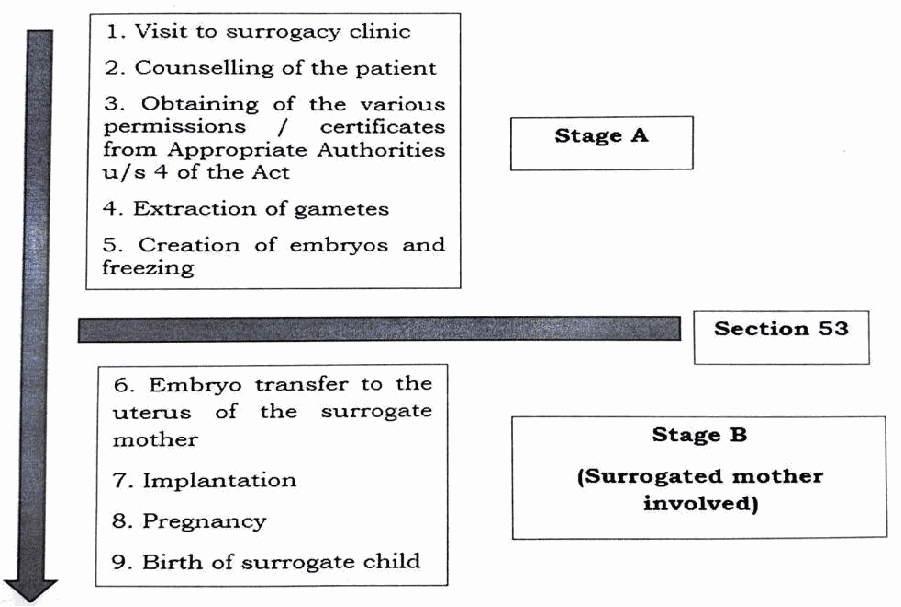
Age restrictions in surrogacy laws cannot be applied retrospectively to couples who initiated processes prior to enactment, preserving their reproductive rights under constitutional protections.

Upper age limits in Surrogacy Act are constitutionally valid, reasonable restrictions protecting child welfare and health.

The court held that age restrictions in the Surrogacy Act do not apply retrospectively to couples who had initiated the surrogacy process prior to the Act's implementation.
Age restrictions under Surrogacy Act, 2021 not applicable retrospectively to pre-Act cryopreserved embryos.
Eligibility for surrogacy services is strictly determined by age limits as stipulated in legislation, ceasing upon reaching the specified age.
The court ruled that the age limit for surrogacy eligibility is strict, and a female becomes ineligible upon reaching 50 years, rejecting interpretations extending eligibility beyond this age.


Section 4 deals with regulation of surrogacy and surrogacy procedures.



An indispensable Tool for Legal Professionals, Endorsed by Various High Court and Judicial Officers
Please visit our Training & Support
Center or Contact Us for assistance

Scan Me!
India’s Legal research and Law Firm App, Download now!


For Daily Legal Updates, Join us on :



 Back to top


