Back
Back





2025 Supreme(Mad) 5338
IN THE HIGH COURT OF JUDICATURE AT MADRAS
R. SAKTHIVEL, J.
K.Amutha @ Rouccoumaniammalle - Petitioner
Versus
Thangammal – Respondent
C.R.P. NO.3033 OF 2018, C.M.P.NO.12264 OF 2021
Decided On : 15-12-2025
For the Petitioner: Ms.V. Srimathi
For the Respondent: Mr. A. Swaminthan
Objections to a document's admissibility must be raised at the time of marking; failing to do so waives such objections, affecting the recognition of Oral Family Arrangements under relevant laws.
Headnote:(A) Code of Civil Procedure, 1908 - Order XIII Rule 3 - Registration Act, 1908 - Admissibility of documents - The Trial Court dismissed the Plaintiff's petition to eschew an unregistered Family Arrangement Agreement marked as evidence, ruling that its legal validity would be determined at the conclusion of the trial - Plaintiff contended the document was inadmissible due to lack of registration and insufficient stamp duty - The Trial Court found that objections to the document's admission were waived when not raised at the time of marking - The Court held that the Trial Court's incidental findings on the document being a valid Family Arrangement were contradictory and set those findings aside while sustaining other parts of the order. (Paras 12, 14, 15, 18)
Facts of the case:
The plaintiff claimed rights over properties alleged to be fraudulently sold by the defendants, presenting a Family Arrangement Agreement as evidence - The defendants argued that the plaintiff forfeited her claims through prior arrangements.
Findings of Court:
The Court determined that the Trial Court's incidental findings regarding the Family Arrangement Agreement were contradictory to its primary ruling regarding admissibility - Other aspects of the Trial Court's order were sustained.
Issues: Whether the document could be marked as evidence in light of its unregistered status and stamp duty issues - The legal implications of an Oral Family Arrangement concerning registration and admissibility.
Ratio Decidendi: The court maintained that objections to a document's admissibility must be raised at the time of its marking, and merely failing to do so waives such objections - It affirmed that whether the Family Arrangement was valid or created rights would need resolution after trial.
Result: Civil Revision Petition is partly allowed.
| Table of Content |
|---|
| 1. identification of parties and case background (Para 1 , 2) |
| 2. plaintiff's claim regarding property shares (Para 3) |
| 3. defendant's denial of plaintiff's claims (Para 4) |
| 4. trial court proceedings and marking of documents (Para 5) |
| 5. arguments challenging document admissibility (Para 8) |
| 6. arguments supporting document's admissibility (Para 9) |
| 7. court's evaluation of document marking issues (Para 10 , 11) |
| 8. legal principles regarding family arrangements (Para 12 , 13) |
| 9. court's analysis of rights created by ex-b.15 (Para 14 , 15) |
| 10. contradictions in trial court's findings (Para 16 , 17) |
| 11. final ruling on the revision petition (Para 18) |
ORDER :
R. SAKTHIVEL, J.
The Revision Petitioner herein is the Plaintiff and the Respondents 1 to 7 herein are the Defendants in the Original Suit in O.S.No.87 of 2010 on the file of 'the Principal Sub-Court, Tindivanam' (hereinafter referred to as the 'Trial Court'). Respondents 8 & 9 herein are the Legal Representatives of the Deceased 2nd Respondent. For the sake of convenience, hereinafter, the parties herein will be referred to as per their array in the Original Suit.
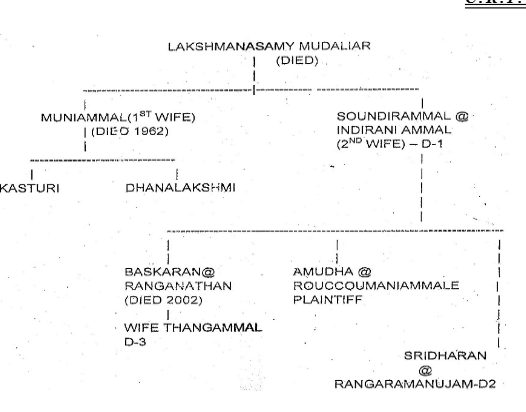
2. For better appraisal of the facts of the case, this Court deems fit to reproduce hereunder the genealogy chart annexed along with the plaint:-
3. Case of the Plaintiff as presented in the plaint is that a portion of Suit Item No.1 was bequeathed to Lakshmanasamy Mudaliar by his father - Duraisamy Mudaliar by Will dated August 19, 1968. Suit Item Nos.2 and 3 were purchased by Lakshmanasamy Mudaliar as his separate property. Suit Item Nos.4 and 5 were purchased by Lakshmanasamy Mudaliar during his life time out of his own income by selling roasted nuts at Tindivanam, in the name of his wife, the 1st Defendant for the benefit of his children including the Plaintiff, who were all minors at the time of purchase. Further, the 1st Defendant has no independent source of income to purchase those lands. Hence, Suit Item Nos.4 and 5 are separate properties of Lakshamanasamy Mudaliar.
3.1. Lakshamanasamy Mudaliar through his first wife had two daughters, who were married off during his lifetime and they have no right in the Suit Properties. Lakshamanasamy Mudaliar divorced his first wife in 1958 and married the first defendant as his second wife. Lakshamanasamy Mudaliar passed away on September 9, 1978. One of his son – Baskaran alias Ranganathan passed away on January 30, 2002 leaving behind his wife / third defendant as his legal heir. Hence, the Plaintiff and the Defendants 1 to 3 are entitled each ¼ share in the Suit Properties.
3.2. While so, Suit Item No.4 was sold in favour of 4th and 5th Defendants vide registered Sale Deeds even dated January 28, 2002 by the 1st Defendant at the instigation of the 2nd Defendant. Further, the 2nd Defendant obtained a Settlement Deed dated February 6, 2002 from 1st Defendant in respect of a portion of the Suit Properties. These were done with a view to defeat and defraud the Plaintiff's rights over the Suit Properties. Hence, the Plaintiff filed the Suit seeking partition and declaration that the Sale Deeds and the Settlement Deed are null and void and do not bind the Plaintiff.
3.3. The 1st Defendant passed away on December 20, 2006 and hence the plaint was amended to the effect that the Plaintiff and the Defendants 2 and 3 are entitled to 1/3 share each in the Suit Properties.
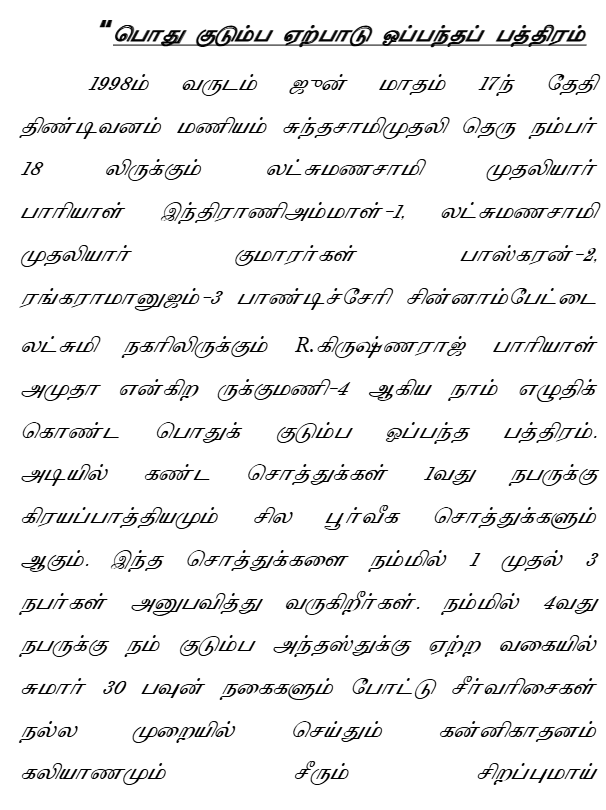
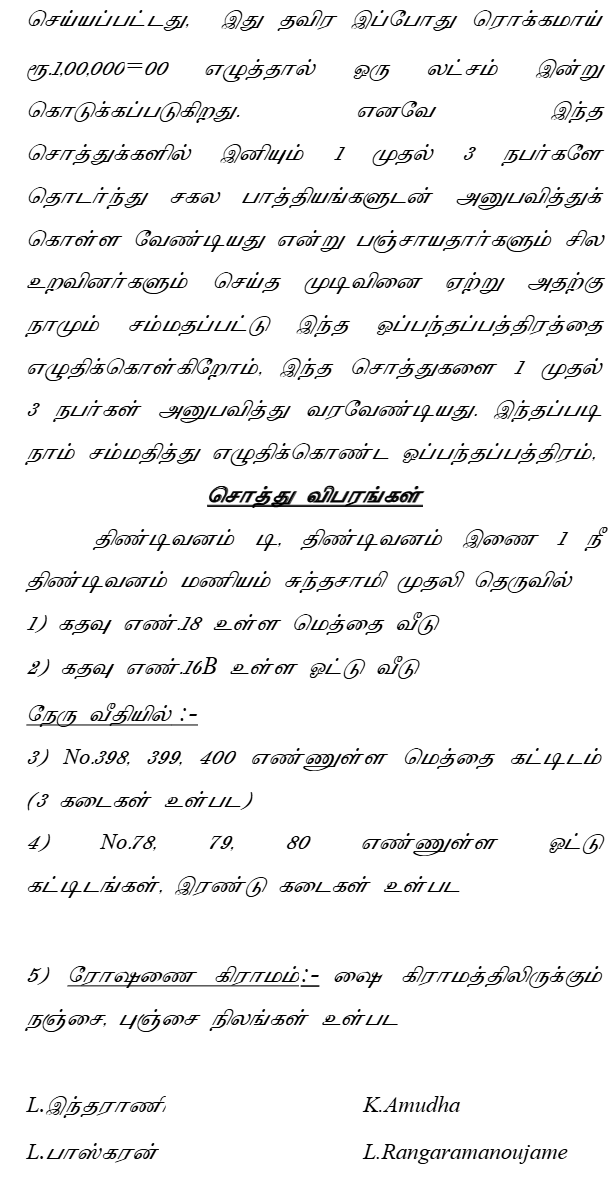
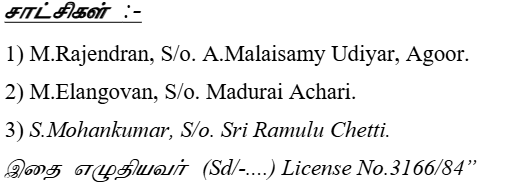
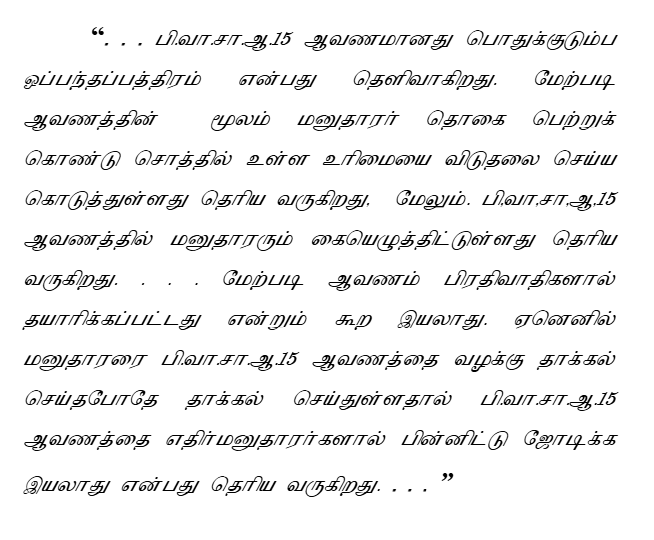
4. The 2nd Defendant filed a Written Statement denying the plaint averments. It is stated that the entire Suit Properties are not an absolute properties of Lakshamanasamy Mudaliar. Item Nos.3 and 4 are separate properties of the 1st Defendant. The Plaintiff demanded partition in 1998. Consequently, a Family Panchayat took place in the presence of relatives and well wishers where an Oral Family Arrangement was arrived at. As per the Oral Family Arrangement, the Plaintiff was given a sum of Rs.1,00,000/- in lieu of relinquishment of her share in the Suit Properties and making an admission to that effect, she executed