Back
Back





2026 Supreme(Mad) 1400
BEFORE THE MADURAI BENCH OF MADRAS HIGH COURT
K. MURALI SHANKAR, J.
Meenachi – Appellant
Versus
Rajalekshmi – Respondent
S.A.(MD).No.467 of 2019 and C.M.P.(MD)Nos.9428 and 9430 of 2019
Decided On : 10-04-2026
For the Appellants : Mr. G. Ramanathan
For the Respondents: Mr. S. Palanivelayutham, Mr. M.P. Senthil for Mr. R. Murugan.
Existence of an unregistered family arrangement deed does not confer partition rights absent proper registration and stamp duty where required by law.
Headnote:The appeal concerns partition and permanent injunction in suit properties claimed to be ancestral joint family properties. Facts indicate the suit properties originally belonged to the first defendant's parents and were inherited by her. The trial court granted partition in favour of the plaintiffs but the first appellate court reversed, allowing the appeal and dismissing the suit. Issues framed whether the properties are joint or individual, and whether the plaintiffs are entitled to partition and injunction. The ratio emphasizes that properties inherited by a female Hindu under Sections 8 and 15 of the Hindu Succession Act do not automatically become joint family properties by mere inheritance absent evidence of blending. The unregistered and unstamped family arrangement deed was held inadmissible for proving title or partition.
Result: The Second Appeal dismissed; judgment and decree of the first appellate court confirmed; suit dismissed.
| Table of Content |
|---|
| 1. facts of suit for partition and injunction. (Para 1 , 2 , 3 , 4 , 5) |
| 2. trial, appeal procedures and issues framed. (Para 6 , 7 , 8) |
| 3. rejection of additional evidence application. (Para 9 , 10 , 11 , 12 , 13 , 14 , 15) |
| 4. nature of suit properties under inheritance. (Para 16 , 17 , 18) |
| 5. admissibility of unregistered family arrangement deed. (Para 19 , 20 , 21 , 22 , 23 , 24 , 25 , 26 , 27 , 28 , 29) |
| 6. effect of sale deed and impleadment; decision. (Para 30 , 31 , 32 , 33 , 34 , 35) |
JUDGMENT :
K. MURALI SHANKAR, J.
1.The Second Appeal is directed against the judgment and decree made in A.S.No.74 of 2014, dated 01.04.2019, on the file of the Principal District Court, Kanniyakumari District at Nagercoil, reversing the judgment and decree passed in O.S.No.74 of 2007, dated 19.07.2010, on the file of the Principal Subordinate Court, Nagercoil.
2. The appellants are the plaintiffs and they filed a suit in O.S.NO.74 of 2007, before the Subordinate Court, Nagercoil, claiming partition and allotment of 3/12 shares in the suit properties and for permanent injunction restraining the defendants and their men from aleinating or encumbering the suit properties.
3. For the sake of convenience and brevity, the parties will hereinafter be referred as per their status/ranking in their original suit.
4. The case of the plaintiffs, in brief, is as follows:
(a) The first plaintiff is the mother of the plaintiffs 2 and 3. The first defendant is the mother of the first plaintiff's deceased husband – Chithambara Kumar, who died on 25.04.2007 leaving behind the plaintiffs and the first defendant as his legal heirs. The suit schedule items 1 and 2 properties belonged to the first defendant's deceased mother Seetha Bai and the suit schedule items 3 and 4 belonged to the first defendant's deceased father Thiraviyam Pillai @ Maraya Kutty Pillai. The said Seetha Bai and her husband Thiraviyam Pillai @ Maraya Kutty Pillai died on 18.06.1989 and 05.09.1999 respectively leaving behind two daughters namely Tmt.Rajalekshmi – first defendant and one Nageshwari.
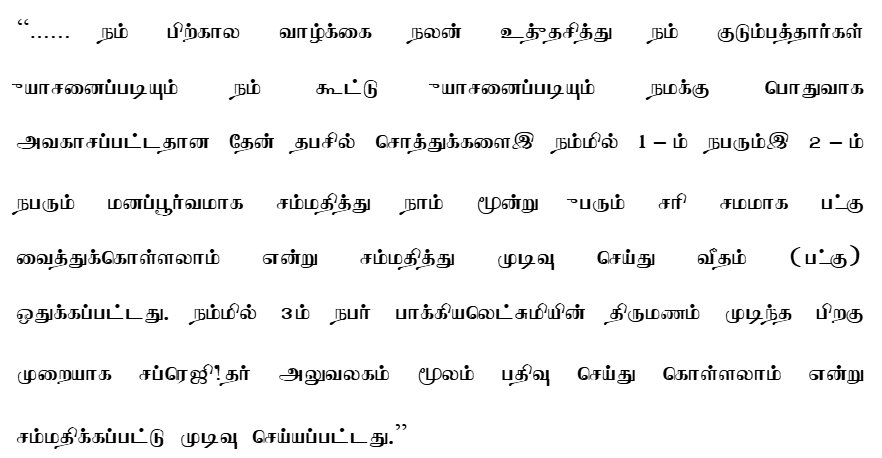
(b) As per the family arrangement, the properties were allotted to the first plaintiff's deceased husband Chithambara Kumar and the defendants. The said Chithambara Kumar and the defendants were in joint possession and enjoyment of the suit properties. Since the suit properties are the family and ancestral properties of the said Chithambara Kumar and the defendants, they entered into a written family arrangement deed on 30.04.2001, whereunder all of them agreed to partition the properties into three equal shares and also agreed to get the document registered, after the marriage of the second defendant.
(c) Even though the second defendant's marriage was held in the year 2002 and the first plaintiff's husband spent more then Rs.2,00,000/- for the said marriage, the defendants 1 and 2 were dragging on, for effecting partition. Hence, the first plaintiff's husband sent a legal notice on 23.11.2006 demanding partition and separate possession of his 1/3 share over the suit properties. But the notices were returned as door locked.
(d) The first plaintiff's husband executed a General Power of Attorney deed dated 08.12.2006 vide document No.280 of 2006 of Edalakudy Sub Registrar's office with regard to the third item of the suit properties. Subsequently, the first plaintiff's husband died on 25.04.2007, leaving behind the plaintiffs. As per the provisions of the Hindu Succession Act, the plaintiffs and the first defendant are each entitled to 1/4 share of 1/3 share of the suit properties and as such, the plaintiffs are entitled to 3/12 shares over the suit properties. Hence, the above suit.
5. The defence of the defendants, in brief, is as follows:
The suit properties are not the ancestral or joint family properties. No family arrangements were entered into and no such agreement for partition of the properties into three equal shares took place. The alleged family arrangement deed is a created and forged o