
 Back
Back





BEFORE THE MADURAI BENCH OF MADRAS HIGH COURT
K. Murali Shankar, J.
T.Ramkumar - Appellant
Versus
Sivasamy - Respondent
Crl.A.(MD)No.121 of 2024
Decided On : 19-12-2025
| Table of Content |
|---|
| 1. judgment related to cheque dishonor and consequences. (Para 1 , 4 , 5) |
| 2. court reinforced presumptive principles of liability in cheque cases. (Para 8 , 10 , 34) |
| 3. the ruling overturned the acquittal based on flawed reasoning. (Para 29 , 36) |
JUDGMENT :
K. Murali Shankar, J.
The Criminal Appeal is directed against the judgment made in S.T.C.No.1427 of 2022 dated 27.12.2023 on the file of the Court of Judicial Magistrate, Tiruchendur, in acquitting the respondent / accused for the offence under Section 138 of the Negotiable Instruments (hereinafter referred as 'NI') Act.
2. The appellant, who is the complainant, filed a complaint under Section 200 Cr.P.C. against the respondent / accused for the alleged offence under Section 138 r/w 142 of the NI Act.
3. For the sake of convenience and brevity, the parties hereinafter will be referred to as per their status / ranking in the trial Court.
4. The case of the complainant is that the accused having acquaintance with the complainant borrowed Rs.4,00,000/- on 24.08.2020, R.2,00,000/- on 11.01.2021, Rs.50,000/- on 01.07.2021, Rs.2,00,000/- on 16.09.2021 and Rs.1,50,000/- on 02.10.2021, totalling Rs.10,00,000/- for his urgent expenses and to purchase lorry agreeing to return the amount within two months. The complainant demanded the accused to return the amount and the accused issued a post-dated cheque dated 02.09.2022 for Rs.10,00,000/- drawn on Canara Bank, Attur Branch and requested the complainant to present the cheque and encash the same. Believing the words of the accused, the complainant presented the cheque for collection on 02.09.2022 through his banker Tamilnad Mercantile Bank, Attur Branch but the cheque was returned dishonored as funds insufficient. Hence, the complainant sent a legal notice dated 21.09.2022 to the accused demanding him to pay the amount covered by the cheque. The accused having received the notice on 24.09.2022 neither sent any reply nor paid the cheque amount. Therefore, the complainant was constrained to file the above complaint for the offence under Section 138 r/w 142 of the NI Act.
5. The learned Judicial Magistrate, Tiruchendur, upon receiving the complaint, recorded the sworn statement of the complainant and on perusing the records, upon satisfied that there existed a prima facie case took the case on file in S.T.C.No.1427 of 2022 for the offence under Section 138 of the NI Act. The Court sent the copies of complaint and records along with summons. After appearance of the accused, the accused was questioned about the offence alleged against him and he denied the commission of offence and pleaded not guilty.
6. During trial, the complainant examined himself as P.W.1 and exhibited 5 documents as Ex.P.1 to Ex.P.5.
7. After closure of the complainant's side evidence, the accused was examined under Section 313(1)(b) Cr.P.C. with regard to the incriminating aspects found against him and he denied the same as false. The accused stated that the accused took a loan of Rs.8,500/- on 01.07.2021 from the complainant, that he had taken loans earlier and repaid them, that the accused did not take loans as alleged by the complainant, that the accused gave six cheques when borrowing Rs.8,500/-, that the signature found in Ex.P.1 (cheque) is his signature and that the accused requested the complainant to hold the cheque due to insufficient funds in the bank account and agreed to pay in installments but the complainant presented the cheque anyway. The accused adduced neither oral nor documentary evidence.
8. The learned Judicial Magistrate, upon considering the evidence both oral and documentary and on hearing the arguments of both the sides, passed the impugned judgment dated 27.12.2023 holding that the complainant has not proved the offence under Section 138 of the NI Act as against the accused beyond reasonable doubt, acquitted him under Section 255(1) Cr.P.C. Aggrieved by the impugned judgment of acquittal, the complainant has filed the present appeal
9. W
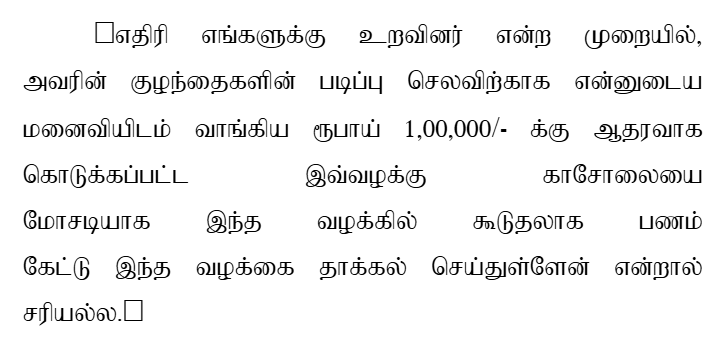
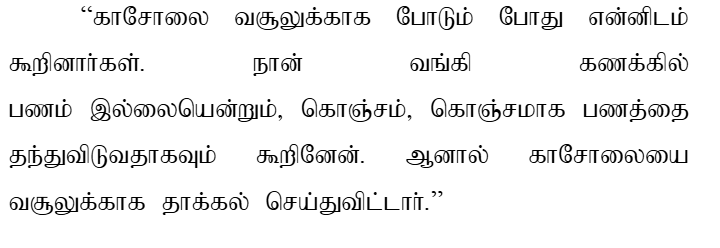
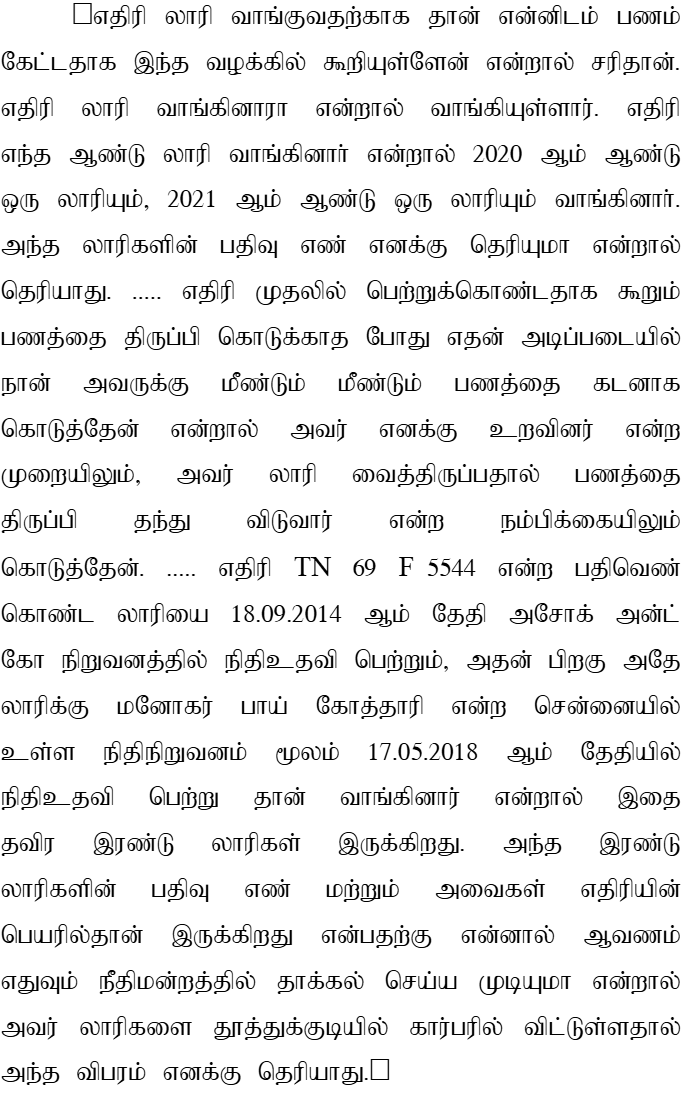
The failure of the accused to respond to a statutory notice under the Negotiable Instruments Act supports the presumption of debt and liability, which the accused must rebut with credible evidence.

The burden is on the complainant to prove financial capacity when questioned; a mere presumption does not suffice if evidence is lacking.

A presumption of debt exists under Sections 138 and 139 of the Negotiable Instruments Act, which the accused failed to rebut, affirming liability for dishonored cheques.
A complainant's debt recovery under the Negotiable Instruments Act relies on established presumptions, rendering the accused's claims of improper notice or lack of financial capacity irrelevant unles....
A drawer of a cheque is presumed liable unless they provide evidence to rebut the presumption of issuance for debt repayment, established under Sections 138 and 139 of the Negotiable Instruments Act.
The court upheld the acquittal as the complainant failed to prove the loan's existence or that the cheque was issued for legitimate debt, emphasizing the rebuttable nature of presumptions under the N....
The burden lies on the complainant to prove the issuance of a cheque for a legally enforceable debt, which was not demonstrated, leading to the dismissal of the appeal.
The statutory presumption under Sections 138 and 139 of the Negotiable Instruments Act establishes that the accused must rebut the existence of a debt with credible evidence; mere denial is insuffici....



An indispensable Tool for Legal Professionals, Endorsed by Various High Court and Judicial Officers
Please visit our Training & Support
Center or Contact Us for assistance

Scan Me!
India’s Legal research and Law Firm App, Download now!


For Daily Legal Updates, Join us on :



 Back to top


