
 Back
Back





BEFORE THE MADURAI BENCH OF MADRAS HIGH COURT
G.K.ILANTHIRAIYAN, R.POORNIMA, JJ.
Manikandan @ Manivannan – Appellant
Versus
The State Represented by Deputy Superintendent of Police, Usilampatti – Respondent
Crl. Appeal (MD) No. 514 of 2022
Decided On : 28-01-2026
| Table of Content |
|---|
| 1. background of the marriage and dowry issues. (Para 1 , 2 , 3) |
| 2. circumstances leading to the deceased's suicide. (Para 4 , 5 , 6) |
| 3. challenge on the charge under section 304-b. (Para 8 , 9) |
| 4. arguments regarding dowry and harassment. (Para 10 , 11 , 12) |
| 5. evidence and its relevance to the charges. (Para 17 , 21 , 24) |
| 6. legal standards for establishing dowry death. (Para 28 , 29 , 30) |
| 7. conclusion and order of the court. (Para 32 , 33 , 34) |
JUDGMENT :
G.K. ILANTHIRAIYAN, J.
1. This appeal is directed as against the Judgment passed in S.C.No.383 of 2014, dated 22.06.2022, on the file of the learned Sessions Judge, Mahilar Court, Madurai, thereby convicting the appellants for the offences punishable under Sections 498 (A) and 304-B of I.P.C.
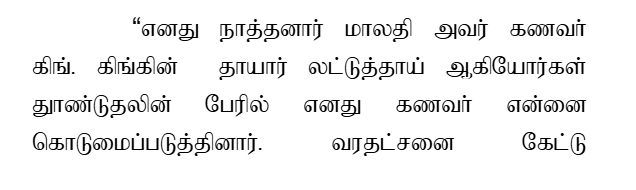
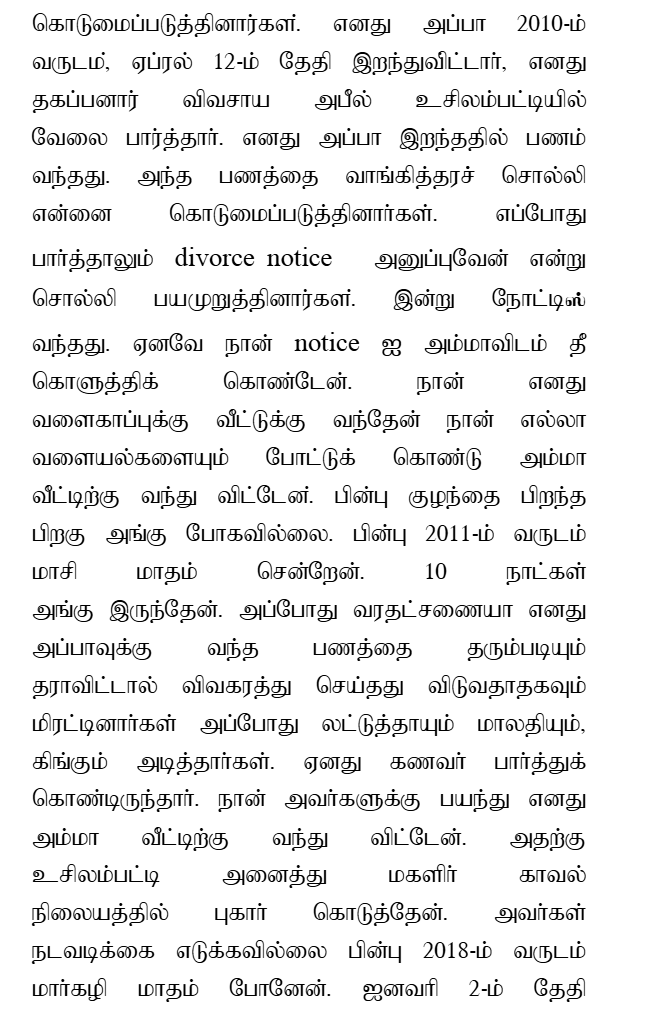
2. The case of the prosecution is that the first accused is the husband of the deceased, accused Nos. 2 and 3 are the parents of the first accused, accused No.4 is the sister of the first accused, accused No.5 is the husband of the fourth accused and accused No.6 is the mother of accused No.5. All the accused are relatives. The marriage between the first accused and deceased was solemnized on 15.02.2009. Out of their wedlock, a male child was born in the year 2010. Thereafter, the father of the deceased expired. Subsequently, disputes arose due to the unlawful demand of huge dowry by the accused. Hence, the deceased went to her parental home. After the demise of the deceased's father, the accused demanded one-third share in the death benefits of her father. Further, they also demanded 10 sovereigns of gold jewels from the parents of the deceased. Since the father of the deceased was working as and Assistant Agricultural Officer, the accused expected more dowry from the deceased's family. The deceased did not return to her matrimonial home till December 2013.
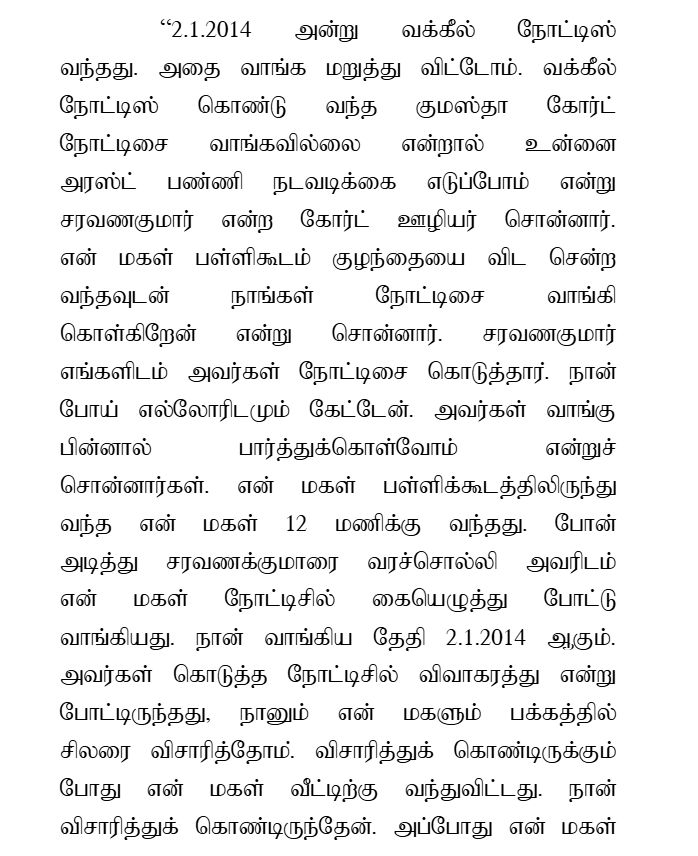
3. While being so, during the month of December 2013, the first accused requested the deceased and her mother to send the deceased back to the matrimonial home. He also promised that he would not demand any jewels or cash. Believing the said words, the deceased returned to her matrimonial home along with her child.
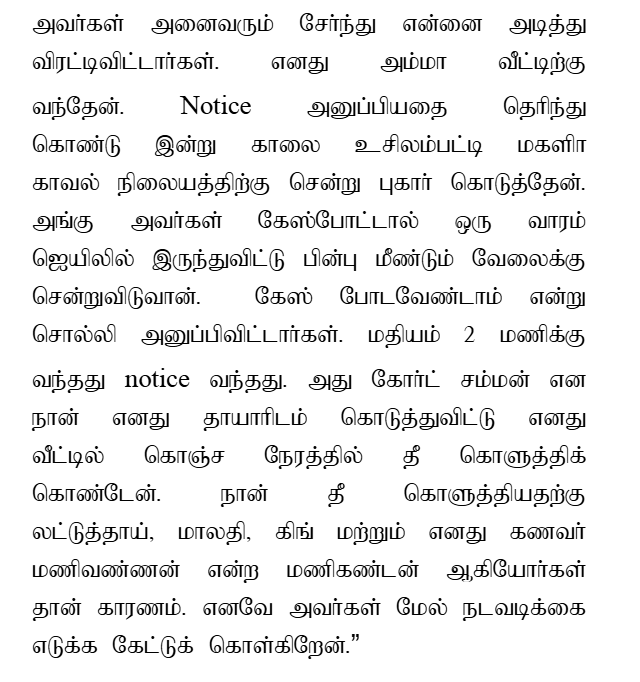
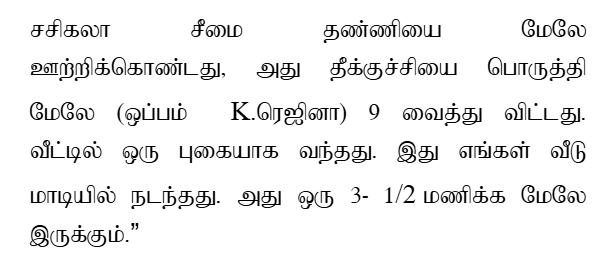
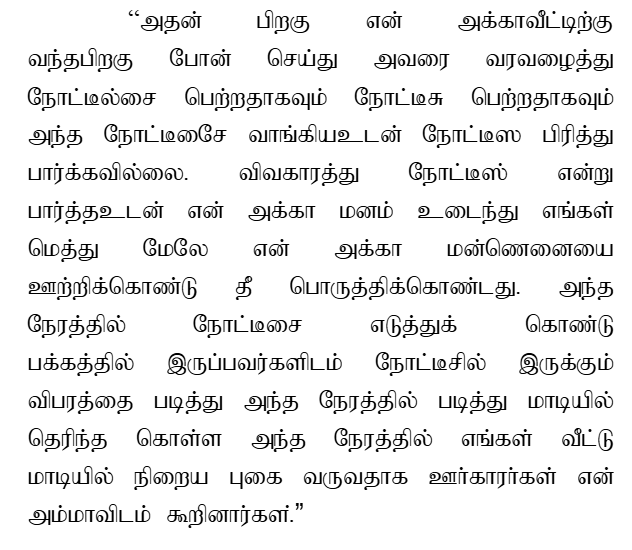
4. While being so, on 02.01.2014, the accused once again demanded dowry of 10 sovereigns of gold jewels and also one-third share in the death benefits of her father. Therefore, the deceased once again returned to her parental home. She also lodged a complaint before the All Women Police Station, Usilampatti and a C.S.R was issued. While the enquiry was pending, the first accused filed a divorce petition and the deceased received the divorce notice from the Court on 02.04.2014. On seeing the Court notice, the deceased became upset and at about 03.15 p.m. on 02.04.2014, she herself poured kerosene and set fire on herself at her parental home. She was immediately taken to the Government Hospital, Usilampatti and thereafter referred to the Government Rajaji Hospital, Madurai. However, she succumbed to the burn injuries at about 08.45 p.m. On the next day, on 03.04.2014, a complaint was lodged and the same has been registered in Crime No.119 of 2014 for the offences punishable under Sections 498 (A) and 304-B of I.P.C. After completion of investigation, the respondent filed a final report and the same has been taken cognizance by the Trial Court.
5. On the side of the prosecution, in order to bring the charges to home, they examined P.W.1 to P.W.15 and Exs.P1 to P18 were marked. The prosecution also produced Material Object M.O.1. On the side of the accused, Ex.D.1 to Ex.D.3 were marked and no witnesses were examined before the Trial Court.
6. On perusal of the oral and documentary evidence, the trial Court found A.1 guilty for the offences punishable under Sections 498 (A) and 304-B of I.P.C and found Accused Nos.2, 4, 5 and 6 guilty for the offences punishable under (A) and 304-B of. A.1 was sentenced to undergo three years Rigorous Imprisonment and to pay a fine of Rs.2,00,000/- in default, to undergo six months Simple
Continuous harassment before death must be proven for dowry death under Section 304-B; mere past incidents are insufficient to establish liability.

Point of law: To indicate that the expression 'soon before' would normally implied that the interval should not be much between the concerned cruelty or harassment and the death in question. There mu....

(1) Dowry death – There must be existence of a proximate and live-link between effect of cruelty based on dowry demand and concerned death.(2) ‘Soon before’ is a relative term and it would depend upo....

The court affirmed the conviction under Section 304-B IPC, establishing that the deceased was subjected to cruelty for dowry demands, leading to her suicide, thus satisfying the legal requirements fo....

The main legal point established in the judgment is that to convict an accused under Section 304-B IPC, the prosecution must prove that the deceased was subjected to cruelty or harassment in connecti....
The prosecution must prove cruelty or harassment for dowry demand soon before death to sustain a conviction under Sections 304-B and 498-A IPC; insufficient evidence leads to acquittal.


To convict under Section 304-B IPC, it must be proven that the victim faced cruelty for dowry-related demands occurring soon before death, which was not established in this case.



An indispensable Tool for Legal Professionals, Endorsed by Various High Court and Judicial Officers
Please visit our Training & Support
Center or Contact Us for assistance

Scan Me!
India’s Legal research and Law Firm App, Download now!


For Daily Legal Updates, Join us on :



 Back to top


