


 Back
Back





2026 Supreme(Mad) 692
IN THE HIGH COURT OF JUDICATURE AT MADRAS
V.LAKSHMINARAYANAN, J.
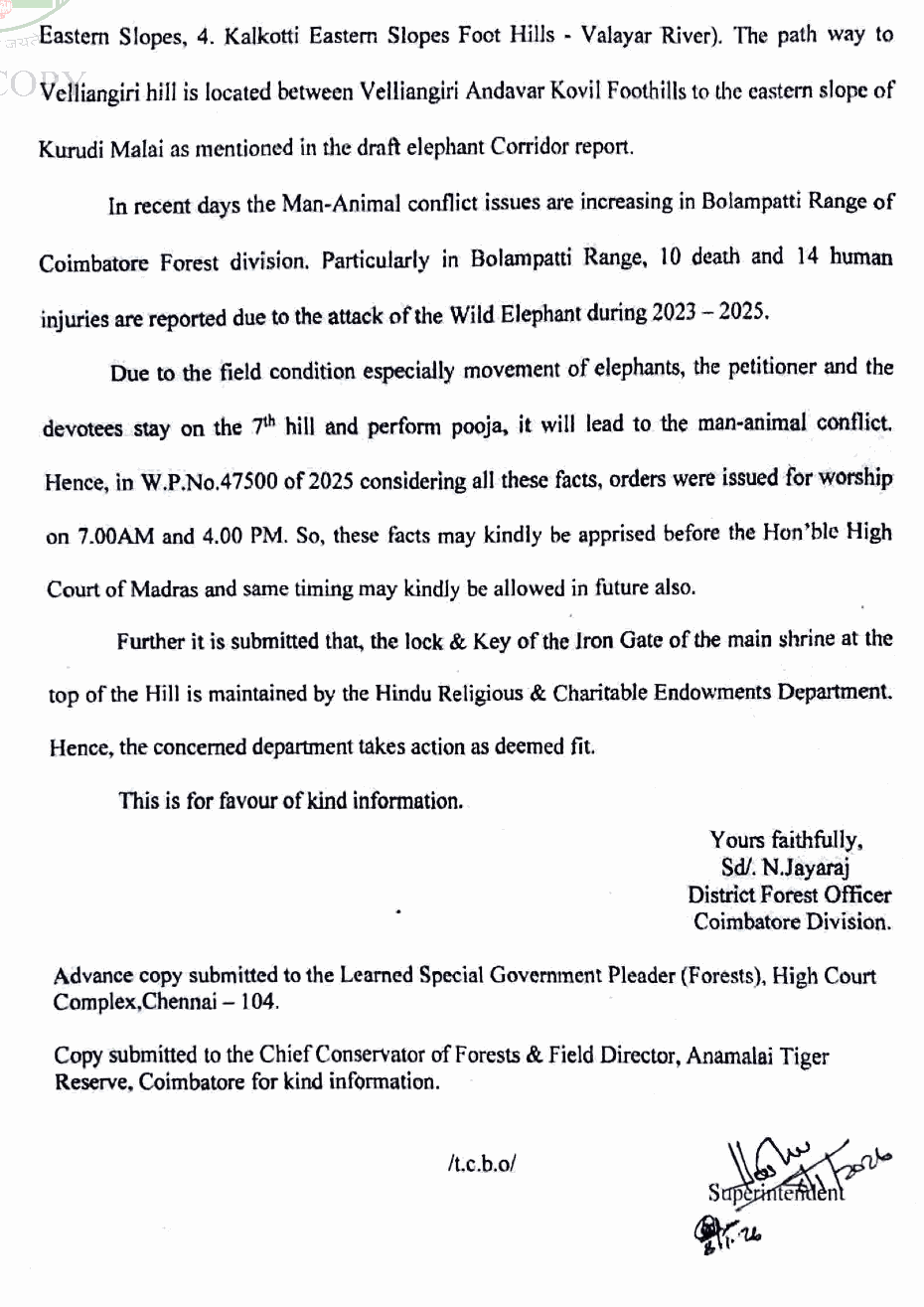
C. Easwaramoorthy – Petitioner
Versus
The Principal Chief Conservator of Forests, Chief Conservator of forest Office, Guindy, Chennai – Respondent
WP No. 476 of 2026 and WMP Nos. 586 & 588 of 2026
Decided On : 09-01-2026
For the Petitioner: Mr. Niranjan Rajagopalan for Mr. M. Marudhachalam.
For the Respondents: Dr. T. Seenivasan, Special Government Pleader.
The court reaffirmed that reasonable access to sacred sites in reserved forests can be allowed, balancing safety concerns with religious practices.
Headnote:(A) Forest Act - Restrictions on Access to Reserved Forest - The petitioner challenged the restrictive timing for devotees to access the temple located in a reserved forest, framed by concerns of safety and forest conservation. The court recognized the necessity of limiting access to prevent conflicts and potential fires. (Paras 3, 6, 11)
(B) Reasonableness of Restrictions - The court found that while the forest department's caution was excessive, reasonable access should be allowed, permitting devotees to enter at 6 AM and exit by 5 PM under controlled conditions. (Paras 11, 12)
Facts of the case:
The petitioner, a devotee, sought permission to perform rituals at a temple in a reserved forest but challenged the restricted hours imposed by the forest department.
Findings of Court:
The court modified the timing allowing access from 6 AM to 5 PM, emphasizing safety considerations.
Issues: The main issue was the validity of restrictive access timings set by the forest department.
Ratio Decidendi: The court held that while the forest department needs to ensure safety, the timing restrictions could be modified to allow earlier access for devotees, emphasizing the need for reasonable accommodation of religious practices.
Result: Writ Petition stands disposed of in modified terms with no costs.
| Table of Content |
|---|
| 1. petitioner's claim regarding temple access. (Para 2 , 3) |
| 2. arguments for extended temple visiting hours. (Para 4 , 7) |
| 3. court's rationale for modifying temple access timings. (Para 6 , 8 , 10 , 11) |
| 4. court's decision and warnings against violations. (Para 9 , 12) |
| 5. final disposal of the writ petition. (Para 13) |
ORDER :
V.LAKSHMINARAYANAN, J.
I heard Mr.Niranjan Rajagopalan, learned counsel appearing for Mr.M.Marudhachalam, learned counsel for the petitioner and Dr.T.Seenivasan, learned Special Government Pleader appearing on behalf of the respondents.
2. The petitioner claims to be a devotee of the Arulmigu Vellingiri Swayambhu Eeswaran. During the Tamil month of ‘Thai’, devotees of the said deity climb the hills to perform religious rituals at the Eeswaran Temple. It is not in dispute that the temple is situated in Bolampatti Block-II reserved forest area. This area had been declared as reserved forest at least a century and half ago.
3. The petitioner approached the 3rd respondent seeking permission to perform religious rites in the aforesaid temple. The 3rd respondent considered the request and passed an order, permitting the devotees to have access to the temple from 7 in the morning till 4 in the evening. The petitioner challenges this restrictive clause relating to timings alone.
4. Mr.Niranjan Rajagopalan states that there are totally six temples before reaching Vellingiri Swayambhu Eeswaran Temple. The entire distance is about 5.4 Km, and it would take not less than seven hours to reach the temple and an equal amount of time to descend. Hence, he requestes that this Court set aside the restrictive timing clause.
5. Taking into consideration the plea of the petitioner, I called upon Dr.T.Seenivasan to get instructions from the District Forest Officer (DFO). He has produced the instructions, which have been scanned and extracted hereunder:
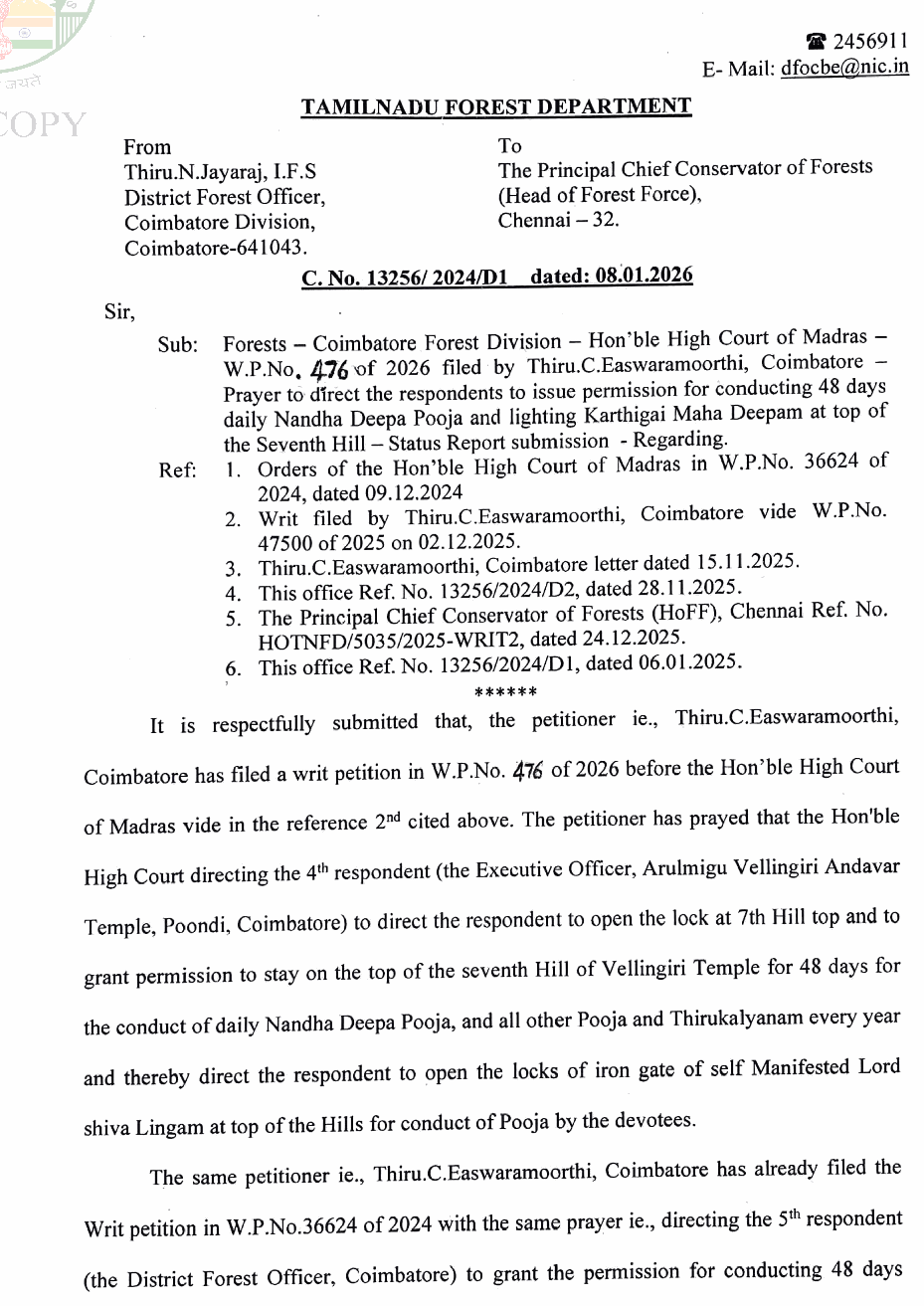
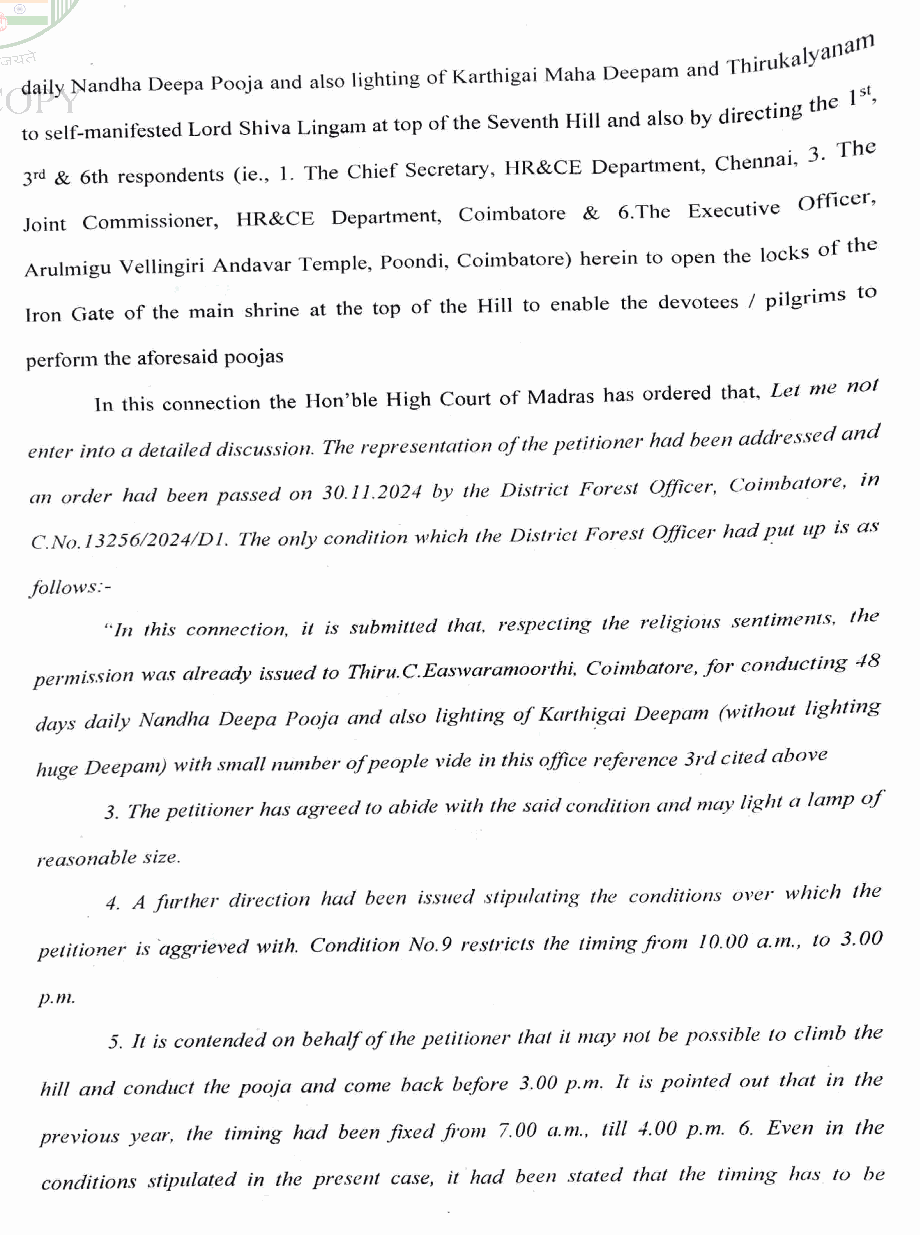
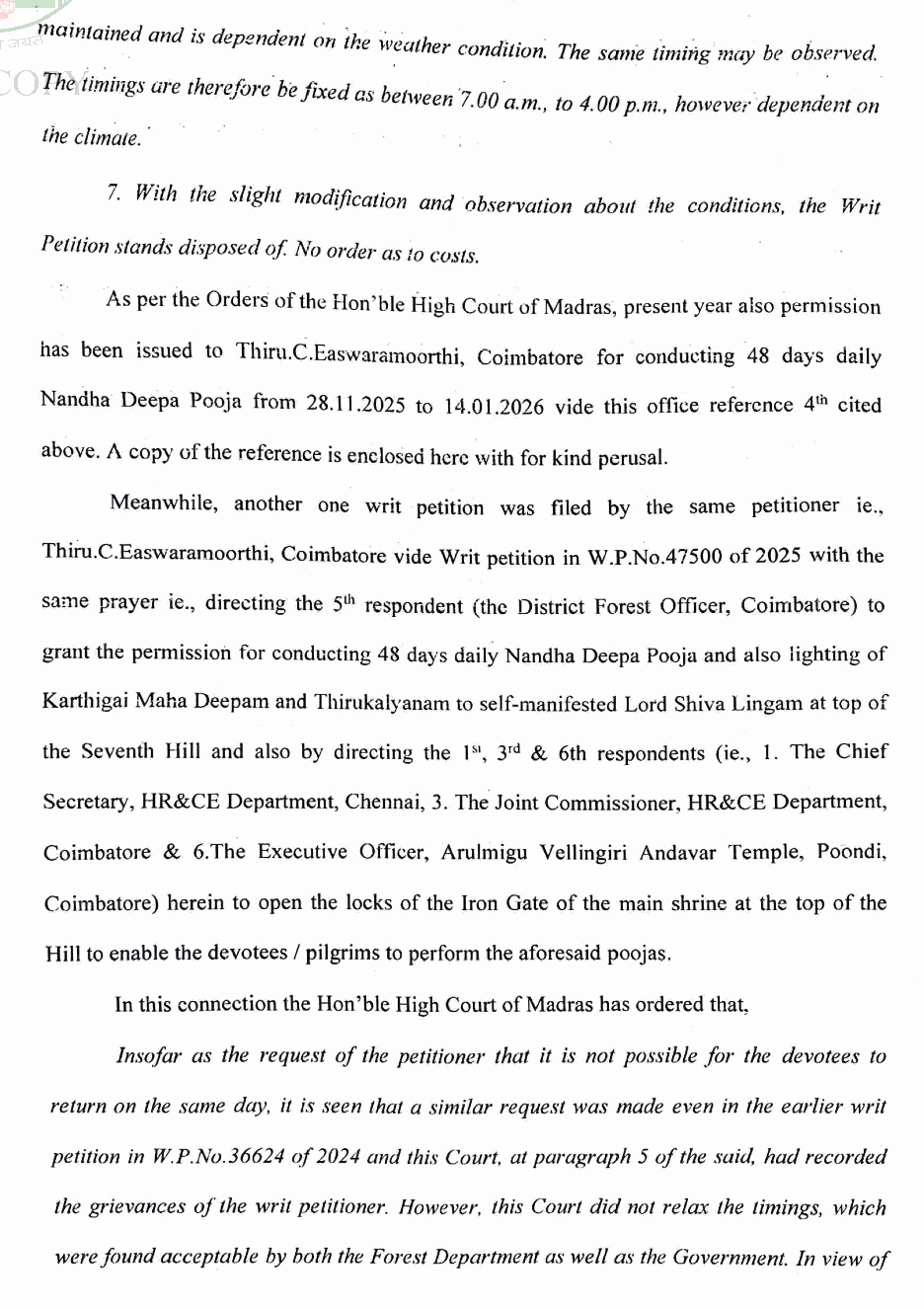
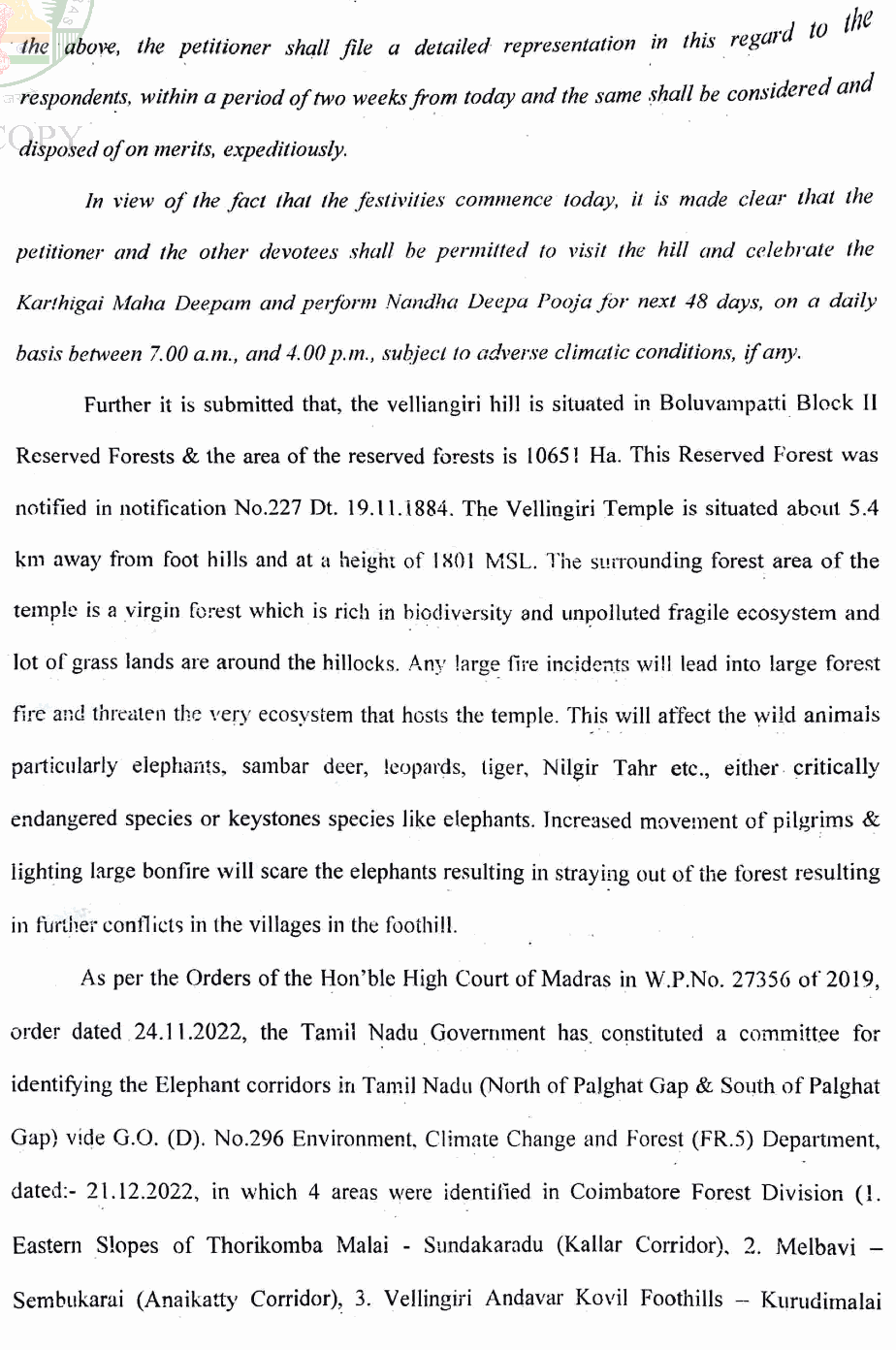
6. A perusal of the same would show that the District Forest Officer fears man-animal conflict after the sunset. In addition, he apprehends that if a large number of pilgrims were to enter the forest and are careless with lighting lamps or other materials, etc, it might lead to forest fires. Dr.T.Seenivasan states that once the sun sets, it becomes difficult for the devotees themselves to navigate their way back safely. He states that the impugned order was passed taking into consideration all these circumstances and that the restrictive timing fixed under the order is extremely reasonable and do not require any interference.
7. In response, Mr.Niranjan Rajagopalan pleads that the hills are situated in the Western Ghats and sunlight is available much later than 04:00 PM, the time that has been fixed by the forest department. He adds that instead of commencing the trek through the forest at 07:00 AM, if the trek commences soon after the sunrise and ends before the sunset, it will give sufficient time for the devotees to ascend and descend.
8. I have carefully considered the submission on both sides and gone through the records.
9. Earlier, devotees like petitioner had approached this Court in WP.No.30169 of 2019 seeking permission to conduct pooja during the Tamil moth of ‘Karthikai’ and also to light the Maha Karthikai Deepam at the Vellingiri Swayambhu Eeswaran Temple. This Court, by way of an order, directed that the suitable season to visit the temple is during the months of March and April. It was further directed that a positive direction cannot be given by the Courts, so as to enable the devotees to visit the temple during the Tamil month of Karthikai and light lamps in the form of Karthikai Deepam.
10. A perusal of the order shows that it had been left to the discretion of the Forest Department to fix the timings. Such an order was passed taking into consideration that the area is a reserved forest teeming with wild animals.
11. The forest department has not totally shut-out the devotees from offering the prayer at the Vellingiri Swayambhu Eeswaran Temple. However, it has












