
 Back
Back





BEFORE THE MADURAI BENCH OF MADRAS HIGH COURT
G.K. ILANTHIRAIYAN, R. POORNIMA, JJ.
Godhandam - Appellant
Versus
Irulayee - Respondent
C.M.A(MD)No.384 of 2020
Decided On : 08-01-2026
| Table of Content |
|---|
| 1. overview of the divorce petition. (Para 1 , 2) |
| 2. details on allegations of cruelty. (Para 4 , 5 , 6) |
| 3. court's critique of evidence assessment. (Para 8) |
| 4. witness testimony revealing marital unrest. (Para 9 , 10) |
| 5. legal standard for proving mental cruelty. (Para 11 , 12 , 13) |
| 6. continuous separation leads to irretrievable breakdown. (Para 14 , 15) |
| 7. conclusion to dissolve the marriage. (Para 16 , 17) |
JUDGMENT :
G.K. ILANTHIRAIYAN, J.
This Civil Miscellaneous Appeal has been preferred against the Judgment and Decree passed in H.M.O.P.No.215 of 2017 dated 06.07.2018 on the file of the Family Court, Sivagangai, whereby dismissing the petition for divorce.
2. The appellant is the husband and the respondent is the wife.
3. Heard the learned Counsels appearing on either side and perused the materials available on record.
4. The appellant and the respondent got married on 19.08.1999. From the day of the marriage, the respondent had shown the appellant her unwillingness to lead a peaceful life with him. She had allegedly abused the appellant physically and verbally and insisted on living separately. Consequently, they got separated and the appellant filed a petition for divorce on the ground of cruelty under Section 13(1) (ia) of the Hindu Marriage Act, 1955.
5. On the side of the appellant, two witnesses were examined as PW1 and PW2, and five exhibits were marked as Exs.P1 to P5. On the side of the respondent, two witnesses were examined as RW1 and RW2 and no exhibit was marked on the side of the respondent.
6. On perusal of the records, it is revealed that the respondent did not cooperate with the appellant for sexual cohabitation. Further she had stated that she was not willing to marry the appellant. Further she had abused the family members of the appellant and had damaged the utensils of the house by throwing it out of anger. After giving birth to two daughters, she had also insisted the appellant for living separately. Subsequently, the family member of the appellant had made the respondent live separately along with their two daughters. At this juncture, in the year 2013, the elder daughter of the appellant and respondent who was examined as PW1 had seen the respondent having illicit affair with another man. Thus, the respondent had committed cruelty to the appellant and as such he filed a petition for divorce on the ground of cruelty. 7. However, the Family Court had dismissed the petition for divorce filed by the appellant, without properly appreciating the evidence of the appellant and concluded that there is no evidence of cruelty by the respondent to the appellant and that the contention of adultery was not properly proved by the appellant. That apart, the Family Court has taken a specific stand that the appellant has sought for divorce only on the ground of cruelty and therefore, the allegation of adultery cannot be considered. Further the Family Court had wrongly concluded that the appellant and his family members were the ones who made the respondent stay separately from the appellant, thereby disregarding the years of mental agony that the respondent had caused the family of the appellant.
8. Further, one of the main reasons that the respondent was asked to live separately is that, her behavior had led to a suspicion on her fidelity. Even after being questioned by the appellant about her suspicious behavior on multiple occasions, the respondent had failed to provide an explanation and had chosen to leave the house and live separately and to this date, she has not attempted to reconcile with the appellant.
9. On the perusal of the evidence of PW2, it is revealed that PW2 who is daughter of the respondent and the appellant has seen the respondent talking to a man. The exact words of PW2 are extracted hereunder:
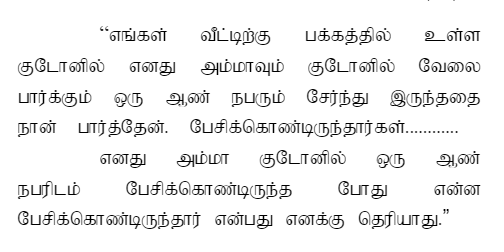
10. Though there is not much detail about the alleged occurrence, it is crucial to note the fact that the own daughter of the respondent was willing to depose against her. This creates a doubt on the con
AI
Cruelty in marriage is subjective, and divorce can be granted if mental cruelty is established, even without proof of adultery.

Mental cruelty includes ongoing suspicion and psychological abuse by a spouse, which may justify divorce when it renders the marriage intolerable.

Mental cruelty requires substantial evidence; trivial marital disputes do not justify divorce. Courts emphasize mutual tolerance and comprehensive assessment of conduct over time in marriage.

Cruelty under the Hindu Marriage Act requires consideration of ongoing abusive behavior and long separation, which can justify a divorce even after previous mediation attempts.
Cruelty in marriage can be established through its impact on the spouse, not solely through direct evidence of misconduct.

Divorce – Cruelty may be mental or physical – It may be intentional or unintentional – It is a matter of inference to be drawn by considering nature of conduct and its effect on complaining spouse.

Cruelty and desertion can serve as grounds for divorce when substantiated by evidence of persistent abusive behavior and long-term separation.

Mental cruelty under the Hindu Marriage Act necessitates substantial and persistent conduct impacting responsibilities; trivial matters do not suffice for divorce.

The main legal point established in the judgment is that the existence of mental cruelty as a ground for divorce under Section 10 of the Indian Divorce Act, 1869, should be determined based on the pr....



An indispensable Tool for Legal Professionals, Endorsed by Various High Court and Judicial Officers
Please visit our Training & Support
Center or Contact Us for assistance

Scan Me!
India’s Legal research and Law Firm App, Download now!


For Daily Legal Updates, Join us on :



 Back to top


