
 Back
Back





IN THE HIGH COURT OF JUDICATURE AT MADRAS
R.SURESH KUMAR, A.D.MARIA CLETE, JJ.
Mrs. A.Philominal, W/o. Late A. Padmanabhan – Appellant
Versus
The Chairman, The Tamil Nadu Electricity Board – Respondent
W.A.No.112 of 2023
Decided On : 22-01-2026
| Table of Content |
|---|
| 1. claim for family pension post-death of husband. (Para 1 , 2) |
| 2. prior civil suit does not adjudicate pension claim. (Para 3) |
| 3. marriage validity affects pension eligibility. (Para 4 , 5) |
| 4. delay in claim affects entitlement. (Para 6) |
| 5. clarity on claims arising from death. (Para 7 , 8) |
| 6. second wife not entitled to family pension. (Para 9 , 10) |
| 7. different basis in representation vs petition. (Para 11 , 13) |
| 8. public policy against multiple claims for pension. (Para 12 , 14) |
JUDGMENT :
A.D. Maria Clete, J.
The present Writ Appeal arises out of W.P.No.7001 of 2014 filed by the appellant. In October 2009, the appellant, for the first time, sent a letter seeking family pension on account of the death of her alleged husband Late A.Padmanabhan, who was employed as a Foreman in the Tamil Nadu Electricity Board (now TANGEDCO) under the Kanyakumari Distribution Circle.
2.In her letter dated 15.02.2010, the appellant stated that she was the second wife of Late A.Padmanabhan, who had retired from service as Foreman First Grade on 30.09.1988 and passed away five years later, on 07.09.1993. She further mentioned that Tmt.Rajammal was the first wife of the said A.Padmanabhan, who had subsequently died on 05.03.2007. After the demise of the first wife, there remained four legal heirs to Late A.Padmanabhan, the first among them being the appellant herself, and the other three being her sons born through the said Padmanabhan. The appellant claimed that, as the second wife and legal heir of Late A.Padmanabhan, she was entitled to family pension. She submitted that she had applied for the same in 2009, enclosing all requisite documents. However, her application was returned with an instruction to approach the office of the Superintending Engineer for further action regarding the claim. It was on this basis that she had addressed the present representation. Upon receipt of the said representation, the fifth respondent, by letter dated 25.09.2012, issued the following reply:
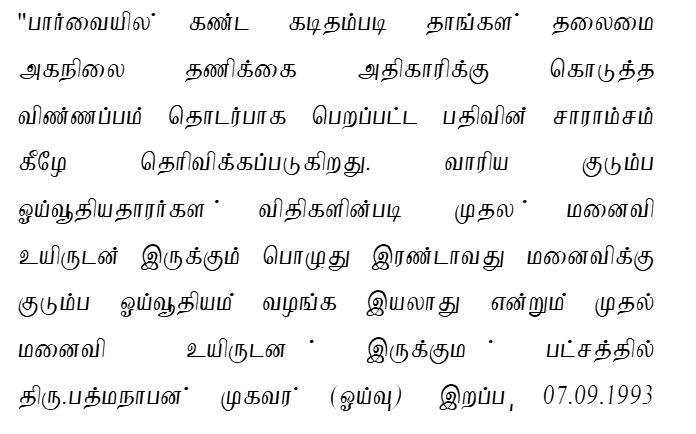
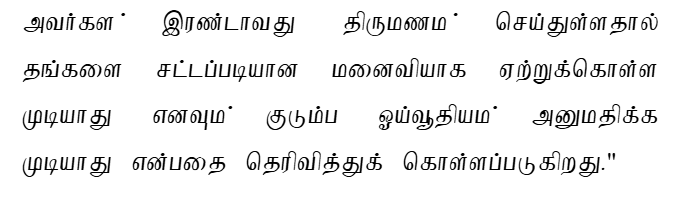
3.Aggrieved by the rejection of her claim, the appellant filed W.P.No.7001 of 2014 i.e two years after the rejection communicated by the 5th respondent. It must be noted that in paragraph 10 of her affidavit filed in support of the writ petition, the appellant relied upon the judgment and decree dated 28.02.2005 passed by the Sub Court, Kuzhithurai in O.S. No. 34 of 2004. In that suit, where Rajammal was the plaintiff, the trial court had held that Rajammal failed to prove the validity of her marriage with A.Padmanabhan, and it concluded that it was the appellant who was the legally wedded wife. The court further held that the appellant and her three sons alone were entitled to succeed to the properties of Late Padmanabhan.
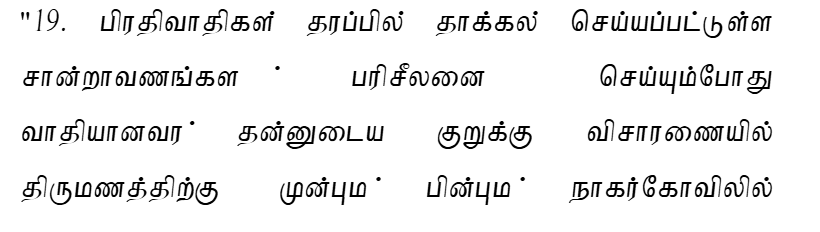
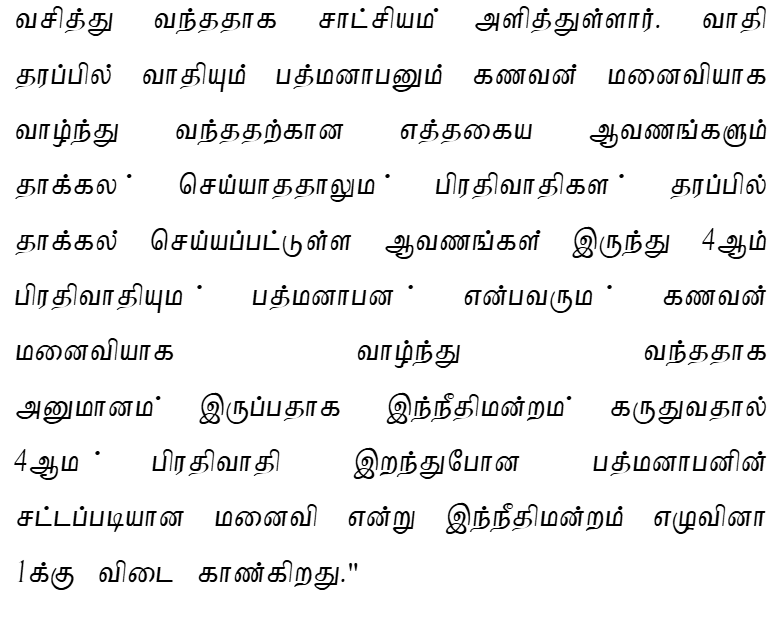
4.The learned Single Judge, by order dated 09.06.2022, dismissed the writ petition. It was observed that the Tamil Nadu Electricity Board (TNEB) was not a party to the civil suit relied upon by the appellant. Based on the records available with the TNEB, the learned Judge noted that the appellant was identified as the second wife of Late A.Padmanabhan, and that her marriage to him was solemnised in July 1979, during the subsistence of his first marriage with Tmt.Rajammal, who passed away only in 2007. Consequently, the second marriage was held to be void in law, and the appellant could not be treated as the legally wedded wife for the purpose of claiming family pension. The learned Judge further noted that, following Padmanabhan's death in 1993, family pension had already been sanctioned in favour of Rajammal and continued to be paid to her until her demise in 2007. In view of these facts, the appellant's claim for family pension was found to be unsustainable. It was also recorded that the civil suit in O.S.No.34 of 2004, filed by Rajammal, was one for permanent injunction concerning possession of properties, and did not involve an adjudication on the marital status of the appellant.
5.However, when the writ appeal came up for admission, referenc
Second wives are not entitled to family pensions if the first wife is alive, reaffirming that claims must be timely and based on legal marriages.

The main legal point established in the judgment is that under Rule 49(7)(a)(i) of the Tamil Nadu Pension Rules, family pension can only be shared between widows if the marriage is valid. Invalid mar....
The validity of a marriage under the Tamil Nadu Pension Rules and Section 5(i) of the Hindu Marriage Act, 1955, and its impact on entitlement to family pension.

In the absence of any special Rules to the contrary, the nominations referred to under Rule 143 of the Assam (Services) Pension Rules, 1969 will be applicable.

Pension is a protected right under Article 300-A of the Constitution; denial of family pension to a legally wedded second wife without due process violates principles of natural justice.
Point of Law : In the absence of any sanction in law, such action by a public authority like APDCL cannot be accepted to be legally valid.

On death of legally wedded wife, who is not survived by any child eligible to receive pension, share of family pension to her stream would not lapse, but would be payable to eligible children from ot....

The conscious actions and representations of the deceased employee regarding the family pension benefit influenced the court's decision on the petitioner's entitlement to family pension.
Family pension is payable only to the legally wedded spouse of an employee, and second marriage during the lifetime of the first spouse makes the petitioner ineligible for family pension under the pe....



An indispensable Tool for Legal Professionals, Endorsed by Various High Court and Judicial Officers
Please visit our Training & Support
Center or Contact Us for assistance

Scan Me!
India’s Legal research and Law Firm App, Download now!


For Daily Legal Updates, Join us on :



 Back to top


