
 Back
Back





IN THE HIGH COURT OF JUDICATURE AT MADRAS
R. SAKTHIVEL, J.
Amsaveni - Appellant
Versus
M.Rajalakshmi – Respondent
APPEAL SUIT NOS.379 OF 2016 AND 605 OF 2019 AND C.M.P. NO.4989 OF 2017
Decided on : 06- 11-2025
| Table of Content |
|---|
| 1. family relationships and dispute origin. (Para 1 , 2 , 3 , 4 , 5) |
| 2. ownership and acquisition of the suit property. (Para 6 , 7 , 8) |
| 3. preparation for trial and issues framed. (Para 9 , 10 , 11) |
| 4. arguments regarding will and possession. (Para 16 , 17 , 18) |
| 5. criteria for assessing the validity of wills. (Para 20 , 21 , 22 , 23 , 24 , 29 , 34) |
| 6. final decision and dismissal of appeal suits. (Para 36) |
JUDGMENT :
R. SAKTHIVEL, J.
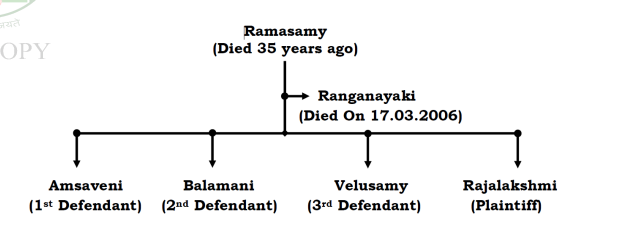
1. One Ramasamy and Ranganayaki had three daughters and one son, namely Balamani, Amsaveni, Rajalakshmi and Velusamy. Ramasamy passed away 35 years ago from the date of plaint which is August 1, 2012. Ranganayaki passed away on March 17, 2006.
2. Amsaveni filed the Suit for declaration and permanent injunction in O.S. No.289 of 2012 on the file of the District Munsif Court, Udumalaipet, against her three siblings. Then, Rajalakshmi filed the Suit for partition and injunction in O.S. No.55 of 2012 on the file of the 'I Additional District and Sessions Court, Tiruppur' ['Trial Court' for brevity] against her siblings and two government officials. Then O.S. No.289 of 2012 was transferred to the Trial Court and renumbered as O.S. No.144 of 2012. Since the parties and the suit property in both the Suits are substantially one and the same, joint trial was ordered and evidence was recorded in O.S. No.55 of 2012. After trial, the Trial Court decreed the Partition Suit filed by Rajalakshmi and dismissed the Declaration Suit filed by Amsaveni vide its Common Judgment and pursuant Decrees dated August 4, 2015, that is to say, the Trial Court decided both the Suit against Amsaveni.
3. Feeling aggrieved, Amsaveni has preferred the instant Appeal Suits. The Appeal Suit in A.S. No.379 of 2016 is filed under Section 96 read with Order XLI Rule 1 of the ' Code of Civil Procedure, 1908 ' ['CPC' for short] over and above the Common Judgment and Decree in O.S. No.55 of 2012 and similarly, the one in A.S. No.605 of 2019 is filed over and above the Common Judgment and Decree in O.S. No.144 of 2012.
4. For the sake of convenience, hereinafter, the parties will be referred to as per their array in O.S. No.55 of 2012.
5. For easy understanding, reference may be made to the following genealogy chart:
6. An extent of 3 Acre 16 Cents comprised in Survey Nos.355/C1, 355/C4, 355/D1 stands in the name of Ranganayaki by virtue of registered Sale Deed dated May 12, 1999 and the same is the suit property in both the Suits. There is no dispute with the above fact.
7. The case of the plaintiff is that the suit property is Ranganayaki's self-acquired property and revenue records stood in her name during her lifetime. Ranganayaki was suffering from neurotic problem and was bed- ridden from the year 2004. Since then, she was not in a sound and disposing state of mind and she passed away intestate on March 17, 2006. After her demise, the suit property devolved upon the plaintiff and defendants 1 to 3 under Section 15 of the Hindu Succession Act, 1956 . While the plaintiff demanded amicable partition, the first defendant fraudulently obtained Legal Heirship Certificate excluding the plaintiff's name. Hence, she filed the Suit in O.S. No.55 of 2012 seeking partition and permanent injunction, after exchange of notices.
8. The case of first defendant is that Balamani got married 37 years before the Suit and shifted to Coimbatore 10 years before the Suit. Rajalakshmi married against the wishes of the family in 1987 and settled in Coimbatore. Velusamy is married and has been settled in Canada for the past 10 years from the date of Suit.
8.1. Further case of the first defendant is that in 1998, her husband retired voluntarily from a private mill and received some retirement benefits. First defendant decided to invest the said amount in the suit property and entered into the Sale Agreement dated July 10, 1998 in her name with the vendors. But as per the advice of astrologer, the suit property was purchased in the name of Ranganayaki vide Sale
The court established that a will must be substantiated with credible evidence, and the lack of such evidence results in the dismissal of claims based on the will, affirming equal inheritance rights ....
The validity of a Will can be upheld despite procedural omissions if supported by sufficient evidence, and a partition suit may be dismissed if barred by limitation.
The burden of proof for the genuineness of a will lies with the propounder, and a will may still be valid even if it lacks a signature on every page, provided it meets statutory requirements.

The court held the burden of proof lies on the propounder of a will to dispel suspicions surrounding its execution; failure to establish genuineness results in dismissal.
The plea of adverse possession and title raised simultaneously is inconsistent and contradictory.

The burden of proof lies on the party asserting the validity of a Will, and properties acquired in a wife's name are presumed to benefit her unless proven otherwise.

The mere presence of the beneficiary at the time of the execution of the Will, by itself, would not be a factor to hold that the Will in question is shrouded with suspicious circumstances and the fir....

The court established that the burden of proving a will lies with the proponent, who must dispel any suspicious circumstances surrounding its execution.
The propounder of a will bears the initial onus to prove its valid execution. When a will is surrounded by suspicious circumstances, such as the beneficiary's active involvement or lack of transparen....



An indispensable Tool for Legal Professionals, Endorsed by Various High Court and Judicial Officers
Please visit our Training & Support
Center or Contact Us for assistance

Scan Me!
India’s Legal research and Law Firm App, Download now!


For Daily Legal Updates, Join us on :



 Back to top


