Back
Back





2025 Supreme(Mad) 5640
IN THE HIGH COURT OF JUDICATURE AT MADRAS
V. LAKSHMINARAYANAN, J
Chakrapani - Appellant
Versus
Rathinasabapathi – Respondent
S.A.No.598 of 2000 & C.M.P.Nos.12026 of 2001 & C.M.P.No.1692 of 2008 & Cros.Obj.No.122 of 2001
Decided on : 26.11.2025
For the Appellant : Mr.Anand for Mr.Ilayaraja Kandasamy
For the Respondent: Mr.R.Srinath Sridevan, Mr.Girish, Mr.R.Silambarasan, Mr.G.Srivenkatesh, Mrs.Avanthika Vasu
JUDGMENT :
V. LAKSHMINARAYANAN, J.
1. This second appeal arises out of the judgment and decree of the Court of Additional District Judge cum Chief Judicial Magistrate, Cuddalore in A.S.No.109 of 1998 dated 11.10.1999, in partly allowing the appeal and modifying the decree of the learned Subordinate Judge at Chidambaram in O.S.No.59 of 1989 dated 22.07.1998.
2. The appellant is the plaintiff in the suit. He is aggrieved by the modification of the decree of the lower appellate court. Insofar as the portion of the decree granting the relief to the plaintiffs is concerned, the defendants have preferred a cross objection in Cros.Obj.No.122 of 2001.
3. For the sake of convenience, the parties will be referred to as per their ranks in the suit.
4. O.S.No.59 of 1989 is a suit for partition and separate possession. For ready understanding, the undisputed genealogy tree is hereunder:
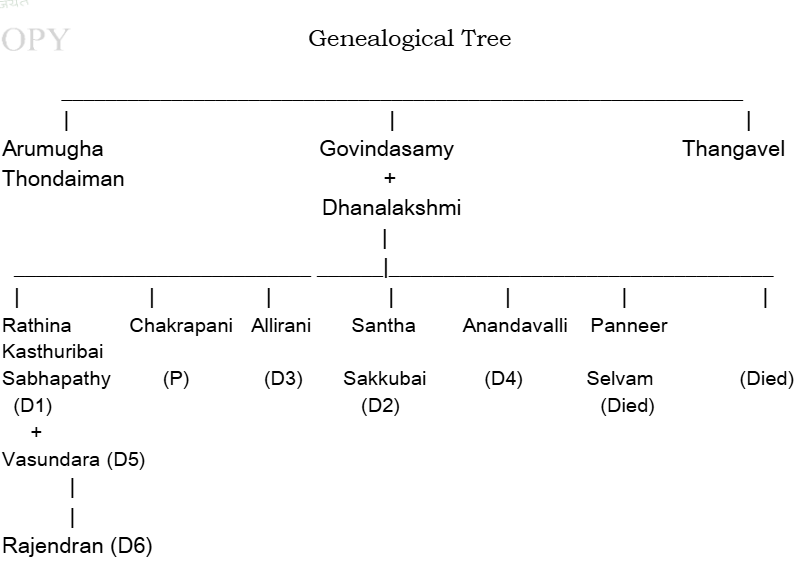
5. The plaintiff Chakrapani, the defendants 1 to 4, viz., Rathina Sabhapathi, Santha Sakkubai, Allirani and Ananthavalli are siblings. They were born to one, Govindasamy Padayatchi and his wife, Dhanalakshmi Ammal. Govindasamy Padayatchi died intestate in 1974. Dhanalakshmi Ammal died in 1981. Apart from the plaintiff and the defendants 1 to 4, the couples had two other children, namely Kasthuri Bai and Panneerselvam. Kasthuri Bai expired in 1972. Panneerselvam died in 02.04.1981.
6. The plaintiff pleaded that Govindasamy Padayatchi had purchased the properties, described under Schedule ‘A’ to the suit both in his name, as well as in the name of the first defendant. The purchases were made from and out of the income derived from the joint family property. Govindasamy Padayatchi was the karta of the family. Govindasamy Padayatchi had his fingers in several businesses. He was running a brick chamber with a capacity of 3,00,000 bricks. Apart from this business, Govindasamy Padayatchi was also running a business in tobacco, and simultaneously carried on plantain and agricultural activities. The plaintiff asserted that Govindasamy Padayatchi performed the wedding of the defendants (D1 to D4) from and out of the income from the joint family property, as well as the aforesaid joint family businesses.
7. On the death of Govindasamy Padayatchi, the eldest brother - 1st defendant / Rathina Sabapathy took over the business of the joint family. From the income generated from the business, he purchased the properties in the name of his wife, Vasundra, the 5th defendant. The plaintiff alleged that, as the properties were purchased by the 1st defendant in the name of the 5th defendant, utilizing the joint family income, those properties also have to be deemed as joint family properties. Hence, he impleaded Vasundra and the son of the first defendant, Rajendran as parties to the suit.
They were arrayed as defendants 5 and 6.
8. The 7th defendant, Kanakasabhapathi, was alleged to be a cultivating tenant under Govindasamy Padayatchi with respect to the suit item No.22, which was leased out to the 7th defendant by Govindasamy Padayatchi. Pending the suit, Kanakasabapathi passed away and the defendants 9 to 13 were brought on record as his legal representatives.
9. The plaintiff alleged that when his mother was living with the first defendant, Rathina Sabapathy, he took possession of 15 sovereigns of her jewels with a promise to return the same but did not keep up the promise. This resulted in a misunderstanding. Therefore, the first defendant chased his mother out of his house, and she came to live with the plaintiff at Vallampadugai village. As the plaintiff was taking care of his mother, Dhanalakshmi Ammal executed a “WILL” in favour of the plaintiff on 05.09.1981, bequeathing her properties in his favour.
10. On account of the misunderstanding between the plaintiff and the first defendant, he issued a notice demanding his share. This demand was denied by the 1st defendant, who took a plea that Govindasamy Padayatchi did not have any joint family property at all. It was also stated tha