
 Back
Back





BEFORE THE MADURAI BENCH OF MADRAS HIGH COURT
N.ANAND VENKATESH, K.K.RAMAKRISHNAN, JJ.
Muthukumar – Appellant
Versus
The Inspector of Police, Thaadikombu Police Station, Dindigul. Crime No. 264 of 2012. – Respondent
Crl. A(MD)Nos.973, 1094 of 2023 and 642 of 2024
Decided On : 01-06-2026
| Table of Content |
|---|
| 1. procedural history and factual background of the case. (Para 1 , 2 , 3) |
JUDGMENT :
N. ANAND VENKATESH, J.
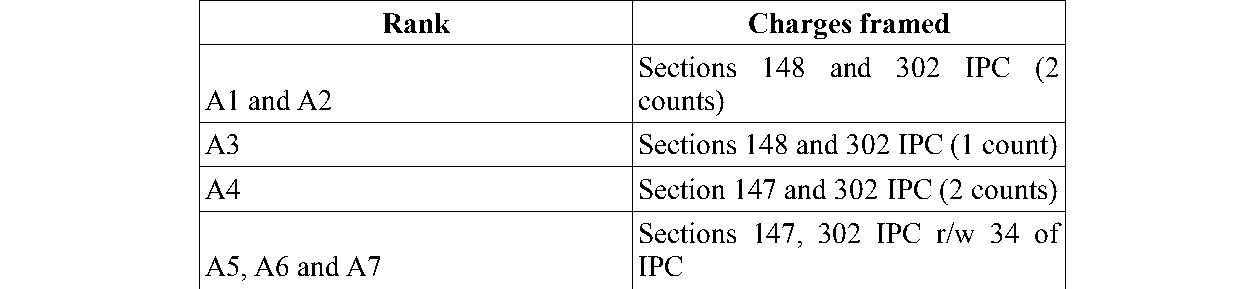
These criminal appeals have been filed in the following manner:

2. These appeals have been filed against the judgment of the Additional District and Sessions Judge, Dindigul, made in S.C. No. 83 of 2018 dated 09.10.2023, wherein the appellants were convicted and sentenced in the following manner:
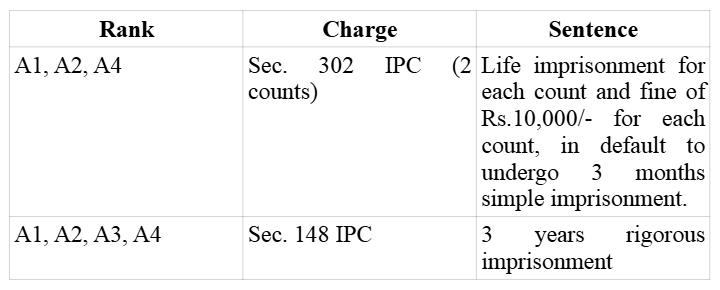
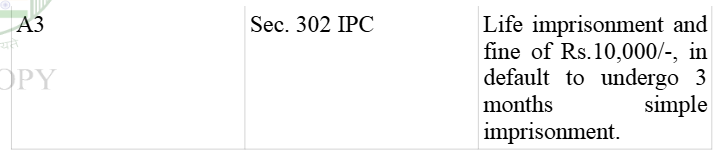
The above sentences were directed to run concurrently.
3. The case of the prosecution is that A1 is the husband of A5 and brother of PW1. A2 is the son and A6 and A7 are the daughters of PW1. A3 is A1’s sister’s son and A4 is the relative and uncle of the deceased Periyasamy (D2). The deceased Kannan (D1), who is the son of PW1 and PW2, was married to A7 and one of those days, when he went to the house of A1, he saw A1 and A7 in a compromising position. Hence, he quarrelled with A1 and A7. Hence, a panchayat was held and it is stated that a customary divorce was effected between D1 and A7. In this panchayat, D2 is said to have supported D1 and his parents and therefore, the accused persons developed enmity against both D1 and D2. After the customary divorce, A7 was married to another person and D1 had gone to Chennai for work.
4. D1 had come to his native place to attend a family function. On 17.05.2012, when he was at his home, D2 called him over phone and hence D1 left to Thadikombu at about 4 p.m. on 18.05.2012. Around 4.40 p.m., PW1 received a phone call to the effect that A1 and A4 were chasing D1 at Thadikombu Road. Immediately, PW1 and PW2 left in a two-wheeler to Thadikombu and on enquiry they were informed that the incident was taking place at Dindigul Road. Immediately, PW1 and PW2 went to the place near the scene of crime and they saw D1 and D2 talking to another person near the TASMAC shop on the main road. A share auto came to that place and A5 to A7 got down from the auto and threw chilli powder on D1 and D2. Immediately, A1 to A4 along with another accused (child in conflict) got down from the same auto and A2 attacked D1 on his neck with aruval. A1 stabbed D1 on his left chest with knife. A4 attacked D1 on his shoulder and hand with aruval. A3 stabbed D1 with knife on his ribs. D2 was attacked by A1 with a knife on his abdomen. A2 attacked with aruval on his chest and A4 attacked D2 with aruval on the back of his head, left hand and right hand. All the accused persons ran away from the place of occurrence. Immediately, intimation was given for 108 ambulance and D2 was taken in an ambulance to Government Hospital, Dindigul. D1 was taken in a separate ambulance and he was declared brought dead.
5. PW1 gave a complaint (Ex.P1) at Thadikombu Police Station on 18.05.2012 at about 11 p.m. and PW15 registered the FIR (Ex.P17) in Crime No.264 of 2012 for offences under Sections 147, 148, 307 and 302 of IPC. The express FIR was sent to Court on 19.05.2012 and it was received at 6 a.m.
6. PW9, who was the duty doctor at Dindigul Government Hospital, had received D2, who was brought by his brother, at about 9.15 p.m. on 18.05.2012 and PW9 prepared Ex.P12 accident register. The original accident register was marked as Ex.C1. The doctor is said to have informed the police about the condition of D2 and immediately steps were taken for recording the dying declaration.
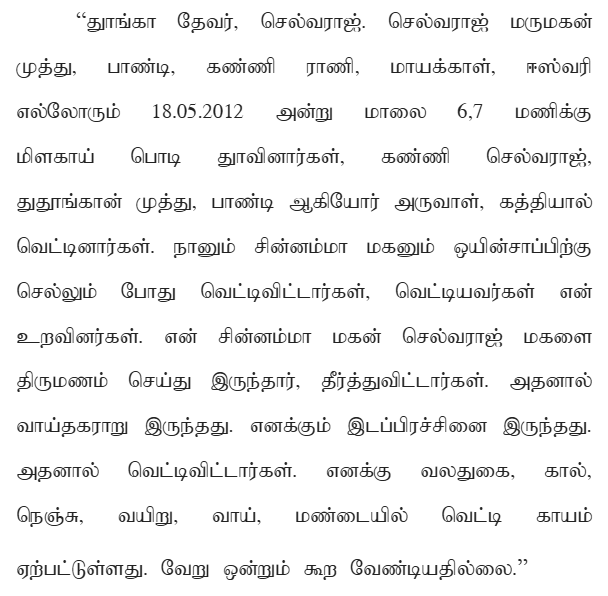
7. PW14, the Judicial Magistrate No.V, Madurai, proceeded to the hospital and recorded the dying declaration of D2 at 12.30 midnight. PW13, who is a doctor, was present and she gave the certificate to the effect that D2 was conscious and in a fit state of mind to give the statement. The dying declaration was recorded and it was marked as Ex.P16. In the dying declaration, D2 is said to have narrated the incident and given the names of the accused persons who were involved in the crime.
8. PW16, who is the Investigation Officer, took up the investigation and he went to the scene of occurrence at about 1.00 a.m. on 19.05.2012 and prepared the observation mahaza
A conviction for a grave offense cannot be sustained on the basis of inconsistent eyewitness accounts and an uncorroborated dying declaration, especially when the investigation is characterized by si....

Dying declarations can be upheld as credible evidence without corroboration if found true and voluntary, emphasizing careful scrutiny for any signs of tutoring.

A conviction based on inconsistent dying declarations is unsafe without corroborative evidence; discrepancies create reasonable doubt undermining the prosecution's case.

In cases of multiple dying declarations, inconsistencies necessitate corroboration for conviction; the earliest declaration indicating self-immolation was preferred, creating reasonable doubt about t....
The reliance on credible dying declarations supported by corroborative evidence confirms conviction for murder despite initial contradictory statements.

The court determined that inconsistent dying declarations and lack of corroborating evidence preclude conviction, emphasizing the burden on prosecution to prove guilt beyond a reasonable doubt.
The conviction of the accused for the murders was upheld, as the prosecution provided credible eyewitness testimony and corroborative medical evidence establishing guilt beyond reasonable doubt.

The prosecution must prove the guilt of the accused beyond reasonable doubt. If there is any doubt as to the guilt of the accused, the accused must be acquitted.
Eyewitness testimony, particularly from injured witnesses, is crucial in establishing guilt, even with minor inconsistencies in their accounts.



An indispensable Tool for Legal Professionals, Endorsed by Various High Court and Judicial Officers
Please visit our Training & Support
Center or Contact Us for assistance

Scan Me!
India’s Legal research and Law Firm App, Download now!


For Daily Legal Updates, Join us on :



 Back to top


