
 Back
Back





BEFORE THE MADURAI BENCH OF MADRAS HIGH COURT
L.VICTORIA GOWRI, J.
M.Sonaimuthu - Petitioner
Versus
The Commissioner of Police – Respondent
WP.Crl.(MD).No.2472 of 2026
Decided On : 29-04-2026
ORDER :
L.VICTORIA GOWRI, J.
Prologue:
Madurai is not merely a city of temples; it is a civilisation of memory. Its streets, riverbanks, mandapams, processions, festivals, songs and silences preserve a living archive of Tamil culture. Among the several villages which stand as sentinels of this civilisational continuity, Thenur occupies a distinctive place.
2. Thenur, a village in Madurai District, is not to be seen merely through the geography of fields and habitations. It is a village of riverine memory, agrarian dignity and cultural discipline. The green stretches of paddy, the rhythm of cultivation, the quiet dignity of rural households, and the collective life of its people reveal a social order deeply rooted in tradition. It is stated before this Court that the people of Thenur observe a strict social discipline, that intoxicants and tobacco are eschewed within the village, and that the village carries forward a moral imagination akin to Gandhian simplicity.
3. The connection of Thenur with Mahatma Gandhi, as placed before this Court, is not without symbolic significance. It is submitted that the sight of rural poverty and agrarian simplicity around Thenur moved the conscience of the Mahatma and contributed to his resolve to identify himself with the poorest of the poor by adopting the simplest attire. Whether recorded by history in documentary fullness or preserved by local memory with emotional fidelity, the moral message is unmistakable: Thenur is projected before this Court as a village of austerity, discipline and self-respect.
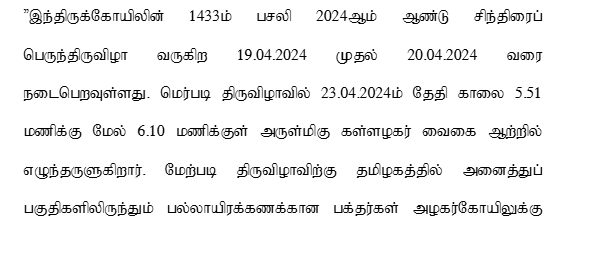
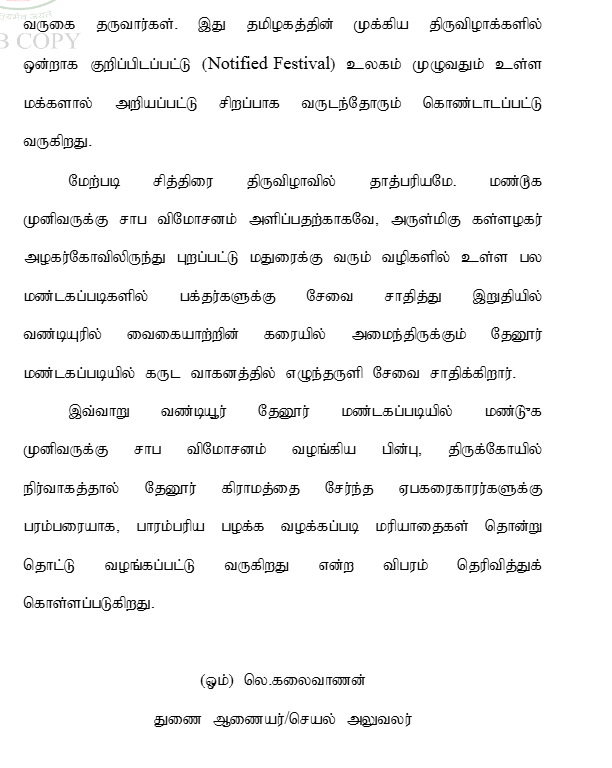
4. The said village also has an inseverable connection with the Chithirai Festival of Madurai and the sacred procession of Lord Kallazhagar to the Vaigai. The Thenur Mandagapadi is not represented merely as a local honour or a ceremonial privilege. It is presented as a bridge between village and city, between agrarian Madurai and sacred Madurai, between history and devotion, and between the people of Thenur and the centuries-old Kallazhagar festival.
5. Festivals of this nature cannot be reduced to matters of crowd control alone. They are civilisational events. They gather within themselves faith, folklore, ritual, public order, local history, community memory and collective identity. The duty of the State, in such matters, is not to create rights where none exist, nor to adjudicate intricate hereditary disputes in writ jurisdiction, but to ensure that recognised and existing customs are not disturbed by unlawful obstruction and that public peace is preserved.
Case of the petitioner:
6. The petitioner claims to approach this Court as one of the traditional representatives of Thenur village and to espouse the cause of the seven hereditary Karikaarars who, according to long- established custom and usage, are recipients of ceremonial honours during the Thenur Mandagapadi associated with the annual Chithirai Festival.
7. According to the petitioner, the Thenur Mandagapadi conducted at Vandiyur in the Vaigai riverbed forms an inseverable and historically significant component of the festival connected with Kallazhagar Temple, and the festival scheduled for the current year is to be held on 02.05.2026.
8. The petitioner would state that, for several centuries, as part of long-standing religious customs and usages, ceremonial honours such as honour, parivattam and allied traditional Maryadhai have been conferred upon the seven Karikaarars representing Thenur village, in recognition of their historic and customary role in the festival observances.
9. It is the petitioner’s case that such customary practice is not merely based on usage but also stands judicially recognised. In this regard, reliance is placed upon the order dated 20.04.2024 passed by this Court in W.P.(MD) No.9494 of 2024, wherein continuation of the festival and the customary practices as followed in previous years was permitted.
10. The petitioner would further state that he was arrayed as the eighth respondent in the said writ proceedings and, a

Court directs police protection for customary religious ritual during festival based on prior recognition and apprehension of obstruction, distinguishing public order maintenance from civil rights ad....


Court may issue directions for peaceful conduct of religious festivals by assigning specific duties based on customs.
Temple administration disputes resolved via civil suit; writ court directs peace committee for peaceful festival with police protection.
The Court directs administrative reconciliation through Peace Committee to resolve temple festival rights between rival groups.
Court directs timely peace committee formation for peaceful temple festivals with police protection.
The court emphasizes the need for police protection during religious festivals while recognizing the rights of multiple parties to celebrate.



An indispensable Tool for Legal Professionals, Endorsed by Various High Court and Judicial Officers
Please visit our Training & Support
Center or Contact Us for assistance

Scan Me!
India’s Legal research and Law Firm App, Download now!


For Daily Legal Updates, Join us on :



 Back to top


