
 Back
Back





BEFORE THE MADURAI BENCH OF MADRAS HIGH COURT
G. JAYACHANDRAN, K.K. RAMAKRISHNAN, JJ.
Hemalatha – Petitioner
Versus
Jeevanantham – Respondent
C.R.P.(MD).Nos.2451 and 2439 of 2025 and C.M.P(MD) Nos.14714 and 14618 of 2025
Decided On : 01-06-2026
COMMON ORDER :
K.K. RAMAKRISHNAN, J.
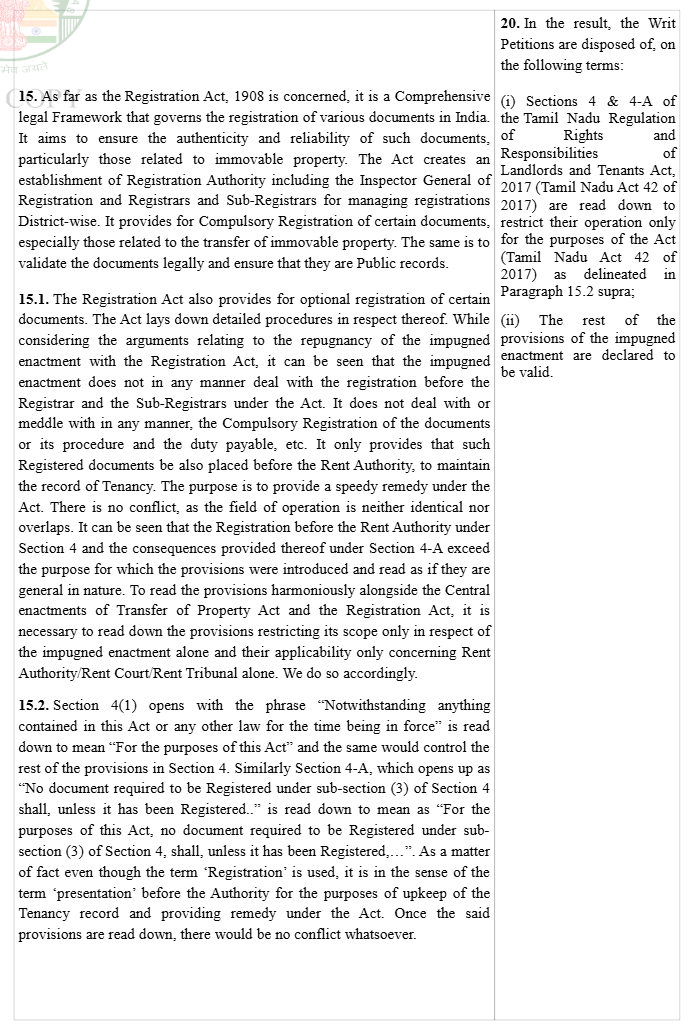
The batch of Civil Revision Petitions have been posted before the Division Bench to resolve the conflict between two Single Bench decisions of this Court regarding the requirement of a registered tenancy agreement under Section 4 of the Tamil Nadu Regulation of Rights and Responsibilities of Landlords and Tenants Act, 2017.
2. The learned Single Judge, noticing the divergence of views between two learned Judges on the necessity of a registered tenancy agreement for invoking the jurisdiction of the Rent Authority, Rent Court and Rent Tribunal constituted under the said Act, has made the present reference.
2.1. Sentinel question of this reference is that'' Is the registered tenancy agreement a rigid “gate pass” without which the doors of justice under the Tamil Nadu Regulation of Rights and Responsibilities of Landlords and Tenants Act, 2017 remain shut?
2.2. It is necessary to have a bird’s-eye view of the background history of the Law governing landlord-tenant in respect of buildings in general, and a quick look at the broad scheme and language of the relevant statutory provisions of past and present.
3. Legislative History of Rent Act, Historically, rent control order in the erstwhile Madras Presidency emerged as an emergency response to wartime exigencies. During the period of the Second World War, acute scarcity of housing and the risk of arbitrary evictions necessitated regulatory intervention. Consequently, the Rent Control Order of 1941 was promulgated as a temporary measure to curb unreasonable eviction of tenants and to regulate rents. This measure, though conceived as transient, was extended periodically in view of continuing necessity.
4. Subsequently, in the post-war context, the said Order was given statutory form through the enactment of the Act, 1946, which came into force on 1 October 1946. The Act was initially intended to operate for a limited duration of two years; however, owing to persistent housing shortages, its operation was extended from time to time, even beyond independence, until 30 September 1951.
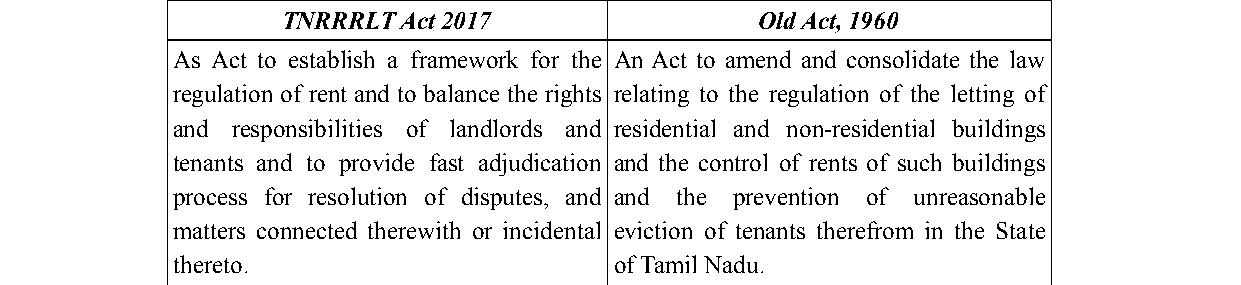
5. Thereafter, recognising the inadequacies of the existing framework, the legislature enacted a more comprehensive and self-contained code in the form of the Tamil Nadu Buildings (Lease and Rent Control) Act, 1960. Although this enactment was also initially introduced with a limited lifespan of five years, it continued to be extended periodically. Ultimately, by virtue of the Tamil Nadu Act 23 of 1973, the statute acquired a permanent status.
6. Despite its permanence, practical experience revealed significant structural deficiencies. The Act, though designed for summary adjudication, in reality became procedurally cumbersome. The adjudicatory process— particularly in eviction proceedings—imposed a heavy evidentiary burden upon landlords, often approximating to the rigour of criminal trials. This resulted in protracted litigation and diluted the efficacy of the statute and the landlords had been undergoing lifelong litigation pain to repossess from the tenant.
7. Such challenges were not confined to Tamil Nadu alone but were reflective of a broader systemic issue across various States. In addition, the Union Government, launched a policy of “Housing for All” and felt the need for Repealing of existing Rent Control Act, and replace it with new legislature on the line of Model Tenancy Act Union suggested the States to bring the new Tenancy Act in the line of “Model Tenancy Act”.
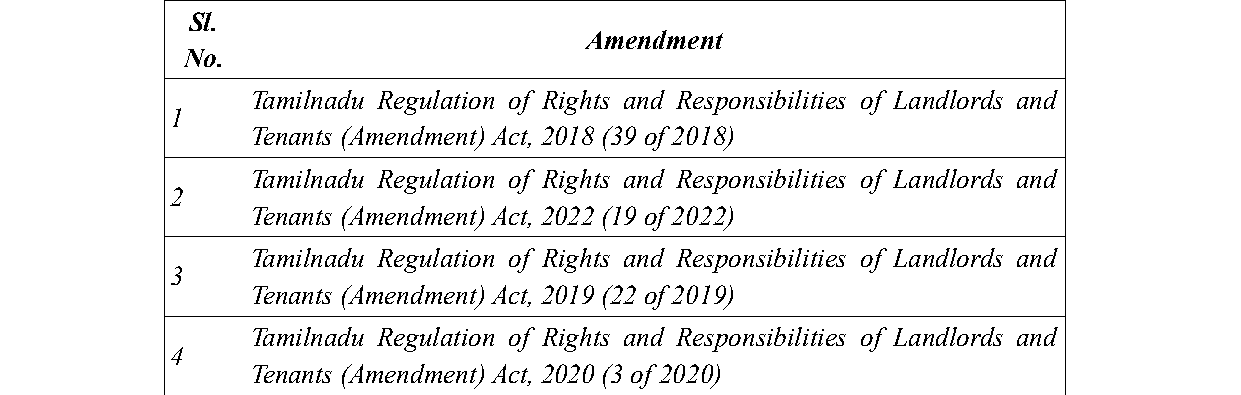
7.1. As per the suggestion of the Union Government, State of Tamilnadu was the first State to adopt the model tenancy Act, and passed the new Act, namely, Tamilnadu Regulation of Rights and Responsibilities of Landlord and Tenancy Act, 2017, (herein after called as TNRRRLT Act, 2017) with the following statement of object and reason:
“While launching “Housing for All” Mission, Government of India recommended to repeal the Rent Control Act and replace it with new Legislation on the line of Model Tenancy Act,





A registered tenancy agreement is a mandatory prerequisite to invoke the jurisdiction of specialized rent authorities under the relevant tenancy statute; failure to obtain registration precludes acce....


The legislative framework of rental laws must adapt to socio-economic changes while maintaining fundamental tenant rights to mitigate unbalanced power dynamics between landlords and tenants.
An unmarked and insufficiently stamped tenancy agreement is inadmissible, failing to create a valid lease under the Tamil Nadu Regulation of Rights and Responsibilities of Landlords and Tenants Act.

The main legal point established in the judgment is that non-registration of a rent agreement does not make it void or inadmissible in evidence under the Punjab Rent Act, 1995.

The rent authority can adjudicate landlord applications even without a written tenancy agreement, emphasizing legislative intent to protect landlord rights and limiting jurisdictional constraints.
Written tenancy agreements are mandatory under the Act; failure to execute justifies eviction.



An indispensable Tool for Legal Professionals, Endorsed by Various High Court and Judicial Officers
Please visit our Training & Support
Center or Contact Us for assistance

Scan Me!
India’s Legal research and Law Firm App, Download now!


For Daily Legal Updates, Join us on :



 Back to top


