
 Back
Back





BEFORE THE MADURAI BENCH OF MADRAS HIGH COURT
P.B. BALAJI, J.
Thirumalaikannan – Appellant
Versus
Bharathan @ Muthuraj – Respondent
SA(MD). No.159 of 2025 and CMP(MD)No.5953 of 2025
Decided On : 10-04-2026
| Table of Content |
|---|
| 1. parties involved in the appeal. (Para 1 , 2) |
| 2. defendants' admissions and denials in pleadings. (Para 3 , 4 , 5) |
| 3. court trial and decisions. (Para 6 , 7 , 8) |
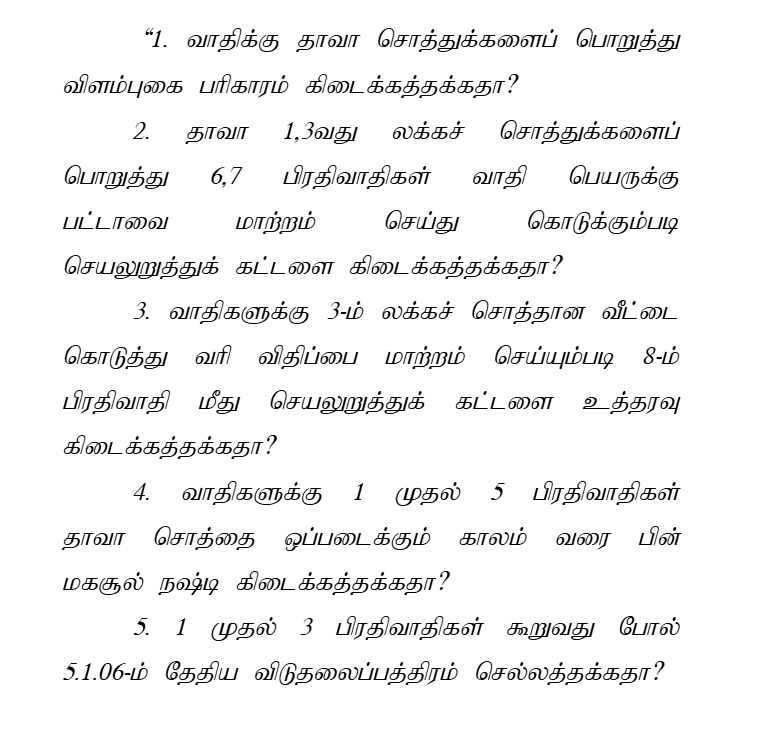
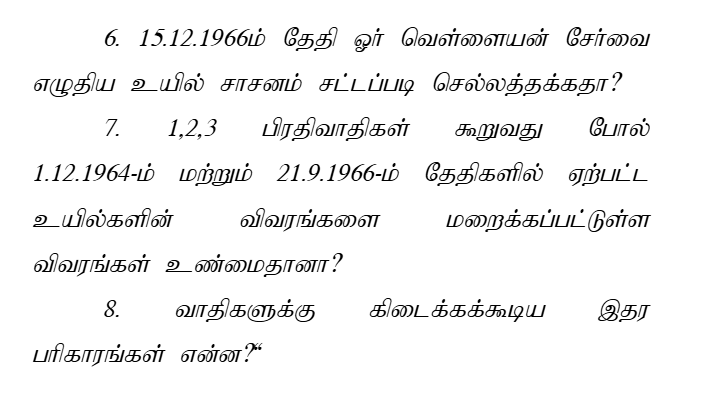
| 4. issues of law framed and presented for the appeal. (Para 9 , 10) |
| 5. arguments presented by both parties. (Para 13 , 14) |
| 6. court's analysis and reasoning for the decision. (Para 15 , 16) |
| 7. answer to substantial question of law. (Para 17) |
| 8. conclusion and dismissal of the appeal. (Para 18) |
JUDGMENT :
P.B. BALAJI, J.
The defendants 2 and 3, in O.S. No.125 of 2007, are the appellants, challenging the concurrent findings of the trial Court as well as the first Appellate Court.
2. The facts that are necessary for deciding the present second appeal, briefly:
Pleadings:
The Plaint in brief:
2.1. The suit properties were originally belonging to one Vellaiyan Servai, the father of the first plaintiff. The said Vellaiyan Servai married Kailayee Ammal as the first wife and Vellaiyammal as the second wife both of his wives being sisters. Through Kailayee Ammal, Vellaiyan Servai was blessed with the first plaintiff and the father of the plaintiffs 3 and 4, viz., Maruthai. Through second wife, Vellaiyammal, Vellaiyan Servai was blessed with a daughter, Maruthammal, wife of the first defendant and a son Sannasi Servai. Both Vellaiyammal and Sannasi Servai were mentally challenged persons. Vellaiyan Servai died on 07.01.1968 and his wife, Kailayee Ammal died on 14.02.1993 and the father of the plaintiffs 3 and 4, viz. Maruthai died on 14.06.1995. The second wife Vellaiyammal died on 14.11.2002 and Sannasi Servai died as a bachelor on 11.04.2000. The wife of the first defendant Maruthammal died on 25.01.2005. The second plaintiff-Manimaran is the son of the first plaintiff. The defendants 2 and 3 are the son and daughter of Maruthammal, that is the children of the first defendant. The defendants 4 and 5 are lessees of defendants 1 to 3, in sofar as the item Nos.1 and 2 suit properties. The Government officials are impleaded as defendants 6 to 8. Items 1 and 2 are landed properties, which has been leased to the defendants 4 and 5. Item No.3 is the house property, which is in possession of the 1st defendant, who is the husband of late Maruthammal.
2.2. Vellaiyan Servai has executed a registered Will dated 15.12.1966 bequeathing the suit property which is set out in B schedule properties in the Will to Maruthammal, who has to maintain Vellaiyammal and Sannasi Servai, both of whom are mentally challenged, from and out of income from Will B schedule property, with no right of encumbrance. After the death of Vellaiyan Servai, Sannasi Servai and Maruthammal, the said properties would devolve on the first defendant and Maruthai and their legal heirs. As Maruthammal died, in terms of the will dated 15.12.1996, the properties devolved on the plaintiffs and one Umamaheswari, who is the daughter of Maruthammal. The said Umamaheswari has already executed a release deed in favour of the plaintiffs 3 and 4 and hence, she is not joining the plaintiffs in filing the suit for recovery of possession, mandatory injunction and mense profits.
3. Written statement filed by the defendants 1 to 3 in brief:
The defendants 1 to 3 admitted the relationship between the parties. The defendants denied that the first plaintiff's mother Kailayee Ammal was the legally wedded wife of Vellaiyan Servai, contending that she was married to a person in Anaikatti Village and Vellaiyammal alone is the legally wedded wife of Vellaiyan Servai. The contention that Vellaiyammal and Sannasi Servai were mentally challenged is denied. The plaintiffs do not have any right in the suit properties, even in terms of Will dated 15.12.1966. Tthe plaintiffs have suppressed the earlier Wills dated 01.12.1966 and 21.09.1966. The Will dated 15.12.1996 under which the plaintiffs now claim right, as well as the Will dated 21.09.1996 were executed by Vellaiyan Servai, under coercion. At that time, he was not in good health and was in a conf


The main legal point established in the judgment is the application of Section 14(1) of the Hindu Succession Act, which grants a female Hindu absolute right and interest over the property possessed b....

A son born from a void marriage has rights to inheritance under amendments to the Hindu Succession Act, affirming equal status to legitimate and illegitimate children in claims for partition post the....

Co-owners are presumed to be in constructive possession of property unless ouster is proven, impacting court fee valuation in partition suits.
The main legal point established in the judgment is the interpretation and application of Sec.14(1) and Sec.14(2) of the Hindu Succession Act in determining the property rights of the parties based o....


Sec. 14 of the Hindu Succession Act provides that any property possessed by a female Hindu becomes her absolute property, regardless of how it was acquired.



An indispensable Tool for Legal Professionals, Endorsed by Various High Court and Judicial Officers
Please visit our Training & Support
Center or Contact Us for assistance

Scan Me!
India’s Legal research and Law Firm App, Download now!


For Daily Legal Updates, Join us on :



 Back to top


