


 Back
Back





2026 Supreme(Mad) 1536
BEFORE THE MADURAI BENCH OF MADRAS HIGH COURT
N. ANAND VENKATESH, K.K. RAMAKRISHNAN, JJ.
Divisional Office, M/s. Universal Sompo General Insurance Company Limited - Appellant
Versus
Sathya Kumar – Respondent
C.M.A.(MD).No.438 of 2026 and C.M.P.(MD).No.4203 of 2026
Decided On : 06-04-2026
For the Appellants : Mr. N. Shyllappakalyan
For the Respondents: Mr. B. Pragash.
The failure to wear a helmet does not constitute contributory negligence unless a direct causal connection between such failure and the occurrence of the accident is proven; the proximate cause remains the primary determinant of liability.
Headnote:(A) Motor Vehicles Act, 1988 - Sections 166 and 173 - Motor accident - Compensation - Contributory negligence - Non-wearing of safety gear - Whether non-wearing of helmet automatically leads to contributory negligence - Held, No - Unless there is a direct causal nexus between the violation of statutory safety norms and the occurrence of the accident, contributory negligence cannot be attributed to the victim - The objective of safety equipment is to mitigate injury severity, not to prevent the accident itself. (Paras 8.3, 8.4)
(B) Evidence - Ocular testimony - Non-mentioning of a witness in the initial report is not a ground to discard credible evidence - Once the opposite party is given an opportunity to cross-examine, the evidence remains reliable unless disproven. (Paras 8.1)
Facts of the case:
The appellant challenged a compensation award for a motor accident death, arguing that the deceased contributed to the accident by not wearing a helmet and failing to maintain a safe distance. The claimant established that the accident was caused by the driver of the insured vehicle who abruptly stopped and opened the door on a public road without precaution.
Findings of Court:
The court found that the accident was caused solely by the negligent act of the insured vehicle's driver. The argument regarding the non-wearing of safety gear was rejected as there was no evidence of a causal link between the lack of gear and the accident occurrence. The awarded compensation was found to be just and reasonable.
Issues: Whether the non-wearing of a helmet by a motorcyclist constitutes contributory negligence and whether the assessment of liability and quantum warrants interference.
Ratio Decidendi: Contributory negligence requires proof of a direct nexus between the victim's negligence and the accident. In cases where the proximate cause is the hazardous act of another driver, the absence of safety equipment does not absolve the tortfeasor of full liability.
Result: Appeal dismissed.
| Table of Content |
|---|
| 1. establishing the factual matrix of the accident and the insurance claim. (Para 1 , 2) |
| 2. summary of lower tribunal findings, appeal grounds, and contentions of the parties. (Para 3 , 4 , 5) |
| 3. defining the legal issues for determination in the appeal. (Para 6 , 7) |
| 4. causal connection required to establish contributory negligence and the validity of helmet-related defenses. (Para 8) |
| 5. justification of compensation quantum and final order of the court. (Para 9 , 10) |
JUDGMENT :
K.K. RAMAKRISHNAN, J.
The appellant–Insurance Company has preferred the present appeal challenging the award passed in M.C.O.P. No. 370 of 2020, by judgment dated 27.06.2023, on the file of the Motor Accident Claims Tribunal cum III Additional Sub Court, Trichy, primarily on the ground of contributory negligence.
2. Facts of the case:
The case of the claimant, in brief, is that on 17.03.2018, at about 9:15 p.m., the injured was riding his two-wheeler bearing Registration No. TN55 AU 6260 on Nidamangalam Road, proceeding from west to east, keeping to the left side of the road. At that time, the car bearing Registration No. TN57 BE 3744, insured with the appellant, which was proceeding ahead of the injured, was suddenly brought to halt by its driver without showing any signal or warning, and the door of the car was abruptly opened. As a result, the injured dashed against the opened door and sustained grievous head injuries and other bodily injuries. Immediately after the accident, the injured was admitted to hospital on the same day and underwent treatment for severe head injuries, including right fronto-parietal temporal decomnpressive craniectomy and evacuation of SDH. Despite continuous treatment, his condition deteriorated; he became bedridden and was reduced to a vegetative state, and subsequently succumbed to the injuries.
2.1. At the time of the accident, the injured was employed as a Superintendent in the office of the Chief Conservator of Forests and was earning a monthly salary exceeding Rs.60,000/-. Owing to the accidental injuries the injured become immobile and hence, his wife, as the dependent, filed a claim petition seeking compensation of more than Rs.2,00,00,000/-.
2.2.The appellant–Insurance Company filed a counter statement denying the manner of the accident, disputing the negligence attributed against the driver of the insured vehicle, and also contesting the income and status of the injured.
2.3.In order to substantiate the claim, the claimant examined four witnesses and marked Exhibits P1 to P17. The Tribunal also marked the disability-related documents as Exhibit C1. On the side of the Insurance Company, neither oral nor documentary evidence was adduced.
3.Finding of the Tribunal Upon consideration of the entire oral and documentary evidence, the learned Tribunal held that the accident occurred due to the negligence of the driver of the insured car and awarded a total compensation of Rs.1,40,38,169/- to the claimant on the following heads:
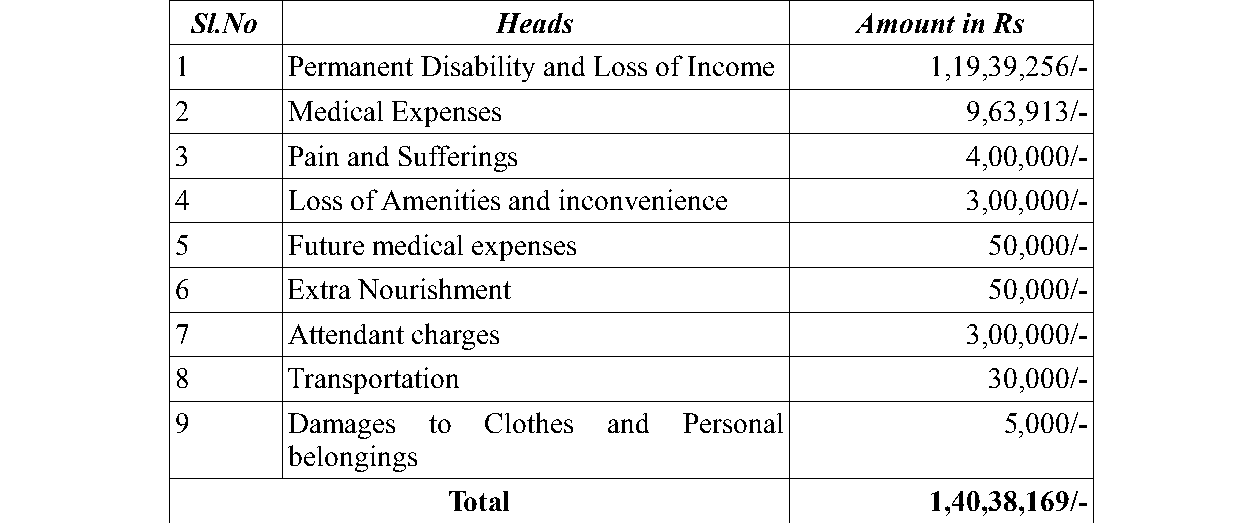
3.1.Aggrieved by the impugned award, the appellant–Insurance Company has filed the present appeal, contending inter alia that the injured himself contributed to the accident, particularly on the ground that he was not wearing a helmet at the time of the occurrence, and therefore, a finding of contributory negligence ought to have been recorded against him. In this case, there is no challenge on the quantum of compensation.
4. Submissions of the learned counsel appearing for the appellant:
The learned counsel for the appellant–Insurance Company contended that the accident occurred due to the negligence of the injured himself, inasmuch as he was not wearing a helmet at the time of the occurrence. It was further submitted that the injured failed to take proper care and did not act with due diligence by keeping a safe distance of the preceding vehicle, and therefore, contributory negligence ought to have been attributed to him. According to the appellant, the Tribunal erred in not fixing any percent












