
 Back
Back





BEFORE THE MADURAI BENCH OF MADRAS HIGH COURT
K. MURALI SHANKAR, J.
Rajalingam – Appellant
Versus
Ramalinga Nadar (Died) – Respondent
S.A. (MD) No. 297 of 2015
Decided On : 19-02-2026
| Table of Content |
|---|
| 1. second appeal against partition judgment (Para 1 , 2) |
| 2. plaintiff's claim for property ownership (Para 5 , 10 , 16) |
| 3. burden of proof for joint property (Para 8 , 11 , 19 , 22 , 24) |
| 4. final outcome of appeal (Para 36 , 38 , 39) |
JUDGMENT :
K. MURALI SHANKAR, J.
1. The Second appeal is directed against the judgment and decree made in A.S. No. 39 of 2010, dated 26.06.2012 on the file of the Subordinate Court, Ambasamudram, confirming the judgment and decree passed in O.S. No. 45 of 2004, dated 24.01.2006 on the file of the Principal District Munsif Court, Ambasamudram.
2. The appellant herein is the plaintiff in the suit. He laid the suit in O.S.No.45 of 2004 originally seeking partition and separate possession of his ½ share in the suit properties. Pending suit, the first defendant, who is the father of the plaintiff and the second defendant, died and consequently, the plaint came to be amended seeking declaration of title over the entire suit properties or in the alternative, for partition and separate possession of 5/6 share in the suit properties and for mesne profits.
3. For the sake of convenience and brevity, the parties hereinafter referred as per their ranking/status before the trial Court.
4. Admittedly, the plaintiff is the son and the second defendant is the daughter of the first defendant Ramalinga Nadar.
5. The case of the plaintiff, in brief, is as follows :
a) The suit properties are belonging to Hindu joint family consisting of the plaintiff and the first defendant. Some of the suit properties were owned by the first defendant ancestrally. Some of the properties were purchased by the first defendant from and out of the income derived from the ancestral nucleus. Hence, all the suit properties were treated and enjoyed as joint family properties.
b) The first defendant, who was aged about 77 years, was not in a position to independently manage his affairs and the second defendant and her husband, by exercising undue influence and dominance over him, were attempting to alienate or encumber the suit properties. Since the suit properties are the joint family properties and the plaintiff is entitled to get ½ share in all the suit properties, the first defendant has no power or authority to alienate the properties or to gift any portion of the properties in favour of the second defendant.
c) The plaintiff sent a legal notice, dated 25.06.1996 to the first defendant demanding partition and allotment of his ½ share in the suit properties. The first defendant having received the legal notice, sent a rely notice with false and untenable allegations. The first defendant's contention is that there was no surplus income available from ancestral properties for purchasing the other properties and that he purchased the other properties with his hard-earned income and as such, they are his separate and self-acquired properties.
d) Items 1 to 6 of the first schedule are ancestral properties and the other items were purchased by utilising the income derived therefrom. The properties standing in the name of Lakshmi Ammal, the mother of the first defendant, were also stated to have been acquired with the aid of joint family income. On the death of the first defendant during the pendency of the suit, the plaintiff claimed that he became entitled to the entire suit properties, or in the alternative, to 5/6 share therein.
6. The defence of the defendants 1 and 2, in brief, is as follows :
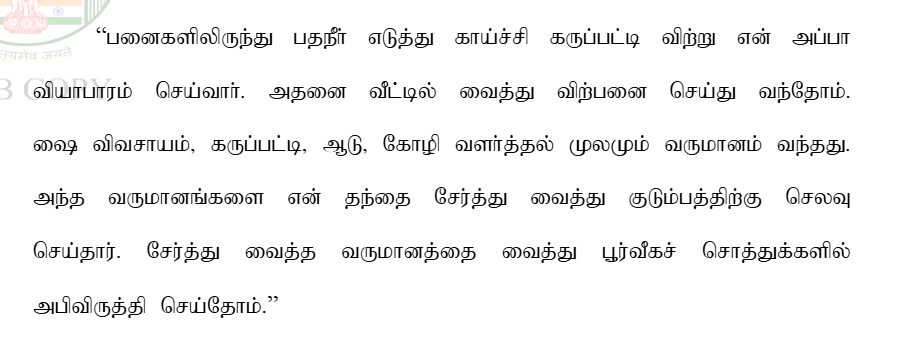
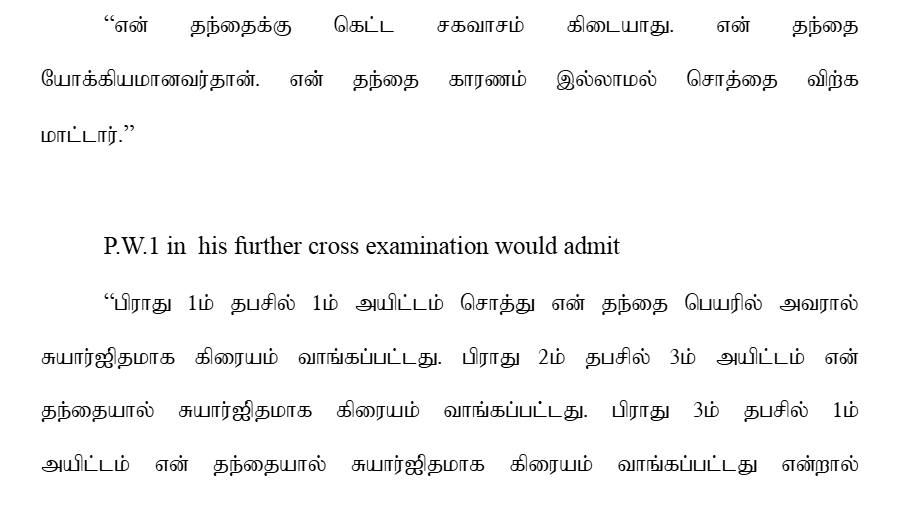
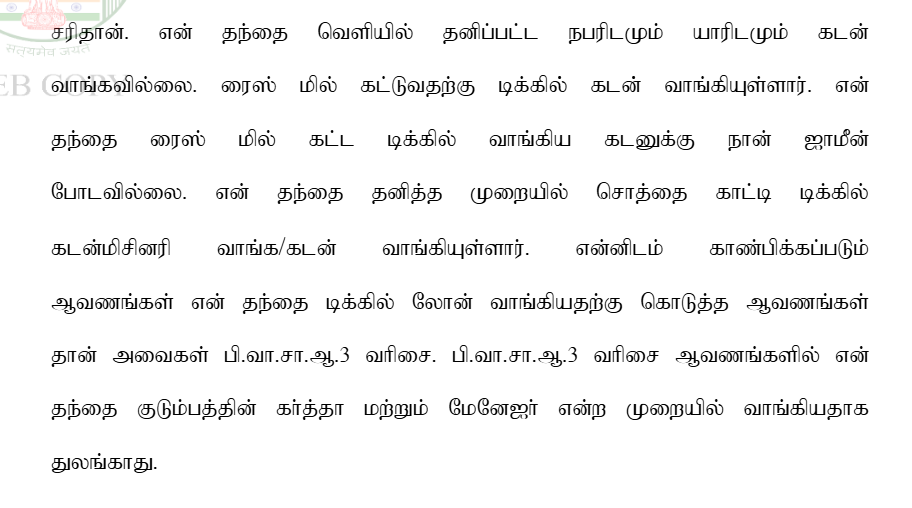
a) The suit properties are not joint family properties and that the plaintiff is not entitled to any share therein. The ancestral properties were very meagre in extent and were incapable of generating sufficient income even for the maintenance of the family and that there was absolutely no surplus income available to form any joint family nucleus for acquisition of further properties.
b) The first defendant had independently cultivated leasehold lands, engaged in business in palm jaggery (karuppatti) and paddy, and was also earning income by renting

The judicial presumption of joint ownership requires proof of a family nucleus, and mere existence of a joint family does not automatically classify all properties as joint.
The claim of property as ancestral requires proof of lineage and sufficient income, with living together not granting rights. The second appeal is restricted to substantial questions of law.

Daughters became coparceners under Hindu Succession (Tamil Nadu Amendment) Act, 1989, allowing them equal rights in joint family properties.
The burden of proof lies on the person claiming property as self-acquired to establish that it was acquired without the aid of joint family funds.
The absence of evidence proving the joint family status of properties allows a presumption that they are individual assets; thus, plaintiffs' claim for partition is dismissed.
The court affirmed that items 1 and 2 of suit properties are ancestral, and items 3 to 11 are self-acquired, highlighting the plaintiffs' burden to prove family property claims.

The plaintiff must prove the existence of a joint family nucleus to establish claims over joint family properties; mere relation does not imply entitlement.
In a partition suit, the burden of proving that property standing in an individual's name is joint family property lies upon the party asserting it, requiring proof of a sufficient ancestral nucleus.....
The court affirmed that admissions made during trial are binding, and ancestral properties cannot be dismissed based on a registered Partition Deed that does not negate the rights of coparceners.

The judgment established the principles of joint family property, partition, and the burden of proof in establishing separate income for property acquisition.



An indispensable Tool for Legal Professionals, Endorsed by Various High Court and Judicial Officers
Please visit our Training & Support
Center or Contact Us for assistance

Scan Me!
India’s Legal research and Law Firm App, Download now!


For Daily Legal Updates, Join us on :



 Back to top


