Back
Back





2026 Supreme(Mad) 2159
IN THE HIGH COURT OF JUDICATURE AT MADRAS
N. SATHISH KUMAR, V. LAKSHMINARAYANAN, JJ.
K. Srinivasan S/o Late Kaliyappan – Appellant
Versus
Deivanai W/o Mahendhiran – Respondent
AS No. 1 of 2026, CMP No. 20 of 2026
Decided On : 19-02-2026
For the Appellant : C. Jaya Chithra
For the Respondents: Anirudh B. Menon, Ramapriya Gopalakrishnan
JUDGMENT :
V. LAKSHMINARAYANAN, J.
1. This appeal arises out of the judgement and decree dated 27.11.2024 passed in O.S.No.312 of 2022 on the file of the Additional District Judge, Krishnagiri. By the said judgment, the suit for partition was partly decreed by passing a preliminary decree in respect of the “A” schedule property, allotting 4/9th share each to the plaintiff and the first defendant and 1/9th share to the third defendant. It was also declared that the “WILL” dated 05.07.2012, said to have been executed by one Kaliyappan in favour of Srinivasan, and Nithya, as null and void. The present appeal has been filed by the defendants.
2. For the sake of the convenience, the parties shall be referred to according to their rank before the Trial Court in the suit.
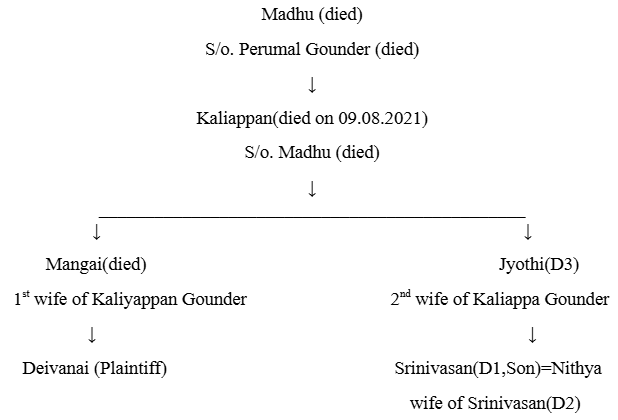
3. The plaintiff presented a suit for partition and separate possession in respect of two items of properties, namely, the “A” and “B” schedule properties. The plaintiff also sought for a declaration that the “WILL” dated 05.07.2012, and the settlement deed dated 08.06.2022, created by the 3rd defendant in favour of the first defendant, as null and void. The plaintiff claims that she is the daughter of one, Kaliyappan, through his first wife, Mangai. The third defendant, Jyothi, is the second wife of Kaliyappan. The first defendant is the son of Kaliyappan and Jyothi, and the second defendant is the wife of the first defendant.
4. The plaintiff urged that the “A” schedule property was inherited by Kaliyappan from his father, Madhu. She further pleaded that the “B” schedule property was acquired by the third defendant, Jyothi, out of the income derived from the “A” schedule property and hence, pleaded that the “B” schedule property is also a joint family property.
5. Her father, Kaliyappan passed away on 09.08.2021, leaving behind the parties to the suit, as his legal heirs. She urged that all of them constituted a Hindu Joint Family. As she and the first defendant, being siblings, claimed that they are entitled to 4/9th share in the suit schedule properties. The other averments regarding the mortgage, etc., are not necessary for the purpose of this appeal.
6. The defendants entered appearance and filed a common written statement. The relationship between the parties was admitted. They pleaded that the second item of the suit property is not an ancestral property, and so, the plaintiff cannot claim any share over the same. They urged that the second item was a self-acquisition of the third defendant, the second wife of Kaliyappan. They pointed out that the “A” schedule property was an Anadheenam Government land, that had been occupied by Madhu Gounder, the grandfather of plaintiff and first defendant. On his death, it was enjoyed by his sons Kaliyappan and Krishnan. Subsequently, separate pattas were obtained from the Government by Kaliyappan for the property situated in Survey No.577/3B and Krishnan obtained patta for the property situated in Survey No.577/3A. Thereafter, Krishnan had sold the property in Survey No.577/3A to the third defendant for a valuable consideration of Rs.14,000/-.
7. It was pleaded that the source for this purchase was the funds raised by the third defendant by selling her jewels and by obtaining financial assistance (streedhana) from her parents. They urged that “A” schedule property is the self acquired property of Kaliyappan and he had executed a registered “WILL” dated 05.07.2012, by which the first and second defendants became owners of the property.
8. The additional written statement filed by them more or less was on the same lines as the original written statement.
9. On the basis of these pleadings, the learned Trial judge framed the following issues:-
1. Whether it is true that suit “A” and “B” schedule properties are joint family properties of the plaintiff and the first defendant herein, as alleged by the plaintiff ?
2. Whether it is true that “A” schedule property was Anadheenam Government land occupied by the Kaliappan and his brother Kris