
 Back
Back





IN THE HIGH COURT OF ORISSA AT CUTTACK
SASHIKANTA MISHRA, J.
Arnapurna Pradhan - Appellant
Versus
Trinath Barik & Ors. - Respondents
RSA No.301 of 2014
Decided on : 27-09-2024
| Table of Content |
|---|
| 1. introduction and context of the case (Para 1 , 2 , 3) |
| 2. factual background concerning ownership of the suit properties (Para 4 , 5 , 6) |
| 3. issues framed by the trial court (Para 7 , 8) |
| 4. arguments presented by the parties (Para 9 , 11) |
| 5. court's analysis on statutory provisions (Para 12 , 13) |
| 6. interpretation of case law concerning female hindu succession (Para 14 , 15) |
| 7. conclusion and order by the court (Para 16 , 17 , 18) |
JUDGMENT :
Sashikanta Mishra, J.
This is an appeal by the plaintiff against a reversing judgment passed by the learned Addl. District Judge, Sundargarh in RFA No. 11/14 of 2012-14 on 07.05.2014 followed by decree, whereby the judgment dated 18.02.2012 followed by decree passed by the learned Civil Judge (Sr. Division), Sundargarh in Civil Suit No. 219 of 2009 was partly set aside.
2. For convenience, the parties are referred to as per their respective status before the trial Court.
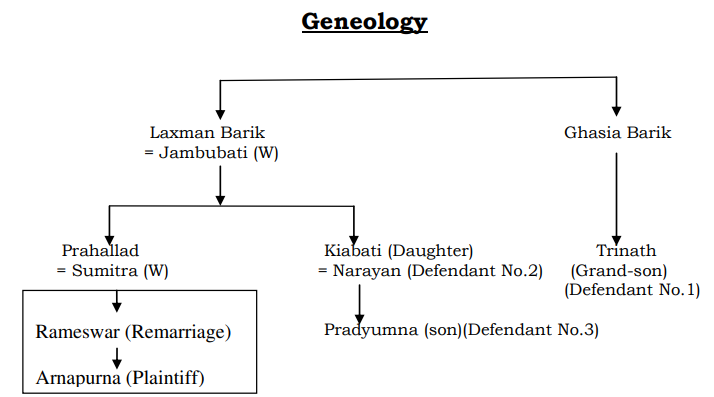
3. The following genealogy shows the relationship between the parties.
4. Suit Land
The suit land pertains to land measuring Ac.5.57 dec. under Khata No.65 and land measuring Ac.0.11 dec. under Khata No.67 in village Girisuan.
5. Plaintiff’s case:
The suit land under khata no.65 was recorded in the name of the mother of the plaintiff Sumitra Barik and her grand-mother Jambubati Barik in the Hal Settlement operation. Land under khata no.67 stands recorded in the name of her mother Sumitra Barik alone. Laxman died leaving behind his son-Prahallad, daughter-Kiabati and widow-Jambubati. Kiabati died leaving behind her husband-Narayan (defendant no.2) and son-Pradumna (defendant no.3). Prahallad died leaving behind his widow-Sumitra and mother-Jambubati. Prahallad and Sumitra had no issue. After the death of Prahallad, Sumitra married another person named Rameswar. The plaintiff, namely, Annapurna was begotten out of such remarriage. It is claimed that after the death of Sumitra, the plaintiff, being her only legal heir, succeeded to the properties of her mother. The defendant no.1 filed mutation cases before Tahasildar, Hemgir being Misc. Cases No. 387 of 2004 and No.388 of 2004 for mutation of the suit properties in his name on the ground that he is the adopted son of Sumitra. The Tahasildar allowed the mutation applications in favour of defendant no.1, but without the knowledge of the plaintiff. After coming to know of the above, the plaintiff filed appeal being M.A. No.5 of 2006 before the Sub-Collector, Sundargarh, which came to be dismissed on the ground that Sumitra having remarried, the plaintiff would have no right, title and interest over the properties belonging to the family. The plaintiff, however, claims to be possessing the suit properties. After dismissal of the appeal thus, the plaintiff filed the suit for a declaration that she is the only legal heir and successor of Sumitra Barik, as also a declaration that defendant no.1 is not the adopted son of Sumitra and not entitled to succeed to her properties.
6. Defendant No.1’s case:
The defendant no.1 in his written statement admitted the basic facts averred in the plaint relating to the relationship between the parties. In addition, he claimed that being the nephew of Sumitra, as he was adopted by her on 22.05.1979 in the presence of relatives and villagers, which fact was acknowledged on a plain paper adoption deed, he possessed the properties of Prahallad and looked after his adoptive mother Sumitra. Subsequently, Sumitra left the village voluntarily and married Rameswar Das and gave birth to the plaintiff. Further, Sumitra abandoned all her properties in the suit village and cut off all relationship with her first husband's family and resided in the house of Rameswar till his death. Being the adopted son of Sumitra, defendant no.1 succeeded to her landed properties and after her death he got the same mutated in his favour, as per orders passed in the mutation cases filed by him before the Tahasildar, Hemgir. The plaintiff's appeal against the orders of the T
AI
A female Hindu retains absolute ownership of her inherited property despite remarriage, and her children from a subsequent marriage are entitled to inherit such property.


The court affirmed that children of a deceased woman inherit her estate under the Hindu Succession Act, irrespective of their birth order, unless adoption is proven, as the mother's remarriage does n....

(1) If a property of a male Hindu dying intestate is a self-acquired property or obtained in partition of a coparcenary or a family property, same would devolve by inheritance and not by survivorship....


The plaintiff, as the daughter of Bhagmat, retains her inheritance rights over property despite her mother's remarriage, confirming the applicability of old Hindu law over Scheduled Tribes.
Succession to the property inherited by a widow as life-estate holder opens on her death and is governed by the provisions of Section 8 of the Hindu Succession Act, 1956, irrespective of the date of ....

Daughters are ineligible to inherit under Mitakshara Law prior to 1956, affirming that property succession is limited to male heirs in such cases.
Female Hindu succession – For establishing full ownership on undivided joint family estate under Section 14(1) of Succession Act Hindu female must not only be possessed of property but she must have ....

Hindu Law – property given to wife - Property had been given to the female Hindu in recognition of or in lieu of her right to maintenance, it was held that the situation fell within the ambit of subs....



An indispensable Tool for Legal Professionals, Endorsed by Various High Court and Judicial Officers
Please visit our Training & Support
Center or Contact Us for assistance

Scan Me!
India’s Legal research and Law Firm App, Download now!


For Daily Legal Updates, Join us on :



 Back to top


