
 Back
Back





IN THE HIGH COURT OF ORISSA AT CUTTACK
A.C. BEHERA, J.
Sanatan Nandi (Dead) and Others – Appellants
Versus
Hara Bewa (Dead) and Others – Respondents
S.A. No. 104 of 1987
Decided On : 23-12-2025
| Table of Content |
|---|
| 1. 2nd appeal against reversing judgment. (Para 1 , 2 , 3) |
| 2. factual background of family pedigree and property rights. (Para 4 , 5 , 6 , 7) |
| 3. issues framed and trial court's findings. (Para 8 , 9 , 10) |
| 4. 1st appellate court allowed the appeal. (Para 12 , 13) |
| 5. substantial questions of law discussed regarding abatement and reasoning. (Para 15 , 21) |
| 6. application of law regarding consolidation ror. (Para 23 , 24) |
| 7. dismissal of 2nd appeal and confirmation of 1st appellate court's decision. (Para 26 , 27 , 28) |
JUDGMENT :
A.C. BEHERA, J.
1. This 2nd appeal has been preferred against the reversing judgment.
2. The appellants in this 2nd appeal were the defendant nos.1 to 4 before the trial court in the suit vide T.S. No.106 of 1977 and respondent nos.1 to 4 before the 1st appellate court in the 1st appeal vide T.A. No.12 of 1979.
3. The respondent in this 2nd appeal was the sole plaintiff before the trial court in the suit vide T.S. No.106 of 1977 and appellant before the1st appellate court in the 1st appeal vide T.A. No.12 of 1979.
The suit of the plaintiff (respondent in this 2nd appeal, i.e., Hara Bewa) against the defendants(appellants in this 2nd appeal) vide T.S. No.106 of 1977 was a suit for declaration, confirmation of possession and permanent injunction.
4. As per the case of the plaintiff, the plaintiff and defendants belong to one family.
In order to have a clarity, the undisputed family pedigree of the plaintiff and defendants given in the plaint is depicted hereunder:-
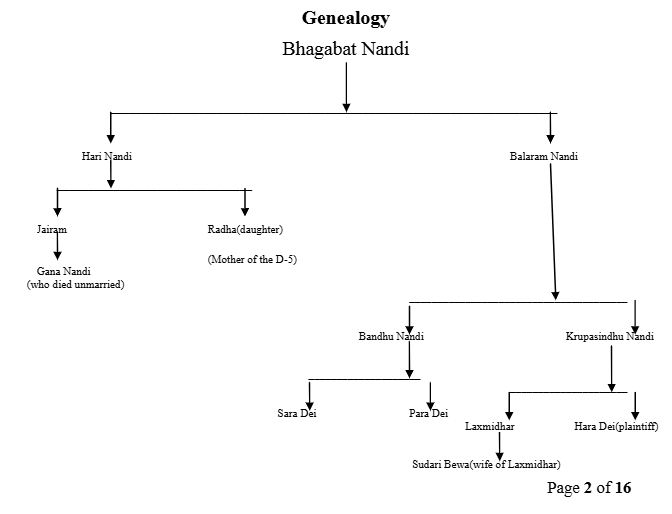
5. As per the aforesaid genealogy, Bhagabat Nandi was the common ancestor of the plaintiff and defendants. Bhagabat Nandi died leaving behind his two sons Hari Nandi and Balaram Nandi.
Hari Nandi died leaving behind his son Jairam Nandi and daughter Radha Nandi.
Jairam Nandi died leaving behind his only son Gana Nandi.
Gana Nandi died during his bachelorhood.
The defendant no.5 is the son of Radha.
The 2nd son of Bhagabat Nandi, i.e., Balaram Nandi died leaving behind his two sons, i.e., Bandhu Nandi and Krupasindhu Nandi.
Bandhu Nandi died leaving behind his two daughters, i.e., Sara Dei and Para Dei.
Krupasindhu Nandi died leaving behind his one son and one daughter, i.e., Laxmidhar and Hara Dei. Hara Dei is the plaintiff in the suit.
6. According to the averments made in the plaint of the plaintiff, the suit properties were recorded jointly in the settlement of the year 1930 in the name of Gana Nandi, Bandhu Nandi and Krupasindhu Nandi. Hari Nandi died prior to 1920 leaving behind his son Jairam Nandi. Jairam Nandi died before 1930 leaving behind his son Gana Nandi.
As, Hari Nandi died prior to 1920, for which, his interest in the suit properties had not devolved upon his daughter Radha, as Radha was a pre-Act daughter.
When, Gana Nandi died, his interest left in the suit properties devolved upon Bandhu Nandi and Krupasindhu Nandi. The plaintiff purchased the suit property from two daughters of Bandhu Nandi after the death of Bandhu Bandi, i.., from Sara Dei and Para Dei on dated 09.07.1954 for a consideration amount of Rs.500/- and took possession of the same. For which, the plaintiff became the owner over the suit properties and she is in possession over the same.
The defendant no.5 being the son of the daughter of Hari Nandi, i.e., Radha, he(defendant no.5) had/has no interest in the suit properties, as Radha had no interest in the same, but, without having his any interest in the suit properties, he(defendant no.5) sold the same illegally through registered sale deed dated 30.06.1977 to the defendant nos.1 to 4 (appellants in this 2nd appeal) without any consideration amount and without delivery of possession. On the basis of the said illegal sale deed dated 30.06.1977, the defendant no.1 to 4 created disturbances in the possession of the plaintiff over the suit properties. For which, the plaintiff approached the civil court by filing the suit vide T.S. No.106 of 1977 against the defendants praying for declaration of her right, title and interest ove
AI
The finalized Record of Rights (RoR) by consolidation authorities is binding, and civil courts cannot alter these determinations once established, reinforcing the plaintiff's title and possession.

A suit for permanent injunction is maintainable without a declaration of title if the plaintiff's title is not in dispute, and abatement of a suit under the OCH and PFL Act, 1972, requires a formal o....
Consolidation authorities' records establish title and possession, superseding claims of adverse possession, which indirectly acknowledge the opposing party's title, rendering simultaneous inconsiste....
Possession of property by a plaintiff, even without established title, can warrant a decree of permanent injunction against a defendant claiming conflicting title.
The court affirmed that concurrent findings of fact by lower courts cannot be interfered with in a second appeal unless shown to be perverse, thus upholding the judgment confirming possession of the ....

A claim of title through adverse possession is inadmissible when a claimant asserts title through inheritance over the same property, as these claims are mutually exclusive.
A party cannot re-agitate land rights questions already adjudicated by consolidation authorities, as such decisions are binding and preclude the same issues from being litigated in civil court.
A suit for declaration of title over undivided property without partition is not maintainable, reaffirming the necessity of establishing specific ownership for claims over joint property.
The court ruled that property devolved exclusively to the male heir after the mother's death before the Hindu Succession Act, invalidating claims of the female heir based on pre-Act rights.
Trial courts must decide all issues raised in a suit, and failure to do so renders judgments unsustainable. Appellate courts must review all issues, not just those identified in trial court rulings.



An indispensable Tool for Legal Professionals, Endorsed by Various High Court and Judicial Officers
Please visit our Training & Support
Center or Contact Us for assistance

Scan Me!
India’s Legal research and Law Firm App, Download now!


For Daily Legal Updates, Join us on :



 Back to top


