
 Back
Back





IN THE HIGH COURT OF ORISSA AT CUTTACK
D.DASH, J.
Mohan Chandra Patel - Appellant
Versus
Lalindra Patel (since dead) through his LRs. & Others – Respondent
R.S.A. NO.260 OF 2009
Decided on : 25-11-2022
| Table of Content |
|---|
| 1. ancestral property and partition claims. (Para 1 , 3 , 4 , 5) |
| 2. outcome of the trial court and first appellate court. (Para 6 , 8) |
| 3. arguments regarding property classification. (Para 9 , 10 , 11) |
| 4. blending of separate property into common stock. (Para 12 , 13 , 14) |
| 5. final order restoring trial court's decree. (Para 15) |
JUDGMENT :
D.Dash, J.
1. The Appellant by filing this Appeal under Section-100 of the Code of Civil Procedure 1908 (for short, ‘the Code’) has assailed the judgment and preliminary decree passed by the learned District Judge, Sundargarh in RFA No.73 of 2005.
By the same, the Appeal filed by the original Respondent No.1, who is now represented in this Appeal by his legal representatives, under Section-96 of the Code has been allowed in part and thereby, the judgment and preliminary decree passed by the Civil Judge (Senior Division), Sundargarh in Title Suit No.131 of 1996 have been set aside to the extent of exclusion of the property described in Schedule-B of the plaint from the purview of the preliminary decree for partition and as per the order of the First Appellate Court the preliminary decree has remained confined to Schedule-A property.
The Appellant as the Plaintiff having filed the suit seeking a preliminary decree for partition of Schedule-A & B of the property described in the plaint, the Trial Court had decreed the same. The original Defendant No.1 in the said suit being aggrieved by the same having carried the First Appeal that preliminary decree passed by the Trial Court has been set aside in part in respect of Schedule-B property.
It may be stated here that now the Plaintiff is the Appellant in this Second Appeal before this Court and the original Defendant No.1 having been died during pendency of this Appeal, his legal representatives so also the legal representatives of other parties are thereon record.
2. For the sake of convenience, in order to avoid confusion and bring in clarity, the parties hereinafter have been referred to, as they have been arraigned in the Suit.
3. The Plaintiff’s case is that one Parsuram Patel was the common ancestor of the parties. The relationship amongst the parties as described by the Plaintiff can be seen from the following:-
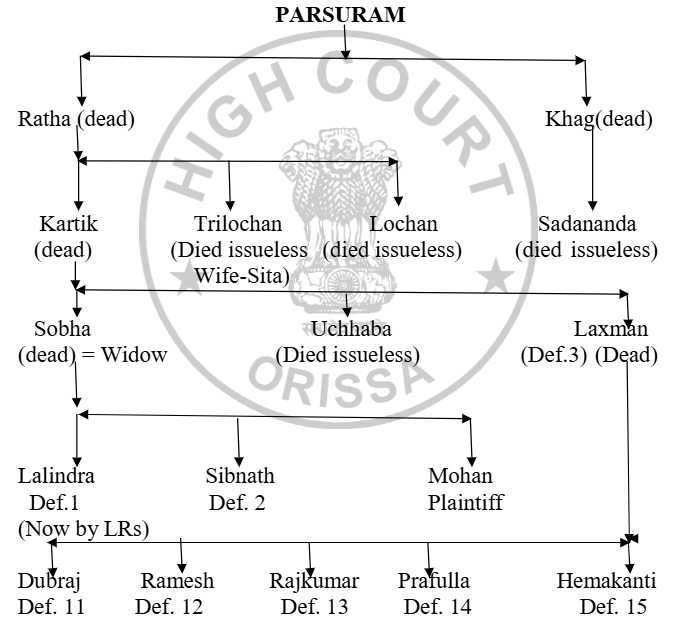
It is stated that the second son of Parsuram namely, Khaga Patel. Kartika, the son of Ratha died leaving behind three sons namely, Sobha, Uchhaba and Laxman, Defendant Nos. 1, 2 and 3, the Plaintiff are the sons of Sobha. Uchhaba died issueless, Laxman, the original Defendant No.3, (He is represented by his legal representatives i.e. Defendant No.11 to 15). Wife of Sobha is stated to have died in the year 1994. After death of her husband, she allotted some portion from out of Schedule-A & B land amongst her three sons and kept reserved some portions for her maintenance. The Defendant No.1 became the Karta of the family after death of his father. The parties started cultivating the lands separately for convenience without any partition in metes and bounds.
Khaga Patel, the second son of Parsuram is stated to have gifted away Schedule-B land which was his separate property to the family of Sobha Patel and Laxman Patel to look after the maintain him. During the Major Settlement, the Schedule-B has been recorded in the name of Defendant No.2 and the Plaintiff. It is further stated after acquisition of the land, the Schedule-B land had been blended with their ancestral property and as such they continued to possess jointly. It is stated that Defendant No.1 by registered sale-deed dated 10.05.1996 without the consent of other co-sharers has sold a portion of Schedule-B land to the Defendant No.16 and thus the same is not binding on all. Since the Defendants recreated disturbance over the possession of the land by the Plaintiff, the suit for partition has been filed.
4. The Defendant Nos.1 & 2 in their joint written statement have admitted that originally the suit property was their ancestral properties. It is stated that Khaga Patel was t
AI
The doctrine of blending separate property into joint family ownership requires explicit proof of intent; however, evidence of mutual acceptance supports the finding of joint ownership for partition.


The applicability of the Hindu Succession Act, 1956 to parties belonging to the Scheduled Tribe Community and the principles governing the partition of ancestral properties among co-sharers.

The presumption of joint family property necessitates proof of individual ownership; without such proof, a child has a right to claim share in ancestral property.


Will validly proved by attesting witness; plaintiff failed to establish joint family property for partition entitlement.
The court ruled that the plaintiffs' claims over certain properties were invalid due to prior sales, emphasizing the necessity of declarations regarding property ownership in joint familial contexts ....
The court reaffirmed that daughters have equal rights as sons in ancestral properties, emphasizing the applicability of Section 6 of the Hindu Succession Act.
The legal principle established in the judgment emphasizes the treatment of properties allotted in a partition deed as separate properties, and the burden of proof in establishing the invalidity of s....

A party may not amend a suit's claims regarding ownership of property in a manner contradicting original pleadings without introducing adequate supporting evidence, undermining the integrity of legal....



An indispensable Tool for Legal Professionals, Endorsed by Various High Court and Judicial Officers
Please visit our Training & Support
Center or Contact Us for assistance

Scan Me!
India’s Legal research and Law Firm App, Download now!


For Daily Legal Updates, Join us on :



 Back to top


