
 Back
Back





IN THE HIGH COURT OF ORISSA AT CUTTACK
D.DASH, J.
Shri Bali Bhotra – Appellant
Versus
Sondhar Banua @ Bhotra (Since Dead) by his LRs & another – Respondent
S.A. No.302 of 2000
Decided on : 25-11-2022
| Table of Content |
|---|
| 1. overview of the case and parties involved. (Para 1 , 2) |
| 2. factual background regarding the adoption claim. (Para 3 , 4 , 5) |
| 3. trial court's findings on the adoption status. (Para 6) |
| 4. substantial questions of law posed by the appeal. (Para 7) |
| 5. arguments presented by the appellant and respondents. (Para 8 , 9) |
| 6. court review of evidence and previous judgments. (Para 10 , 11) |
| 7. legal requirements for valid adoption and ruling reasons. (Para 12 , 13) |
| 8. final ruling and conclusion of the case. (Para 14) |
JUDGMENT :
D.Dash, J.
1. The Appellant, in this Appeal under Section 100 of the Code of Civil Procedure, 1908 (for short, ‘the Code’), has assailed the judgment and decree 28.07.2000 and 09.08.2000 respectively passed by the learned Additional District Judge, Jeypore in T.A. No.3 of 1995.
By the same, the Appeal filed by the original Respondent No.1 under section 96 of the Code in challenging the judgment and decree dated 06.09.1993 and 14.09.1993 respectively passed by the learned Subordinate Judge, Jeypore in T.S No.54 of 1990, has been allowed. The Trial Court, having dismissed the suit filed by the original Respondent No.1, as the Plaintiff and thereby non-suiting him; the First Appellate Court has decreed the suit declaring the right, title, interest of the original Respondent No.1 (Plaintiff) over the suit land and directing the present Appellant and Respondent No.1, the Defendant Nos.1 & 2 respectively before the Trial Court to restore possession of the suit land to the original Respondent No.1 (Plaintiff).
Be it stated here that the original Respondent No.1 (Plaintiff), having died during pendency of the suit, his legal representatives have come on record on being substituted and they are the Respondent Nos.1(a) to 1(b).
2. For the sake of convenience, in order to avoid confusion and bring in clarity, the parties hereinafter have been referred to, as they have been arraigned in the Trial Court.
3. Plaintiff’s Case:-
The parties are Bhotra by caste and as such, they are the members of the Scheduled Tribe Community. They being Hindus the traditional Hindu Law applies to them and they are governed by Mitaskhara School of Hindu Law. The provisions of Hindu Succession Act and other such enactments are not applicable to them.
4. It is stated that the land in suit exclusively belonged to one Sanadhara Banua @ Bhotra. Said Sanadhara died eleven to twelve years before the institution of the suit in the year 1990. He had only two daughters, namely, Defendant Nos.1 & 2. The Defendant No.3 is the son of Defendant No.2. The Plaintiff has provided the genealogy showing the relationship amongst the parties and that is given hereunder:-
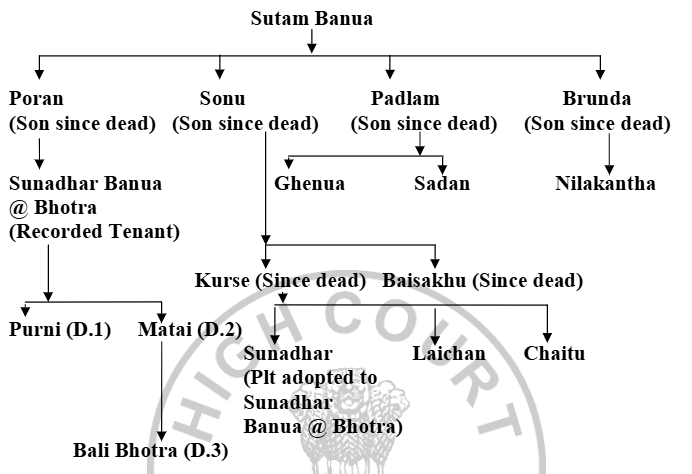
It is stated that during the life time of Parau, Sanu, Padlama and Brunda, they had partitioned their properties in metes and bounds and possessed their respective shares separately. Since Sanadhara had no male issue and his daughters had grown up, he decided to adopt the Plaintiff. Such a decision of adoption was taken in the year 1949. The Plaintiff then was a boy of 7 to 8 years old. The Plaintiff was adopted by Sanadhara and lived in his house with all the relationship with Sanadhar as father and son. It is further stated that the adoption was with the consent of the adoptive mother and natural parents. The Plaintiff, in course of time, got married and it was performed by that Sanadhar. On 14.04.1949, Sanadhar had executed a deed of acknowledgement of adoption of the Plaintiff. Much prior to the execution of the deed of adoption, late Sanadhara had gifted portions of his landed properties to his daughters, which had been recorded in their name in the Current Holding Nos.66 & 74. Daughters have been in Cultivating possession of those lands gifted to them. The Defendants have no right, title, interest and possession of the suit land. The Plaintiff, since the attainment of age of discretion, was cultivating the suit land to the exclusion of the Defendants. However, being instigated by some pers
AI
The validity of adoption requires clear, cogent evidence of factum, including actual giving and taking; mere documentation is insufficient without proof of the legal requirements.


Point of law: A perfectly valid adoption deed can be made without an adoption deed and any status which the adopted son gets by virtue of adoption is due to the proper ceremonies being performed and ....

The validity of an adoption must establish consent of both natural parents, failing which the adoption may be considered invalid under Hindu law.


The main legal point established in the judgment is that the adoption deed was obtained by fraud and misrepresentation, and the physical act of giving and taking of adoption did not take place in acc....

The central legal point established in the judgment is the requirement to prove adoption strictly in accordance with the provisions of the Hindu Adoptions and Maintenance Act, 1956, including the con....

The court established that for an adoption to be valid under the Hindu Adoptions and Maintenance Act, 1956, there must be clear and convincing evidence of the actual giving and taking in adoption, wh....



An indispensable Tool for Legal Professionals, Endorsed by Various High Court and Judicial Officers
Please visit our Training & Support
Center or Contact Us for assistance

Scan Me!
India’s Legal research and Law Firm App, Download now!


For Daily Legal Updates, Join us on :



 Back to top


