
 Back
Back





IN THE HIGH COURT OF KARNATAKA, KALABURAGI BENCH
K.S. HEMALEKHA, J.
Smt. Chandamma W/o. Shankrappa Chalgeri – Appellant
Versus
Channaveer Alleged, S/o. Anandraya Hadagil @ Narayanapur – Respondents
Regular Second Appeal No.200036 of 2014 (DEC)
Decided on : 10-10-2023
Adoption - Property Dispute - Hindu Adoption and Maintenance Act, 1956 - Section 11 - Section 16 - The court held that the plaintiff is the adopted son of deceased Neelamma, the absolute owner in exclusive possession of the suit schedule property, and the partition in favor of the defendant is declared as null and void. The court discussed the requirements of a valid adoption under the Hindu Adoption and Maintenance Act, 1956, the presumption as to registered documents relating to adoption, and the locus standi to question the validity of the adoption deed.
Fact of the Case:
The plaintiff, claiming to be the adopted son of Neelamma, filed a suit seeking declaration as the absolute owner of the suit schedule property. The trial court dismissed the suit, but the first appellate court reversed the decision, declaring the plaintiff as the adoptive son and absolute owner of the property. The defendant appealed to the second appellate court.
Finding of the Court:
The court found that the plaintiff was validly adopted by Neelamma and is the absolute owner of the suit schedule property. The court also held that the defendant had no locus standi to question the validity of the adoption deed.
Issues: The issues involved the validity of the plaintiff's adoption, ownership of the suit schedule property, and the defendant's locus standi to dispute the adoption.
Ratio Decidendi: The court emphasized the requirements of a valid adoption under the Hindu Adoption and Maintenance Act, 1956, the presumption as to registered adoption documents, and the limited locus standi to question the validity of the adoption deed.
Final Decision: The court dismissed the second appeal and confirmed the judgment and decree of the first appellate court, declaring the plaintiff as the adoptive son and absolute owner of the property.
JUDGMENT :
The present regular second appeal by the legal representatives of the defendant assailing the judgment and decree of the appellate Court in reversing the judgment and decree of the trial Court, holding that the plaintiff, is the adopted son of deceased Neelamma w/o Anandraya Hadagil, the absolute owner in exclusive possession of the suit schedule property and the partition in favour of defendant is declared as null and void, not binding on the plaintiff.
2. This Court while admitting the appeal has formulated the following substantial question of law on 13.06.2016:
“In the absence of any evidence as regards the giving and taking of the adoption, whether the Court below could have accepted the adoption deed?”
3. Sri Vinayak Apte, learned counsel for the appellants and Sri Ameet Kumar Deshpande, learned senior counsel appearing for the respondents have been heard on the substantial question framed by this Court.
4. For the sake of convenience, the parties herein are referred to as per their ranking before the trial Court.
5. The undisputed facts are that:
(i) Neelamma filed Form No.7 before the Land Tribunal, Aland, the occupancy rights was granted on 25.04.1981 in favour of Neelamma and the name of Neelamma was entered in the revenue records as per Form No.10.
(ii) Neelamma adopted the plaintiff-Channaveera on 04.11.2005 and the registered adoption deed was executed on 29.12.2005.
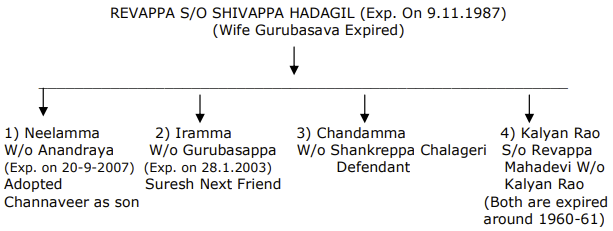
(iii) Neelamma adoptive mother of the plaintiff and defendant are sisters born to one Revappa Shivappa Hadagil.
(iv) Genealogy referred in the plaint is not disputed by the defendant.
(v) Several revenue proceedings were initiated by the defendant and Neelamma in respect of the suit schedule property.
6. The trial Court based on the pleadings framed the following:
“ISSUES
1. Whether plaintiff proves that, he is the absolute owner, in possession of the suit schedule properties?
2. Whether the plaintiff proves that, he is the adopted son to the deceased Neelamma W/o. Anandraya?
3. Whether defendant proves that, she is the absolute owner of the suit schedule properties?
4. Whether plaintiff is entitled the relief of declaration and permanent injunction as prayed for?”
7. The trial Court taking into consideration the oral and documentary evidence, dismissed the suit of the plaintiff.
8. Feeling aggrieved by the judgment and decree of the trial Court, the plaintiff preferred appeal before the first appellate Court. The first appellate Court reappreciated the entire oral and documentary evidence independently and reversed the findings of the trial Court, holding that:
i) The plaintiff is declared as the adoptive son of Neelamma;
ii) Plaintiff is declared as the absolute owner in exclusive possession of the suit schedule property;
iii) The partition deed as contended by the defendant is declared as null and void and not binding on the plaintiff;
iv) Directed the Revenue Authorities to delete the name of the defendant appearing in the revenue records in respect of Sy. No.190/A to the extent of 5 acres 24 guntas;
v) Defendant or any person claiming through her were restrained perpetually from interfering into the suit land in any manner.
9. Defendant-Chandamma, being aggrieved by the reasoning of the first appellate Court in reversing the finding of the trial Court, has approached this Court in the second appeal.
10. Learned counsel appearing for the appellants-defendant would contend that in the absence of any material evidence of giving and taking ceremony as mandate under Section 11 of the Hindu Adoption and Maintenance Act, 1956 (hereinafter referred to as “the HA & M Act, 1956” for the sake of convenience), the plaintiff has failed to prove the essential ingredients to validate the adoption. Learned counsel would contend that, the adoption as alleged by the plaintiff is by playing fraud on Neelamma and without her consent. He would also contend that Neelamma, during her lifetime, had partitioned the suit schedule property and an extent of 5 acres 24 guntas fell to t
AI

The main legal point established in the judgment is the validity of the adoption deed and the plaintiff's lack of locus standi to question the adoption.
Point of law: A perfectly valid adoption deed can be made without an adoption deed and any status which the adopted son gets by virtue of adoption is due to the proper ceremonies being performed and ....

The burden of proof lies on the claimant to establish valid adoption as per statutory requirements; registered deeds are rebuttable and do not eliminate the need for actual proof.

The main legal point established in the judgment is that the adoption deed was obtained by fraud and misrepresentation, and the physical act of giving and taking of adoption did not take place in acc....
The central legal point established in the judgment is the requirement to prove adoption strictly in accordance with the provisions of the Hindu Adoptions and Maintenance Act, 1956, including the con....

The validity of adoption requires clear, cogent evidence of factum, including actual giving and taking; mere documentation is insufficient without proof of the legal requirements.

Point of law: Capacity of a male Hindu to take in adoption-Any male Hindu who is of sound mind and is not a minor has the capacity to take a son or a daughter in adoption. Provided that, if he has a ....

Adoption requires strict adherence to legal prerequisites, including consent from both biological parents, making an invalid registration insufficient for legitimacy.
The validity of an adoption requires strict compliance with statutory conditions, including the consent of the biological mother, and such conditions were not met in this case.



An indispensable Tool for Legal Professionals, Endorsed by Various High Court and Judicial Officers
Please visit our Training & Support
Center or Contact Us for assistance

Scan Me!
India’s Legal research and Law Firm App, Download now!


For Daily Legal Updates, Join us on :



 Back to top


