
 Back
Back





IN THE HIGH COURT OF PUNJAB AND HARYANA AT CHANDIGARH
ARCHANA PURI, J.
Ashok Kumar Sharma - Appellant
Versus
Rakesh Kumar Sharma – Respondent
CR No. 1974 of 2020
Decided On : 19-03-2024
Counterclaim - Property Dispute - CPC Order 8 Rule 6A to 6G - The court interpreted the provisions regarding counterclaims, concluding that a defendant cannot file a counterclaim against a co-defendant, which influenced the decision to dismiss the counterclaim.
Fact of the Case:
The petitioner challenged an order dismissing his application to dismiss a counterclaim filed by co-defendants regarding property rights based on conflicting wills. The petitioner claimed exclusive rights under his mother's will, while the counterclaimants asserted rights through natural inheritance.
Finding of the Court:
The court found that the counterclaim against the petitioner was not maintainable as per the provisions of the CPC, which only allow counterclaims against the plaintiff, not co-defendants. The court emphasized the lack of procedural rights for a co-defendant in such cases.
Issues: Whether a defendant can file a counterclaim against a co-defendant under the provisions of the CPC.
Ratio Decidendi: The court held that the provisions of Order 8 Rule 6A to 6G of the CPC do not permit a counterclaim by a defendant against a co-defendant, as such a claim is not contemplated within the statutory framework.
Result: The revision petition is allowed, and the counterclaim is dismissed.
JUDGMENT :
(Archana Puri, J.) :
The petitioner has invoked the jurisdiction of this Court under Article 227 of the Constitution of India, thereby, making a prayer for setting aside of the order dated 08.01.2020 (Annexure P-14), being illegal ultravires, void and without jurisdiction and further made a prayer that application dated 11.07.2019 (Annexure P-12) filed by the petitioner, for dismissal of the counter-claim, be allowed in the interest of justice.
2. The essential facts, to be noticed, are as herein given:-
That, initially, respondent No.1 (plaintiff before learned trial Court) had filed a suit for issuance of permanent injunction to restrain defendant No.1 (petitioner in the present revision petition) from alienating, transferring or mortgaging more than his half share and further to restrain the other defendants and their attorneys etc. from alienating, transferring or mortgaging any part of the suit property, as detailed in the headnote of the plaint. Though, not reproduced in the plaint, but what could be gathered from the title of the suit as well as from the grounds of revision, the essential pedigree table is reproduced, as herein given:-
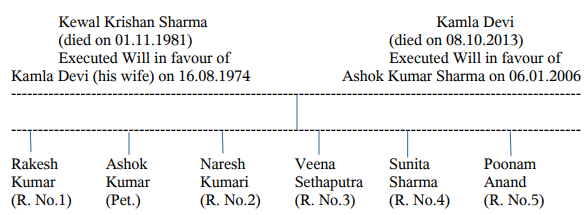
3. In the plaint, it is asserted that Kewal Krishan Sharma, was owner of the suit property (as detailed in the headnote of the plaint). During his lifetime, he had executed a Will dated 16.08.1974, vide which, he had appointed his wife Kamla Devi i.e. mother of the plaintiff and defendants, as trustee and it was duly mentioned in the Will that after the death of Kamla Devi, his property is to bequeath in favour of plaintiff Rakesh Kumar Sharma and defendant No.1 Ashok Kumar Sharma, in equal shares. Probate was also granted by the High Court of Singapore. On the basis of the said Will, mutation of inheritance was sanctioned, in favour of mother of the parties i.e. Kamla Devi, vide mutation No.944, as per the order of Collector dated 25.08.2004, which has been incorporated in the revenue record.
4. The said property was joint property, along with other co-sharers i.e. brothers of K.K.Sharma and the property was partitioned between the parties and mutation in this regard was sanctioned vide mutation No.1096, which entry was reflected in the jamabandi.
5. However, mother of the parties, namely Kamla Devi died on 28.10.2013. Defendant No.1 (petitioner), in order to frustrate the right of the plaintiff on the basis of the Will dated 16.08.1974, had moved an application before concerned office, to sanction mutation of inheritance of Kamla Devi, in his exclusive name. The plaintiff having come to know about the same, had filed objections before the concerned Tehsildar. Also, it was averred in the plaint, that the plaintiff and defendant No.1 are joint owners in possession of the said property, in equal shares, as per Will dated 16.08.1974 and the plaintiff also requested defendant No.1 and other defendants, to admit his claim, but they clearly refused in this regard. It was asserted that defendant No.1 wants to alienate whole land and other defendants are also trying to alienate the suit property, to some other persons, in order to defeat the rights of the plaintiff.
6. Defendant No.1-petitioner filed written statement. Besides raising preliminary objections, also defendant No.1, asserted about the execution of Will by his father on 16.08.1974, on the basis whereof, property has been transferred/mutated in the name of Kamla Devi. Furthermore, it was asserted that during her lifetime, Kamla Devi had executed a Will dated 06.01.2006, in his favour. The said Will was upheld at various forums and accordingly, land in Karnal had been mutated in the name of the answering defendant vide mutation No.8203. Even, on the basis the Will, executed by his mother, mutation No.733 has been sanctioned in favour of the answering defendant by the Revenue Officer at Kapurthala. Also, it was asserted that plaintiff had sought to set aside the Will of Lt.Smt.Kamla Devi before the Hon’ble High Court of Singapore i
AI
A defendant cannot file a counterclaim against a co-defendant under the CPC, as the provisions only allow counterclaims against the plaintiff.

Plaintiffs have an unqualified right to abandon parts of their claims without court permission, overriding objections from co-defendants regarding counter-claims.

A counterclaim directed solely against a co-defendant is typically impermissible; however, if it intertwines with a plaintiff's claim, it may hold validity under commercial agreements.
A counter-claim cannot be permitted after the framing of issues unless exceptional circumstances exist, which were not present in this case.


A counter claim must relate to the plaintiff's claims; dissimilarity in cause of action renders it non-maintainable.


Counter claims in partition suits must be directed against the plaintiff; co-defendants cannot initiate claims solely against each other without notice, as all parties have interchangeable roles.

A counterclaim in a partition suit must be against the plaintiff; failing to notify co-defendants constitutes a violation of natural justice, rendering any ex parte decree unsustainable.
Counterclaims may be allowed after closing evidence if justified by circumstances; procedural rules must serve justice.



An indispensable Tool for Legal Professionals, Endorsed by Various High Court and Judicial Officers
Please visit our Training & Support
Center or Contact Us for assistance

Scan Me!
India’s Legal research and Law Firm App, Download now!


For Daily Legal Updates, Join us on :



 Back to top


