
 Back
Back





IN THE HIGH COURT OF PUNJAB AND HARYANA AT CHANDIGARH
TRIBHUVAN DAHIYA, J.
Chetan Kaur through Lrs. - Appellants
Versus
Jaspreet Singh & Ors. – Respondents
RSA No.299 of 2014 (O&M)
Decided On : 10-02-2023
| Table of Content |
|---|
| 1. factual basis of plaintiff's claim. (Para 2) |
| 2. arguments regarding plaintiff's legal standing. (Para 3 , 7 , 8) |
| 3. trial court findings on fraud and misrepresentation. (Para 5) |
| 4. lower appellate court's affirmation of findings. (Para 6) |
| 5. concurrent findings of no misrepresentation. (Para 10 , 11) |
| 6. key substantial questions of law. (Para 12) |
| 7. discussion on family settlement claims. (Para 13) |
| 8. (Para 14) |
| 9. final ruling and court orders. (Para 15 , 16 , 17) |
JUDGMENT :
(Tribhuvan Dahiya, J.)
This is plaintiff's appeal against the judgment of reversal.
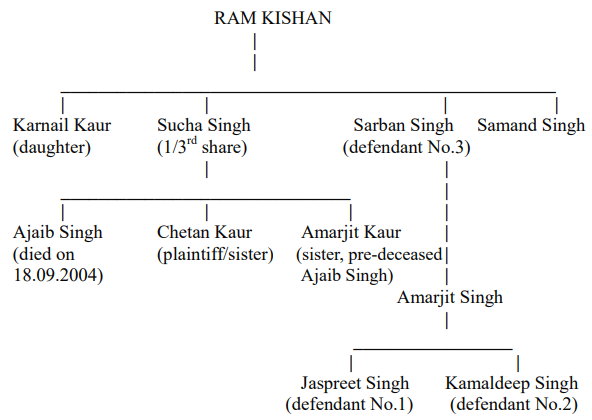
2. The facts of the case as pleaded are, the appellant/plaintiff (hereinafter referred to as 'plaintiff') being represented through LR, filed a suit for possession of 1/3rd share pertaining to Ajaib Singh, son of Sucha Singh in the total land measuring 225 bighas 19 biswas, and for permanent injunction restraining the defendants from selling or encumbering the suit land as well as the houses. Ajaib Singh son of Sucha Singh was real brother of the plaintiff, who died a bachelor on 18.09.2004 leaving behind plaintiff as his only legal representative. The other sister of Ajaib Singh, namely, Amarjit Kaur @ Jeeto predeceased him in the year 1992. After Ajaib Singh's death, the plaintiff is the only successor-in-interest to him. His mother had also predeceased him. When the plaintiff approached halka patwari for entering of mutation in her name, she came to know that suit land already stood entered in the name of defendants No.1 and 2 on the basis of a decree passed in civil suit No.56 of 09.02.1996, decided on 12.03.1996. Ajaib Singh was made to suffer the decree by paying a fraud and he, actually, did not consent to passing of the same. The counsel who represented defendants No.1 and 2 as well as Ajaib Singh before the trial Court were real brothers and were practicing jointly at that time. These facts, it was alleged, clearly established that the decree was got passed by defendants No.1 to 3 in a fraudulent manner without disclosing true facts to Ajaib Singh, and, therefore, the same was illegal, null and void.
3. The suit was contested by the respondents/defendants (hereinafter referred to as 'defendants'), admitting that Ajaib Singh died a bachelor. It was denied that plaintiff was the only legal representative of Ajaib Singh. The plaintiff was married, living with her husband at a village in Patiala. She was not successor of Ajaib Singh since during his lifetime, defendants No.1 and 2 used to take care and serve him. It was only on account of the deceased's love and affection to them that he willingly suffered the decree dated 12.03.1996 in their favour pertaining to his share. Therefore, defendants No.1 and 2 have become owners in possession of suit land; the plaintiff has no concern with it. The mutation with regard to transfer of ownership was in the knowledge of the plaintiff, and the suit was accordingly barred by limitation.
4. On the pleadings of the parties, the following issues were settled by the trial Court:
1. Whether plaintiff is entitled for possession of 1/4 share pertaining to Ajaib Singh in the suit land? OPP
2. Whether judgment and decree dated 12.03.1996 is illegal, null and void qua the rights of the plaintiff? OPP
3. Whether the plaintiff entitled for permanent injunction? OPP
4. Whether the suit is not legally maintainable? OPD
5. Whether suit is time barred? OPD
6. Whether plaintiff has no locus standi to file this suit? OPD
7. Relief.
5. Issues No.1, 2 and 3 were decided together by the trial Court holding that there was no misrepresentation or fraud, as alleged by the plaintiff. There was no evidence on record to doubt the validity of the judgment and decree, dated 12.03.1996 (Ex.P4), suffered by Ajaib Singh. The proceedings were on the basis of documents signed by Ajaib Singh himself. More importantly, Ajaib Singh died only in the year 2004, i.e., after about eight years of suffering the decree. Had there been any fraud played upon him by his uncle
AI

The judgment emphasizes the importance of evidence in establishing fraud and misrepresentation, the definition of family for the purpose of family settlement, and the requirement of compulsory regist....
Consent decrees based on family settlements cannot be challenged on procedural grounds but only on proven fraud.

Consent decrees based on family settlements cannot be challenged on incorrect facts unless fraud is proven; registration is not required for such decrees when they involve pre-existing rights.

Consent decree-Setting aside of-Decree was procured by fraud on ground of Family settlement-Appellant had no antecedent title, claim or interest in the land in dispute-Contention that there was a fam....



An indispensable Tool for Legal Professionals, Endorsed by Various High Court and Judicial Officers
Please visit our Training & Support
Center or Contact Us for assistance

Scan Me!
India’s Legal research and Law Firm App, Download now!


For Daily Legal Updates, Join us on :



 Back to top


