
 Back
Back





IN THE HIGH COURT OF PUNJAB AND HARYANA AT CHANDIGARH
ANIL KSHETARPAL, J.
Jarnail Singh (Deceased) Through Lrs & Ors. – Appellants
Versus
Major Singh & Anr. – Respondents
RSA-2909 of 2013 (O&M)
Decided On : 05-01-2023
| Table of Content |
|---|
| 1. factual background of the dispute. (Para 3 , 4 , 5) |
| 2. arguments regarding adoption and limitation. (Para 11 , 12) |
| 3. analysis of evidence regarding adoption. (Para 14 , 15 , 16 , 20) |
| 4. determination of legal standing and merits. (Para 17 , 19 , 22) |
| 5. conclusion and dismissal of the appeal. (Para 23 , 24) |
JUDGMENT
Anil Kshetarpal, J.
The Regular Second Appeal in the States of Punjab, Haryana and Union Territory, Chandigarh, is governed by Section 41 of the PUNJAB COURTS ACT , 1918 and not by Section 100 of the Code of Civil Procedure, 1908, as held by a five Judge Bench of the Supreme Court in Pankajakshi (Dead) through LRs v. Chandrika and others , (2016) 6 SCC 157 .
2. The plaintiffs have preferred this second appeal against the judgment and decree passed by the First Appellate Court which, in turn has reversed the judgment and decree passed by the trial Court.
3. The relevant facts, in brief, are required to be noticed, which are as follows:
4. The suit was filed by Sh. Jarnail Singh and Sh. Babu Singh, sons of late Sh. Ajmer Singh for grant of decree of declaration with a consequential relief of possession and for permanent injunction. In order to understand inter se relationship between the parties, it would be appropriate to draw a small pedigree of the family:-
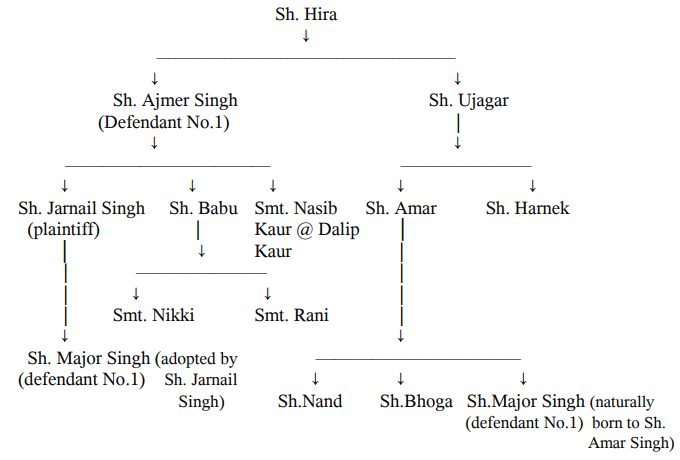
5. The plaintiffs, while filing the suit, impleaded Sh. Ajmer Singh, (their father) as defendant No.1, whereas, Sh. Major Singh (his son adopted from his paternal uncle's son Sh. Amar Singh) was impleaded as defendant No.2. Claiming that they are owners of 1/3rd share each in land measuring 62 bighas and 7 biswas, the plaintiffs sought a decree of declaration to the effect that the judgment and decree passed on 06.09.1997 in Civil Suit No.97, is collusive and a result of fraud. It is the case of the plaintiffs that the property is a joint Hindu family coparcenary property which is ancestral in nature and they came to know of the judgment and decree dated 06.09.1997 in the first week of April, 2002. The aforesaid judgment and decree was passed in favour of Sh. Major Singh and against late Sh. Ajmer Singh. It is claimed by the plaintiffs that the aforesaid judgment and decree is a result of fraud and misrepresentation by late Sh. Ajmer Singh.
6. While practically admitting the plaintiffs' case, Defendant No.1 (late Sh. Ajmer Singh) filed a written statement. He stated that defendant No.2 played fraud with him and the suit property was, in fact, a coparcenary property. Defendant No.2, while contesting the suit, stated that he was adopted by Sh. Jarnail Singh (plaintiff No.2) and the property is neither joint Hindu family coparcenary property not ancestral in nature. In fact, in the family settlement, defendant No.1 (late Sh. Ajmer Singh) conceded the fact that defendant No.2 is the owner in possession of the property. The judgment and decree dated 06.09.1997 was passed acknowledging the aforesaid family settlement.
7. On appreciation of the pleadings, the trial Court culled out the following issues:-
"1. Whether the plaintiffs are entitled to declaration as prayed for? OPP
2. Whether the property in dispute is joint Hindu family ancestral and coparcenaries property? OPP
3. Whether the plaintiffs are owner of the property to the extent of 1/3 share since the date of their birth? OPP
4. Whether the collusive decree in Civil Suit No.97 of 2.5.97 decided on 6.9.97 is illegal null and void and liable to be set aside? OPP
5. Whether the plaintiffs are entitled to get possession of 1/3 share of the property? OPP
6. Whether the plaintiffs have no locus-standi to file the present suit (defendant No.2)? OPP
7. Whether the suit is bad for non-joinder of necessary parties? OPP
8. Whether suit is not withing limitation? OPP
9. Whether suit filed by plaintiff just to harass the defendants? OPP
10. Relief."
8. After appreciating the evidence, the trial Court decreed the suit while observing that Sh. Major Singh is estopped from claiming that the property is not joint Hindu fa
AI

Consent decrees based on family settlements cannot be challenged on incorrect facts unless fraud is proven; registration is not required for such decrees when they involve pre-existing rights.

The judgment emphasizes the importance of evidence in establishing fraud and misrepresentation, the definition of family for the purpose of family settlement, and the requirement of compulsory regist....
The court upheld the validity of a consent decree, ruling that the deceased had the authority to alienate property as separate property, and the plaintiffs failed to prove fraud.

Fraud - Fraud has been defined in Section 17 of the Contract Act to mean as Fraud means and includes any of the following acts committed by a party to a contract, or with his connivance, or by his ag....

Adoption – Ceremony of adoption may vary depending upon circumstances of each case, but for a valid adoption there has to be ceremony of giving and taking of child in adoption.



An indispensable Tool for Legal Professionals, Endorsed by Various High Court and Judicial Officers
Please visit our Training & Support
Center or Contact Us for assistance

Scan Me!
India’s Legal research and Law Firm App, Download now!


For Daily Legal Updates, Join us on :



 Back to top


