
 Back
Back





2025 SHC 73
IN THE HIGH COURT OF SIKKIM AT GANGTOK
BHASKAR RAJ PRADHAN, J.
Prem Bahadur Rai and Another – Appellants
Versus
The Branch Manager, United India Insurance Co. Ltd. and Another – Respondents
MAC. App. No. 22 of 2024
Decided On : 10-07-2025
Advocates Appeared :
For the Appellants : Umesh Ranpal, Rubusha Gurung
For the Respondents : Pramit Chettri, Bhusan Nepal
| Table of Content |
|---|
| 1. overview of the claim and the initial dispute regarding passenger status. (Para 1 , 2 , 3 , 4) |
| 2. conflicting stances on the deceased's categorization as a workman or passenger. (Para 5 , 6) |
| 3. definition of workman under e.c. act versus evidentiary weight of hearsay investigations. (Para 7 , 8 , 9) |
| 4. review of the tribunal’s handling of evidence regarding the worker status. (Para 10 , 11 , 12) |
| 5. admissions by the vehicle owner carry higher probative value than hearsay evidence. (Para 13 , 14 , 15 , 16) |
| 6. establishment of vicarious liability and determination of just compensation quantum. (Para 17 , 18 , 19) |
| 7. final appellate order and directives for disbursement of compensation. (Para 20 , 21 , 22) |
JUDGMENT :
Bhaskar Raj Pradhan, J.
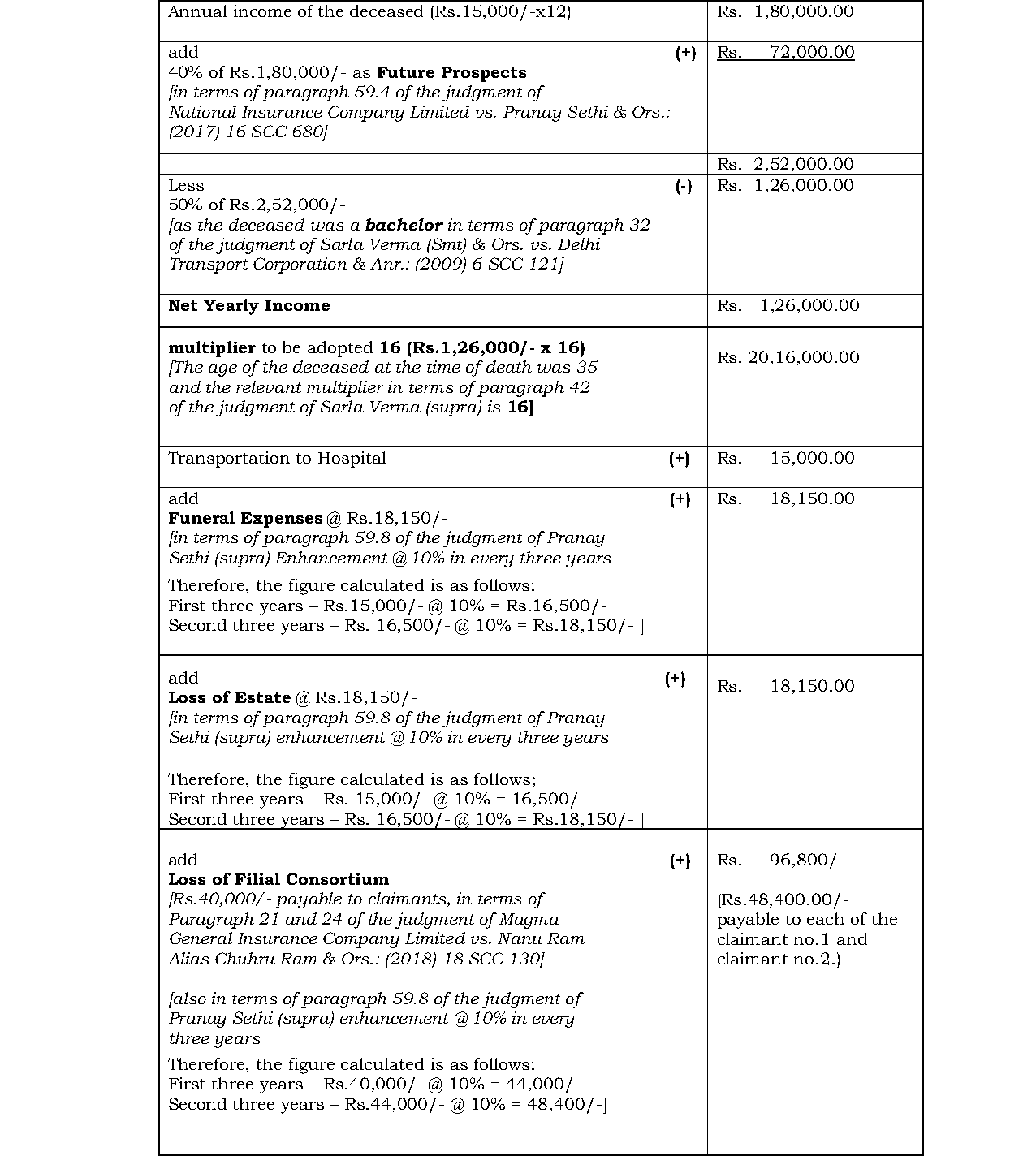
1. The appellants/claimants-father and mother of the deceased in an application filed under Section 166 of the Motor Vehicles Act, 1988 (the MV Act) had sought compensation to the tune of Rs. 22,41,000/- (Rupees twenty two lakhs forty one thousand) only, on account of the accidental death of their son in a motor vehicle accident that occurred on 20.04.2023.
2. The question which arose for consideration before the learned Motor Accident Claims Tribunal (the learned Tribunal) was whether the deceased was a workman covered by the insurance policy or a gratuitous passenger not entitled to compensation? Both were questions of fact.
3. The learned Tribunal has rejected the claim of the appellants (claimants) who were the parents of the deceased on the ground that the deceased was a gratuitous passenger in the accident vehicle and not a workman or a helper in the accident vehicle.
4. The claimants had asserted that the deceased was working as a daily wage labor of the accident vehicle and on the relevant day of the accident he was travelling from Rorathang to Bering to unload sand of Ms. Durga Mishra when the accident occurred due to which both the deceased and his brother died.
5. The Insurance Company (respondent no.1) disputed the claim made by the claimants by filing its written objection and denying the assertion of the claimants that the deceased was a workman working as a daily laborer in the accident vehicle. The Insurance Company asserted that the deceased and the driver of the accident vehicle were from the same village and therefore, the deceased had taken a lift in the accident vehicle. The Insurance Company supported this claim by filing the Motor TP Claims Investigation Report (exhibit-R1) made by Binud Arjel- the Insurance Investigator who opined that the deceased was a gratuitous passenger in his report.
6. The owner of the accident vehicle (respondent no.2) in his written objection admitted that he had required five bags of sand to repair the drain of his house which were loaded in the accident vehicle along with the sand of Mr. Durga Mishra on the relevant day; the deceased boarded the accident vehicle to unload the said five bags of sand belonging to the owner but unfortunately before unloading the sand, the accident vehicle met with an accident.
7. In the insurance policy it is seen that the owner has paid an additional premium for insuring his liability to workmen greater than six. The insurance policy which is dated 04.02.2023 does not define the word “workmen”. During the course of the hearing it was suggested that the word “workmen” as mentioned in the insurance policy would have the same meaning as was defined in Workmen Compensation Act, 1923. By section 4 of the Workmen Compensation (Amendment) Act, 2009 nomenclature of the Act has been amended by substituting the word “Employee’s” for the word “Workmen’s” w.e.f. 18.01.2010 and now the Act stands as the Employee’s Compensation Act, 1923. The Employee’s Compensation Act, 1923 defines the word “Employee” in section 2(dd) to include a person recruited as driver, helper, mechanic, cleaner or any other capacity in connection with a motor vehicle. Thus, the deceased would be covered by the definition of an “Employee” as afore

AI
A passenger is not a gratuitous passenger if they are engaged as an employee for the conveyance of goods in a vehicle for which a specific premium for worker liability has been paid, and such status ....

A person engaged in manual tasks like unloading materials from a motor vehicle qualifies as an employee/workman. Evidence derived from investigative reports based on unverified third-party statements....

Point of law: Compensation - When a specific Policy has been taken by respondent No. 3-owner of the vehicle, then the liability of the Insurance Company will be confined to that arising under the Wor....


The liability of the insurance company under the Motor Vehicle Act and the coverage of risk for helper/cleaner under the insurance policy were the central legal points established in the judgment.

Gratuitous passengers in goods vehicles are not entitled to insurance coverage under the Motor Vehicles Act, affecting liability in compensation claims.
The insurance company's liability to compensate was affirmed, determining that the deceased was a helper covered under the policy, contrary to the lower court's ruling.


The insurance policy must explicitly state the coverage terms, and any ambiguity will be interpreted against the insurer. Additionally, compensation for motor vehicle accidents must adhere to establi....



An indispensable Tool for Legal Professionals, Endorsed by Various High Court and Judicial Officers
Please visit our Training & Support
Center or Contact Us for assistance

Scan Me!
India’s Legal research and Law Firm App, Download now!


For Daily Legal Updates, Join us on :



 Back to top


