
 Back
Back





IN THE HIGH COURT OF ALLAHABAD
Hon'ble Saurabh Shyam Shamshery, J.
Saida – Applicant
Versus
State Of Uttar Pradesh And Others - Opposite Party
Application U/S 482 No. - 47176 of 2023
Decided On : 09-07-2024
CRIMINAL PROCEDURE - Filing of FIR and Investigation - Sections 154, 156(3), 190, 200, 202, 203, 201 of Cr.P.C. - The court discussed the obligations of police officers to register FIRs under Section 154 and the discretion of Magistrates under Section 156(3) to direct investigations. It emphasized that when a cognizable offence is disclosed, the Magistrate must order an investigation, especially in cases of alleged forgery and misrepresentation, as was evident in this case. The court found that the trial court failed to appreciate the seriousness of the allegations, necessitating a police investigation.
Fact of the Case:
The applicant, a woman, filed an FIR against several individuals for offenses including forgery and misrepresentation, alleging that they submitted a forged affidavit claiming she did not oppose a final report. The trial court accepted the final report based on this affidavit, which the applicant contested, asserting it was not her signature or photograph.
Finding of the Court:
The court found that the trial court did not adequately consider the serious allegations of forgery and misrepresentation. It ruled that the applicant's complaint warranted a police investigation under Section 156(3) of the Cr.P.C., as the facts indicated a cognizable offense had occurred.
Issues: Whether the trial court erred in not directing the police to register an FIR and investigate the allegations of forgery and misrepresentation made by the applicant.
Ratio Decidendi: The court held that when a complaint discloses a cognizable offense, the Magistrate has a duty to direct the police to investigate. The discretion under Section 156(3) must be exercised to ensure justice, particularly in cases involving serious allegations like forgery.
Final Decision: The court set aside the trial court's order and directed the police to register an FIR based on the applicant's complaint and proceed with the investigation.
JUDGMENT :
Hon'ble Saurabh Shyam Shamshery,J.
1. Applicant before this Court is a woman who has filed an FIR bearing No. 0594 dated 10.10.2021 against opposite parties no. 2 to 4 for offence under Sections 452, 376-D, 506 IPC wherein after investigation, a final report being no. 01 dated 31.12.2021 was submitted.
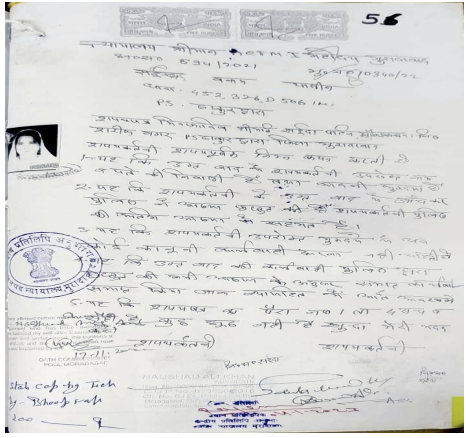
2. It is alleged by applicant that no notice was issued to her on final report and opposite parties no. 2 to 4 put an imposter of applicant and filed an affidavit putting her forged thumb impression along with forged photograph that she does not want to file any protest petition and final report may be accepted. A scanned copy of same is pasted hereinafter :-
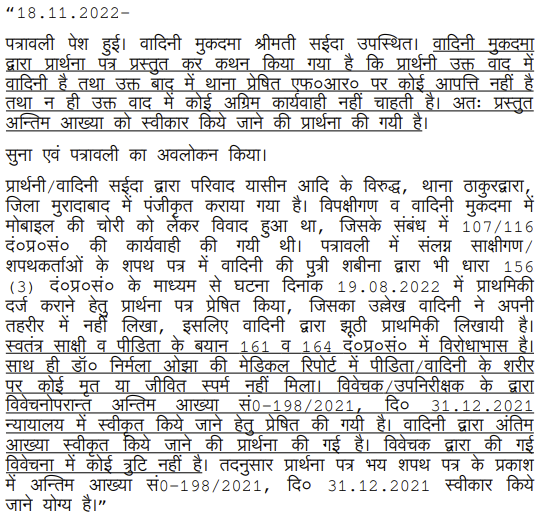
3. It is further case of applicant that trial Court on basis of above referred forged affidavit has accepted the final report dated 18.11.2022. For reference, said order is quoted below :-
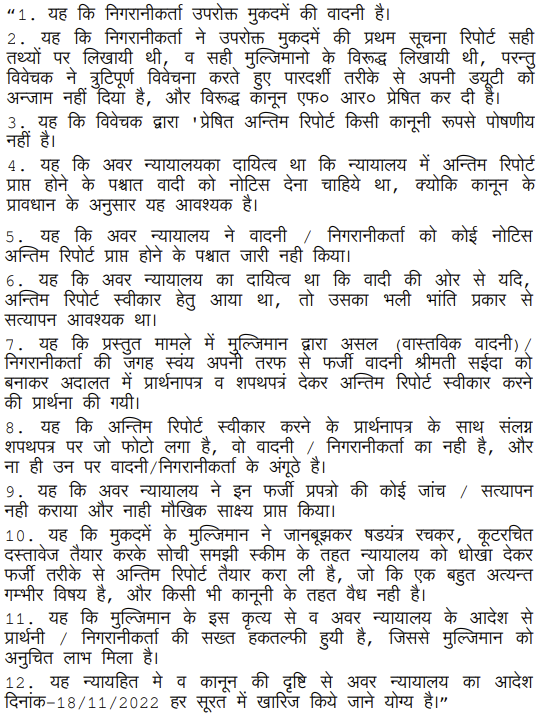
4. Sri Arvind Prabodh Dubey, learned counsel for applicant has submitted that aforesaid order has been challenged by way of filing a criminal revision bearing No. 402/2022 which is pending before Chief Judicial Magistrate, Moradabad and grounds taken therein are quoted below :-
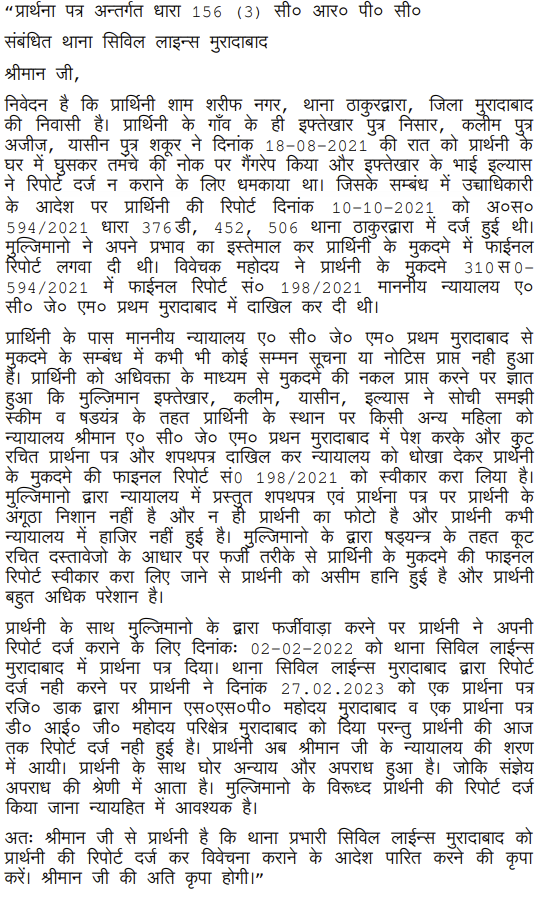
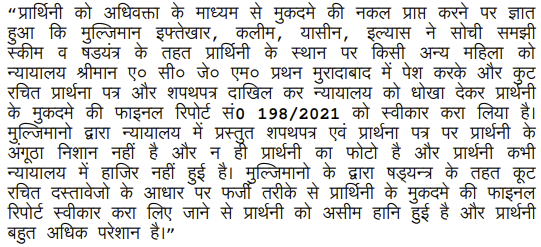
5. Learned counsel has further submitted that since opposite parties no. 2 to 4 have prepared a forged document i.e. an affidavit putting forged thumb impression and a photograph of applicant and submitted before trial Court, as such, they have committed an offence and therefore, she filed an application under Section 156(3) Cr.P.C. against present opposite parties no. 2 to 4 and 1 other named as well as an unknown women with a prayer that an FIR be lodged and investigation be conducted against them for committing offence of cheating, forgery, etc. For reference, said application is quoted below :-
6. Aforesaid application was considered by Chief Judicial Magistrate, Moradabad and it was disposed of by an order impugned dated 31.03.2023 whereby instead of giving a direction to lodge an FIR, the application was considered to be a complaint and matter was put for recording statement of the complainant under Section 200 Cr.P.C. Relevant part of impugned order is quoted below :-
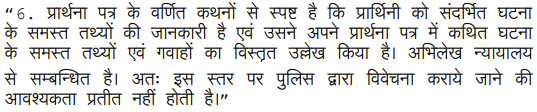
7. Learned counsel has submitted that applicant is aggrieved by aforesaid order wherein observations of trial Court are that all facts are within knowledge of applicant/complainant, therefore, there is no need to lodge FIR.
8. Learned counsel has further submitted that said observation is contrary to contents of application as it is a case where opposite parties no. 2 to 4 along with other persons have put an imposter of applicant and prepared a forged affidavit that she does not want to protest final report. Applicant always wanted to lodge an FIR against proposed accused persons and contents of application was for same cause.
9. Learned counsel has next submitted that an offence has been committed in pleadings before Court and all original documents are seized of with trial Court, therefore, applicant could not submit any evidence to it rather it was a fit case where FIR ought to have been lodged and investigation ought to have been carried out.
10. Learned counsel has referred a judgment passed by Supreme Court in case of Anju Chaudhary vs. State of Uttar Pradesh and another (2013) 6 SCC 384 and relevant paragraphs 13 and 14 are quoted below :-
“13. A copy of the information so recorded under Section 154(1) has to be given to the informant free of cost. In the event of refusal to record such information, the complainant can take recourse to the remedy available to him under Section 154(3). Thus, there is an obligation on the part of a police officer to register the information received by him of commission of a cognizable offence. The two-fold obligation upon such officer is that (a) he should receive such information and (b) record the same as prescribed. The language of the section imposes such imperative obligation upon the officer. An investigating officer, an officer-in-charge of a police station can be directed to conduct an investigati
AI
The Magistrate has a duty to order an investigation when a cognizable offense is disclosed in a complaint, particularly in cases involving serious allegations such as forgery.

The Magistrate has discretion under Section 156(3) of the CrPC to determine whether to direct an investigation, particularly in civil disputes masquerading as criminal matters.

The magistrate must ensure a complaint discloses a cognizable offence before directing police investigation under Section 156(3) Cr.P.C., and a detailed affidavit is required to support such applicat....

Point of law: although Sec. 156(3) is very briefly worded, there is an implied power in the Magistrate under Sec. 156(3) Cr.P.C. to order registration of a criminal offence and / or to direct the off....


Revision maintainable against dismissal of Section 156(3) CrPC application; prior police complaints evidenced by postal receipts satisfy precondition; forgery to obtain scheme benefits discloses cogn....



An indispensable Tool for Legal Professionals, Endorsed by Various High Court and Judicial Officers
Please visit our Training & Support
Center or Contact Us for assistance

Scan Me!
India’s Legal research and Law Firm App, Download now!


For Daily Legal Updates, Join us on :



 Back to top


