
 Back
Back





IN THE HIGH COURT OF ALLAHABAD
RAJIV GUPTA, SHIV SHANKER PRASAD, JJ.
Hari Shankar Rai – Appellant
Versus
State - Respondent
Criminal Appeal No. 128 Of 1983 with Government Appeal No. 877 of 1983
Decided On : 17-05-2024
JUDGMENT :
(Shiv Shanker Prasad, J.) :
1. Heard Mr. R.K. Shahi, learned counsel for the accused, Mr. Harish Chandra Tiwari, learned counsel for the first informant and Mr. Jitendra Kumar Jaiswal, learned A.G.A. for the State in both the appeals, as well as perused the record.
2. Since these criminal appeal as well as government appeal are directed against the judgment and order dated 19th January, 1983 passed in Sessions Trial No. 245 of 1981 (State Vs. Mahendra Rai & Hari Shanker Rai) arising out of Case Crime No. 215 of 1979 (251/3), under Section 302 of I.P.C., Police Station, Tariya Sujan, District-Deoria, whereby the accused Hari Shanker Rai has been convicted and sentenced to undergo four years rigorous imprisonment for the offence punishable under first part of Section 304 of I.P.C., whereas the accused Mahendra Rai has been acquitted for the offence punishable under Section 302 of I.P.C., the same have been heard and clubbed together and are being decided by this common judgment.
3. During the pendency of the instant Government Appeal before this Court, the accused-respondent no.1 Mahendra Rai has already passed away and the Government Appeal qua accused-respondent no.1 Mahendra Rai has been abated vide order dated 31st August, 2022.
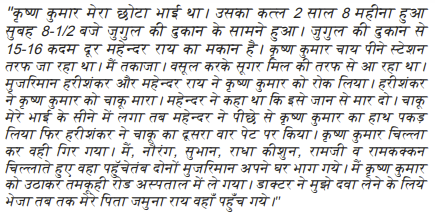
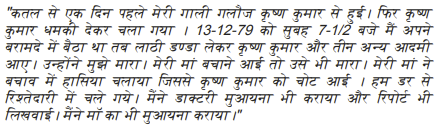
4. The prosecution case as cropped up from the records of both the above appeals is that on a written report given by the informant/P.W.-1 Shivji dated 13th December, 1979 (Exhibit-ka/1), first information report (Exhibit-Ka/8) came to be registered on 13th December, 1979 at 1305 hours at Police Station-Tariya Sujan, District-Deoria against the accused Hari Shanker Rai @ Chhotey and Mahendra Rai under Section 302 of I.P.C. In the written report, it has been alleged by the informant/P.W.-1 that his brother Krishna Kumar was studying in Lok Manya Inter College. The accused Hari Shankar Rai @ Chhotey also studied in the same school. There was a fight between his brother Krishna Kumar and accused Harishanker Rai @ Chhote a few days back over some issue. Because of said fight, on 13th December, 1979 at 08:00 a.m. in the morning, when his brother Krishna Kumar was going to have tea from the western side of the road, while passing in front of the house of Harishankar alias Chhote, he saw that accused Harishanker Rai @ Chhotey and his father Mahendra Rai assaulted his brother Krishna Kumar by knives on his chest and stomach with intention to kill him due to which his brother Krishna Kumar sustained injuries and fell down. Due to noise, Navrang Prasad, Ramji, Subhan, Radha Kishna, Prasad, Kanu and Ram Kankan Ram, the informant and many other persons reached there, by then the accused Harishankar and Mahendra Rai ran away. The informant took his brother Krishna Kumar, who was in a serious condition, to the Government Hospital at Tamkuhi Road for his treatment. The incident has been witnessed by above witnesses and many other people. While the treatment of his brother Krishna Kumar was going, on at the Government Hospital, Tamkuhi Road, his brother succumbed to the said injuries caused by the accused, namely, Harishanker Rai @ Chhotey and Mahendra Rai. After leaving the dead body of his brother at Government Hospital, he came to the Police Station for lodging the first information report.
5. After lodging of the first information report, P.W.-4 Sub- Inspector Ausaf Ahmad Khan, after taking over the charge of Investigating Officer, went to the Government Hospital, where the dead body of the deceased was lying and at about 02:45 p.m. he prepared the inquest report (Exhibit-ka/2) of the body of the deceased. Thereafter P.W.-4 prepared the diagram and chalan (Exhibit-ka/3 and 4). After keeping the dead body of the deceased in a sealed cover, the same was sent to the Mortuary for postmortem.
6. An autopsy of the deceased has been conducted by Dr. C.B. Singh (P.W.-5) on 14th December, 1979 at 11:15 a.m. and in the autopsy report (Exhibit-ka/7), the cause of death of the deceased has been reported to be shoc
AI
The court established that direct eyewitness testimony is paramount in murder cases, and self-defense claims must be substantiated by credible evidence.

The reliability of eyewitness testimony and oral dying declaration in criminal cases, and the reasonableness of delayed recording of police statements.


The appellate court may reverse an acquittal if it determines the trial court's findings are perverse and unsupported by credible evidence, reaffirming the reliance on direct eyewitness testimony.

The principle that mere absconding does not imply guilt unless supported by corroborative evidence was emphasized, reinforcing the standard of proof required in criminal cases.

The court affirmed the conviction for murder based on credible eyewitness testimony and a reliable dying declaration, emphasizing the established motive of caste rivalry.
The court established that eyewitness testimony from related witnesses can be credible and sufficient for conviction, provided it is consistent and corroborated by other evidence, and that the absenc....



An indispensable Tool for Legal Professionals, Endorsed by Various High Court and Judicial Officers
Please visit our Training & Support
Center or Contact Us for assistance

Scan Me!
India’s Legal research and Law Firm App, Download now!


For Daily Legal Updates, Join us on :



 Back to top


