
 Back
Back





IN THE HIGH COURT OF ALLAHABAD
Saral Srivastava, J.
Jamia Urdu Aligarh Regd - Appellant
Vs.
Jamia Urdu Sanstha And Others - Respondent
Second Appeal No. - 352 of 2024
Decided On : 08-05-2024
EVIDENCE - PROOF OF DOCUMENTS - Indian Evidence Act, 1872: Sections 61, 62, 63, 64, 65 - The court discussed the provisions of the Indian Evidence Act regarding the admissibility of secondary evidence. It emphasized that primary evidence is required unless specific conditions for secondary evidence are met. The plaintiff failed to establish a factual foundation for the non-production of original documents, leading to the conclusion that the certified copies could not be admitted as evidence. This legal framework significantly influenced the court's decision to dismiss the appeal.
Fact of the Case:
The plaintiff, a registered educational institution, purchased two plots of land in Aligarh. The defendants allegedly attempted to take possession of a portion of this land based on a fraudulent sale deed. The plaintiff sought a declaration that the defendants' sale deed was invalid and requested an injunction against them.
Finding of the Court:
The Trial Court and First Appellate Court found that the plaintiff failed to prove its title to the property and did not provide sufficient evidence to establish that the societies involved were distinct entities. The courts concluded that the plaintiff's claims were not substantiated by adequate documentation.
Issues: Whether the plaintiff established its title to the property and whether the sale deed executed by the defendants was valid.
Ratio Decidendi: The court held that the plaintiff could not rely on secondary evidence without establishing a factual basis for the non-production of primary evidence. The failure to provide original sale deeds and the lack of evidence regarding the registration of the plaintiff's society were critical in dismissing the appeal.
Final Decision: The appeal was dismissed, with the court concluding that the plaintiff's suit was barred by limitation and lacked merit, resulting in a cost of Rs. 25,000 being imposed on the plaintiff.
JUDGMENT :
Saral Srivastava, J.
1. Heard learned counsel for the appellant.
2. The present appeal has been preferred by the plaintiff/appellant challenging the judgement and decree dated 05.03.2024 passed by the First Appellate Court i.e. Additional District Judge, Court No.14, Aligarh in Civil Appeal No.34 of 2017 as well as judgement and order dated 13.01.2017 passed by the Additional Civil Judge (Senior Division), Court No.2, Aligarh in Original Suit No.914 of 2010.
3. The case of the plaintiff/appellant (hereinafter referred to as 'plaintiff') is that the plaintiff is a registered educational institution having Registration No.625/1983-84 (Renewal No.551/1995) under the Societies Registration Act, 1860, and Smt. Saba Khan is the Registrar of the said institution who is competent to verify and sign the plaint. As per the plaintiff's case, the plaintiff purchased a piece of land measuring 1250.07 square yards out of Khasara No.539 situated at Dhorra Muafi, Pargana & Tehsil Koil, District Aligarh as detailed in Schedule-A at serial no.1 by registered sale deed dated 31.03.1997 executed in pursuance of registered agreement to sale dated 06.03.1997 for a sale consideration of Rs.10,62,500/-.
4. The plaintiff purchased another piece of land measuring 1250.07 square yards abutting the said land towards the southern side of the above land as detailed in Schedule-A at serial No.2 out of Khara No.539 situated at Dhorra Muafi, Pargana & Tehsil Koil, District Aligarh by another sale deed dated 31.03.1997 executed in pursuance to agreement to sell dated 06.03.1997. It is further stated that on 01.06.2010, respondent nos.1 & 2 (defendant first set) and respondent no.3 (defendant second set) (hereinafter referred to as defendant first set and defendant second set) came on the spot and tried to take forcible possession over 111 square yards land out of total land purchased by the plaintiff by the two sale deeds detailed above to raise illegal construction.
5. The further case of the plaintiff is that after getting the knowledge of the sale deed dated 27.12.2001, the plaintiff applied for the certified copy of the said sale deed on 02.06.2010 which was made available to the plaintiff on 05.06.2010. The plaintiff came to know for the first time about the contents of the sale deed and also the fraud and misrepresentation played by the defendant's first set and the defendant's second set in collusion with each other in getting the sale deed dated 27.12.2001 executed.
6. It is further stated that the defendant first set in collusion with the defendant second set created a fake institution in the name of 'Jamia Urdu Sanstha' which is akin to the name of the plaintiff's institution to usurp the property detailed in Schedule-A and to use the registration number of the plaintiff i.e. Jamia Urdu Aligarh. It is further stated that a fraudulent power of attorney was executed on 28.09.2001 in respect of the property of Schedule-A in favour of defendant no.2 (Imran Sabir) who as attorney holder of Jamia Urdu Sanstha, transferred the plot measuring 111 square yards out of Khasra No.539 to the defendant second set detailed at the foot of the plaint as Schedule-B by sale deed dated 27.12.2001.
7. The plaintiff has prayed for the following relief in the aforesaid backdrop:-
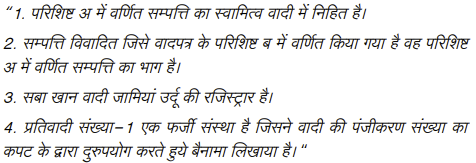
“(A). That a decree for declaration be passed in favour of the plaintiff and against the defendants. It be declared that the alleged sale deed dated 27.12.2001 alleged to be executed by defendant No.1 through defendant No.2 as attorney holder in favour of defendant IInd Set with regard to the property in question as detailed at the foot of the plaint in Schedule 'B' registered in Bahi No.1 Zild No.3236 on pages 505 to 512 at No.221 registered on 10.1.2002 in the office of the sub- Registrar, Koil, Aligarh and the information to this effect be sent to the office of the sub-Registrar, Koil, Aligarh.
(B). That a decree for permanent prohibitory injunction be passed in favour of the plaintiff and aga
AI
The admissibility of secondary evidence under the Indian Evidence Act requires a factual foundation for the non-production of primary evidence, which the plaintiff failed to establish.

The main legal point established in the judgment is the presumption of genuineness attached to a registered document and the burden of proof in challenging its validity.

Admissibility of documents in court proceedings hinges on clear admissions in pleadings, validating secondary evidence despite objections regarding public or private document status under the Indian ....

The court ruled that while a certified copy of a sale deed is admissible as secondary evidence, it does not suffice to prove the execution of the deed, which must demonstrate intention and legal vali....

The application of Section 17 of the Limitation Act to protect the rights of a party defrauded from lapse of time until they remain in ignorance of the fraud, and the presumption of validity of a reg....

The court established that a sale deed can be declared void if proven to be forged, and that limitation does not apply when the party was unaware of the document's existence due to fraud.


Sale deeds must be proved by the signature of the executant as per Section 67 of the Evidence Act, and cannot be admitted without such proof, under Section 91, rendering erroneous decisions based on ....

A certified copy of a registered sale deed is classified as a public document and admissible as secondary evidence without formal proof under relevant provisions of the Evidence Act.



An indispensable Tool for Legal Professionals, Endorsed by Various High Court and Judicial Officers
Please visit our Training & Support
Center or Contact Us for assistance

Scan Me!
India’s Legal research and Law Firm App, Download now!


For Daily Legal Updates, Join us on :



 Back to top


