
 Back
Back





IN THE HIGH COURT OF ALLAHABAD
SARAL SRIVASTAVA, J.
Kammo Since Deceased And Others - Appellants
Versus
Shahmim Ahmad And Another - Respondents
Second Appeal No. 340 of 2024
Decided On : 09-05-2024
WAQF - Waqf Management and Tenancy - Waqf Act, 1995, Section 83; Transfer of Property Act, Section 106 - The court discussed the provisions of the Waqf Act, particularly Section 83, which was amended in 2013, and the Transfer of Property Act, Section 106, regarding tenancy and eviction notices. The court interpreted the waqf deed to determine the legitimacy of the appointment of the Mutawalli and the implications of subletting without consent. The court concluded that the First Appellate Court correctly found that the plaintiff was competent to institute the suit, as the defendants failed to adequately challenge the appointment of the Mutawalli.
Fact of the Case:
The plaintiffs, representing a waqf, sought eviction of the defendants, who were tenants, for non-payment of rent and unauthorized subletting. The trial court dismissed the suit, ruling that the plaintiff's Mutawalli was not validly appointed. The First Appellate Court reversed this decision, finding the appointment valid and the suit maintainable.
Finding of the Court:
The First Appellate Court found that the trial court erred in its interpretation of the waqf deed regarding the appointment of the Mutawalli. It held that the defendants did not adequately challenge the appointment and that the evidence supported the plaintiff's claims.
Issues: Whether the First Appellate Court erred in finding that the plaintiff's Mutawalli was validly appointed and competent to institute the suit, and whether the amendment to Section 83 of the Waqf Act affected the jurisdiction of the civil court.
Ratio Decidendi: The court emphasized that the validity of the Mutawalli's appointment was not sufficiently challenged by the defendants in their written statement, and that the amendment to Section 83 of the Waqf Act did not retroactively affect the jurisdiction of the civil court over the case decided prior to the amendment.
Final Decision: The appeal was dismissed, affirming the First Appellate Court's decision to allow the plaintiff's suit for eviction.
JUDGMENT :
(Saral Srivastava, J.) :
1. Heard Sri Ajay Kumar Sharma, learned counsel for the appellants and Sri Utpal Chatterji, learned counsel for the respondents.
2. The present appeal has been preferred by the defendants/appellants challenging the judgement and decree dated 03.02.2024 passed by the First Appellate Court i.e. Additional District Judge, Court No.20 Meerut in Civil Appeal No.163 of 2011 whereby he has allowed the civil appeal preferred by the plaintiffs/respondents.
3. The brief facts of the case are that plaintiff no.1 is the waqf in the name of Waqful Aulad Kayam Karda of which plaintiff no.2-Shamim Ahmad is the Mutawalli. As per the plaint case, defendants/appellants (hereinafter referred to as "defendants") are the tenants of a land of about 100 yards described at the foot of the plaint. The rent of the land was Rs.5 per month and the registered rent deed dated 18.05.1972 was executed between the plaintiff and defendant no.1 through Mutawalli Suleman (as he then was), who was the elder brother of plaintiff no.2.
4. It is further pleaded that defendant no.1 stopped paying the rent Since July 2002, and he sublet the suit property to Naseem (defendant no.4), Saleem (defendant no.3) and Anees (defendant no.2) without the consent of plaintiff, and subletting of the suit property by defendant no.1 to defendant nos.2 to 4 violated terms and conditions of the rent deed dated 18.05.1972.
5. The plaintiff gave a registered notice dated 25.08.2008 under Section 106 of the Transfer of Property Act to the defendants through the registered post which was served upon them. Another notice dated 25.08.2008 was separately given to defendant nos.2 to 4 asking them to vacate the suit property. The aforesaid notice was replied to by the defendants by stating false and incorrect facts in their reply.
6. In the aforesaid backdrop, the plaintiff prayed for the following relief:-
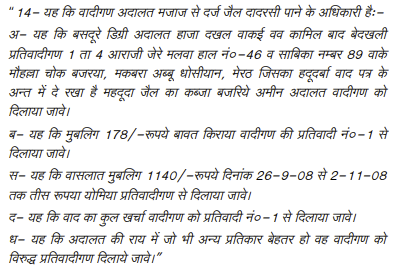
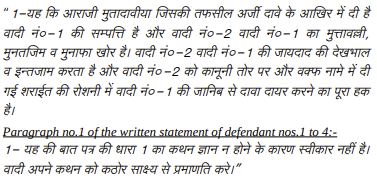
7. The suit was contested by the defendants denying the averments of the plaint contending inter-alia that they have attempted to pay rent by sending the rent to plaintiff, but the plaintiff refused to accept it. It is also pleaded that there is no breach of the terms and conditions of the rent deed. Accordingly, the defendants pleaded that the suit was based on incorrect facts and deserved to be dismissed.
8. The Trial Court framed as many as eight issues. Issue no.1 on which the finding has been assailed by the appellant is relevant and is reproduced below:

9. The Trial Court considered the waqf deed and after analysing the stipulations in the waqf deed, it concluded that according to the waqf deed, the male lenient descendant shall be appointed as Mutawalli. It found that the waqf was created by Dr. Gulam Haidar and after the death of Dr. Gulam Haidar, his eldest son Suleman, the next male lenient descendant was appointed as Mutawalli. The Trial Court further recorded a finding that plaintiff no. 2-Shamim Ahmad was the youngest brother among the three sons of Dr Gulam Haidar namely, Suleman, Usman and Shamim Ahmad, and Usman was next in line being younger to Suleman and elder to plaintiff no.2-Shamim Ahmad after the death of Suleman should have been appointed as Mutawalli, therefore, plaintiff no.2 could not have been appointed as Mutawalli. Thus, plaintiff no.2 as Mutawalli of plaintiff no.1 was not competent to institute the suit for eviction. Consequently, the Trial Court dismissed the suit.
10. The plaintiff/respondent being aggrieved by the order of the Trial Court preferred civil appeal before the First Appellate Court which was allowed by the First Appellate Court and the suit of the plaintiff was decreed.
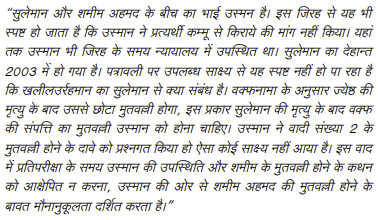
11. The First Appellate Court held that the finding of the Trial Court that plaintiff no.2 could not have been appointed as Mutawalli as after the death of Suleman, Usman being younger to Suleman and elder to plaintiff no.2 should have been appointed as Mutawalli is erroneous and illegal.
12. In recording the aforesaid finding, the First Appellate Court
AI
The court established that a party must specifically plead challenges to the appointment of a Mutawalli in a waqf case, and that amendments to the Waqf Act do not retroactively affect cases already a....

The court upheld the authority of an appointed Mutawalli to file suit on behalf of a waqf, affirming that absence of objection from rightful successors negates claims of illegitimacy in appointment.

The judgment establishes the principle that a petitioner must demonstrate a direct injury or violation of legal rights to have locus standi to challenge an act, and waiver of specific rights may impa....


The main legal point established in the judgment is the lack of clear guidelines for the appointment of Mutawalli, leading to biased and arbitrary decisions by the Wakf Board, and the intervention of....



An indispensable Tool for Legal Professionals, Endorsed by Various High Court and Judicial Officers
Please visit our Training & Support
Center or Contact Us for assistance

Scan Me!
India’s Legal research and Law Firm App, Download now!


For Daily Legal Updates, Join us on :



 Back to top


