
 Back
Back





IN THE HIGH COURT OF ALLAHABAD
ASHWANI KUMAR MISHRA, MOHD. AZHAR HUSAIN IDRISI, JJ.
Irfan Ahmed alias Guddu – Appellant
Versus
State of Uttar Pradesh – Respondent
Criminal Appeal No. 1990 of 2023
Decided On : 30-04-2024
CRIMINAL LAW - MURDER AND KIDNAPPING - IPC SECTIONS 364, 302, 201; ARMS ACT SECTION 4/25 - The court examined the application of Sections 364 (kidnapping), 302 (murder), and 201 (causing disappearance of evidence) of the IPC, along with Section 4/25 of the Arms Act. The court emphasized the necessity of establishing a complete chain of circumstantial evidence to prove guilt beyond reasonable doubt. It highlighted the importance of reliable witness testimony, proper recovery procedures, and the need for corroborative evidence, particularly in cases relying on circumstantial evidence. The court found significant lapses in the prosecution's case, including failure to establish the identity of the deceased and the credibility of witness statements, leading to the conclusion that the prosecution did not meet its burden of proof.
Fact of the Case:
The accused, Irfan Ahmed, was convicted for the murder of his cousin, Farhat Fatima, whose decomposed body was found after she went missing. The prosecution's case was based on circumstantial evidence, including the accused's alleged confession and the recovery of body parts and personal items. The defense argued that the evidence was insufficient and unreliable.
Finding of the Court:
The court found that the prosecution failed to establish a complete chain of circumstantial evidence linking the accused to the crime. Key evidence, including the identity of the deceased and the circumstances surrounding the recovery of the body, was deemed unreliable. The court noted significant procedural lapses in the investigation and the lack of independent witnesses to corroborate the prosecution's claims.
Issues: Whether the prosecution established the guilt of the accused beyond reasonable doubt through circumstantial evidence, and whether the evidence presented was credible and reliable.
Ratio Decidendi: The court reiterated that in cases based on circumstantial evidence, the prosecution must establish a complete chain of events that excludes any reasonable doubt regarding the innocence of the accused. The court emphasized the need for corroborative evidence and proper adherence to legal procedures in the collection and presentation of evidence.
Final Decision: The appeal was allowed, the conviction and sentence of the accused were set aside, and he was ordered to be released unless wanted in another case.
JUDGMENT :
ASHWANI KUMAR MISHRA, J.
1. This appeal is by the accused Irfan Ahmed Alias Guddu challenging his conviction and sentence vide judgment and order dated 13.01.2023, passed by the Additional Sessions Judge, Court No. 1, Fatehpur in Sessions Trial No. 06 of 2012 arising out of Case Crime No. 383 of 2011, under Sections 364, 302, 201 IPC and in Sessions Trial No. 07 of 2012, arising out of Case Crime No. 385 of 2011, under Section 4/25 Arms Act, Police Station Kotwali, District Fatehpur; whereby he has been sentenced to ten years rigorous imprisonment alongwith fine of Rs.5000/- coupled with a default sentence of six months imprisonment under Section 364 IPC; life imprisonment alongwith fine of Rs. 25000/-coupled with a default sentence of one year imprisonment under Section 302 IPC; three years imprisonment alongwith fine of Rs. 2000/-coupled with a default sentence of three months under Section 201 IPC and four months imprisonment alongwith fine of Rs. 400/-coupled with a default sentence of one month imprisonment under Section 4/25 Arms Act. All the sentences are directed to run concurrently.
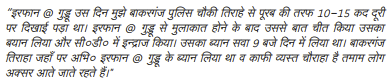
2. This is a case where a young lady had gone missing and later her decomposed body, cut in pieces, was allegedly recovered on the pointing out of the accused appellant Irfan. The deceased was the cousin of accused. The prosecution case is based on circumstantial evidence and the question for consideration in this appeal is as to whether the prosecution has successfully connected the chain of events so as to establish the hypothesis of guilt attributed to the accused appellant and that no alternative hypothesis, consistent with the innocence of accused, exists. The correctness of conclusions drawn by the trial court, on this aspect, is under challenge.
3. Basis of prosecution case in the present case is a written report of the father of the deceased (informant) Kamrulhuda, wherein he informed that he is resident of 517 Maswani, District Fatehpur. His daughter Km. Farhat Fatima @ Jeenat (deceased), aged 28 years had completed her M.A., B.Ed. and was preparing for PCS Examination. On 29.8.2011 at about 12.30 in the afternoon, she had gone to get medicines for herself, but did not return. While going to the market she had taken her mobile No. 08957088397. Despite frantic efforts she could not be traced. Informant apprehended that as accused Irfan Ahmad @ Guddu was after her, as such, he was responsible for the disappearance of his daughter. Although efforts were made by the informant as well as family members Zafar Alam and Mohammad Ahmad to counsel accused Irfan but it yielded no result. The informant apprehended that his missing daughter has been taken by the accused somewhere. Prayer was accordingly made to investigate the matter and trace out informant’s daughter Farhat Fatima @ Jeenat.
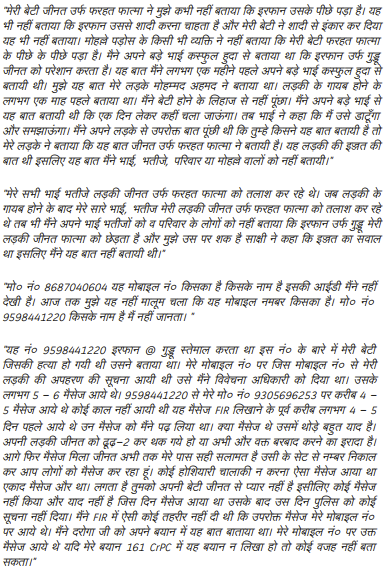
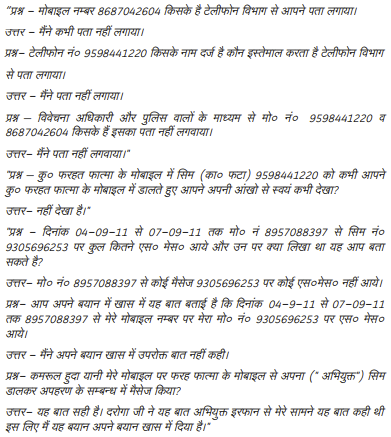
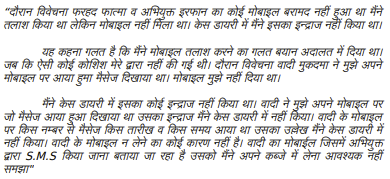
4. On the basis of the above written report a first information report came to be lodged on 8.9.2011 at 7.05 am as Case Crime No. 383 of 2011, under Section 364 IPC. Investigation proceeded in the matter and based upon the FIR allegations as well as the statement of informant recorded under Section 161 Cr.P.C. the Investigating Officer proceeded in the matter. The I.O. could find the accused appellant near Bakarganj Tiraha upon the pointing out of the informant. The accused was moving from Bakarganj to Jwalaganj. The accused was intercepted and taken to the side for questioning by the I.O. at about 13.10 hours on 8.9.2011. The accused was confronted with the fact that he had used his SIM in the mobile phone of missing girl to send SMS to her father between 4.9.2011 to 7.9.2011 and had also called Farhat Fatima twice on 29.8.2011 from his mobile whereafter she has gone missing. On hearing it and seeing the call detail record the accused broke and confessed that Farhat Fatima is no longer alive. The confessional statement of accused was allegedly recorded whereafter he (accused) offered to provide the dead body of Farhat Fatima. He also informed the I.



AI
In criminal cases relying on circumstantial evidence, the prosecution must establish a complete and unbroken chain of evidence that excludes all reasonable hypotheses of innocence, and any procedural....
The prosecution must establish its case beyond reasonable doubt, and procedural safeguards for evidence recovery must be strictly adhered to for admissibility.


Circumstantial evidence can establish guilt if it forms a complete chain pointing to the accused, even without direct evidence.

The prosecution must establish an unbroken chain of evidence beyond reasonable doubt for conviction, failing which the accused is entitled to acquittal.


The court ruled that circumstantial evidence must establish a consistent and unbroken chain linking the accused to the crime, and any reliance on unreliability of recovery evidence warrants the benef....



An indispensable Tool for Legal Professionals, Endorsed by Various High Court and Judicial Officers
Please visit our Training & Support
Center or Contact Us for assistance

Scan Me!
India’s Legal research and Law Firm App, Download now!


For Daily Legal Updates, Join us on :



 Back to top


