
 Back
Back





IN THE HIGH COURT OF ALLAHABAD
SIDDHARTHA VARMA, VINOD DIWAKAR, JJ.
Ram Krishna – Appellant
Versus
State of U.P. – Respondent
Criminal Appeal No. 748 of 1983
Decided On : 05-11-2024
Indian Penal Code, 1860 - Section 302 - Arms Act, 1959 - Section 25 - Conviction for murder and illegal possession of firearm - The trial court convicted the accused based on eyewitness testimony, but the appellate court found the evidence insufficient and unreliable due to contradictions and lack of corroboration. (Paras 25, 26)
Facts of the case:
The accused was charged with murdering Bahadur, allegedly due to a land dispute involving the deceased's employer. Eyewitnesses testified to the incident, but inconsistencies arose regarding their reliability. (Paras 4, 5, 10)
Findings of Court:
The appellate court determined that the conviction was unsafe based on the quality of evidence presented, particularly the testimony of the main eyewitness, which was deemed neither wholly reliable nor wholly unreliable. (Paras 25, 26)
Issues: The main issues included the credibility of eyewitness testimony and the adequacy of evidence to support the conviction. (Paras 25, 26)
Ratio Decidendi: The court emphasized that a conviction cannot be based solely on unreliable testimony and that the prosecution must establish guilt beyond reasonable doubt. (Paras 25, 26)
Result: The conviction and sentence were set aside, and the accused was acquitted of all charges. (Para 27)
JUDGMENT :
VINOD DIWAKAR, J.
1. Heard Shri Ram Kishor Gupta, learned counsel for the appellant, Shri Amit Sinha, learned A.G.A. assisted by Ms. Mayuri Mehrotra, learned brief holder for the State-respondent, and perused the record.
2. Upon completing the investigation in Case Crime No. 49 of 1981, u/s 302 IPC and in Case Crime No. 51 of 1981, u/s 25 of Arms Act, both registered at P.S. Kharela, District Hamirpur, the police filed the charge-sheet against the accused-appellant Ram Krishna and he was charged u/s 302 IPC and section 25 of Arms Act respectively, wherein, he denied the prosecution case and claimed trial.
3. The learned trial court vide impugned judgment and order dated 8.3.1983 convicted the accused-appellant Ram Krishna, and sentenced him to undergo life imprisonment for the offenses under Sections 302 IPC and section 25 of the Arms Act. Aggrieved by the impugned judgment of conviction and order of sentence, the accused-appellant preferred the instant appeal before this Court.
4. The prosecution case, in brief, is that a written complaint was lodged at Police Station Kharela, District Hamirpur, on 11.8.1981 at 17:30 p.m. regarding an incident took place in broad day light in Mohalla Manik Kasba Kharela, by one Siddha-father of the deceased-Bahadur with the allegation that the accused Ram Krishun Singh called his son Bahadur at gate and when his son reached at the gate of his house, he shot dead his son with a double barrel gun. On hearing the rescue cry by the complainant, Murli s/o Bhannu Teli, Ram Asrey s/o Daya Ram Teli, Ram Ratan s/o Buddh Kori also reached at the place of incident. The deceased died on spot. For clarity the contents of tehrir are reproduced herein below:
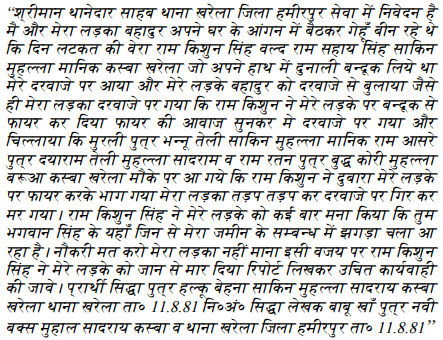
5. The motive assigned in the tehrir is that the deceased- son of the complainant was working with one Bhagwan Singh, who had a land dispute with the accused and the accused has reprimanded the complainant’s son not to work with one Bhagwan Singh or else he would be killed.
6. On receipt of the information, after registration of the FIR, the police conducted the investigation and recorded the statement of the witnesses under section 161 Cr.P.C. and filed the charge-sheet against the accused-appellant.
7. The Chief Judicial Magistrate took the cognizance and after complying with the provisions of section 207 Cr.P.C. committed the case to the court of sessions for its trial. The trial court framed the charge under section 302 IPC against the accused-appellant and a separate charge was framed under section 25(1)(a) and 25(1)(b) of the Arms Act and the same was read over and explained to the accused, who pleaded not guilty and claimed trial.
8. The prosecution has produced the following documentary evidence to prove its case:
“(i) Written Report dated 11.8.1981 marked as exhibited as Ex.Ka-1
(ii) First Information Report dated 11.8.1981, marked and exhibited as Ex.Ka-2
(iii) First Information Report dated 25.8.1981, marked and exhibited as Ex.Ka-18
(iv) Recovery memo of 12 bore pistol dated 25.8.1981, marked as exhibited at Ex.Ka-18
(v) Recovery memo of blood stained vest & ‘Gamchha’ dated 11.8.1981 marked and exhibited as Ex.Ka-10
(vi) Recovery memo of one pellet dated 11.8.1981 marked and exhibited as Ex.Ka-11
(vii) Recovery memo of plain and blood stained soil dated 11.8.1981 marked and exhibited as Ex.Ka-14
(viii) Recovery memo of 12 bore pistol dated 25.8.1981, marked as exhibited at Ex.Ka-4
(ix) Post-mortem report dated 12.8.1981 marked and exhibited as Ex.Ka-6
(x) Report of Vidhi Vigyan Prayogshala marked and exhibited as Ex.Ka-24
(xi) Letter to chemical examiner dated 12.8.1981
(xii) Report of Chemical examiner marked and exhibited as Ex.Ka-26
(xiii) Panchayatnama dated 11.8.1981 marked and exhibited as Ex.Ka-7
(xiv) Charge-sheet ‘mool’ dated 11.10.1981 marked and exhibited as Ex.Ka-17
(xv) Charge-sheet ‘mool’ dated 23.9.1981 marked and exhibited as Ex.Ka-20”
9. Besides the above documentary evidence, the prosecution has examined the complainant- Siddha as PW-1;
AI
A conviction cannot be sustained on unreliable eyewitness testimony; the prosecution must prove guilt beyond reasonable doubt.

The court ruled that the prosecution failed to prove the accused's guilt beyond a reasonable doubt due to unreliable eyewitness testimony and insufficient evidence.

The judgment underscores the principle that a conviction cannot be based solely on the testimony of a single witness unless it is wholly reliable and corroborated by other evidence.

Murder – It is duty of prosecution to establish use of weapon discovered in commission of crime – Failure to do so may cause aberration in course of justice.

The court established that the reliability of eyewitness testimony is crucial for a conviction, and the absence of corroborative evidence, along with significant contradictions in the testimony, can ....

Court affirmed the conviction for murder based on the credible testimony of a sole eyewitness, emphasizing that absence of motive does not negate established guilt.

Mere failure of the prosecution in producing reports from the Forensic Science Laboratory relating to the weapon of offence and the blood-stained earth and clothes would not derogate from the veracit....

Conviction under Section 302/34 IPC unsustainable on uncorroborated, contradictory testimony of interested sole eyewitness; benefit of reasonable doubt mandates acquittal where prosecution fails to p....
A conviction can be sustained on the sole testimony of a reliable witness, especially when corroborated by medical evidence, and the presence of adequate light at the scene can validate eyewitness id....



An indispensable Tool for Legal Professionals, Endorsed by Various High Court and Judicial Officers
Please visit our Training & Support
Center or Contact Us for assistance

Scan Me!
India’s Legal research and Law Firm App, Download now!


For Daily Legal Updates, Join us on :



 Back to top


