
 Back
Back





IN THE HIGH COURT OF ALLAHABAD
NAND PRABHA SHUKLA, J.
Vishram Singh – Petitioner
Versus
State of Uttar Pradesh – Respondent
Matters Under Article 227 No. 9376 of 2024
Decided On : 13-09-2024
(A) Constitution of India - Article 227 - Advocates Act, 1961 - Section 32 - Non-advocates representation - The court clarified that non-advocates may be permitted to represent parties in specific cases, considering their antecedents and the nature of the request. Previous permissions granted to the petitioner were noted, leading to the conclusion that the rejection of the application was unjustified. (Paras 5, 6, 8, 9)
(B) Interpretation of 'particular' - The court found that the term 'particular' refers to a specific case, and the previous permissions granted to the petitioner indicated sufficient experience to represent the party. (Paras 8, 9)
Facts of the case:
The petitioner sought to represent Anand Kumar Rajpoot in a criminal case where no advocate was willing to contest due to the aggressive nature of the opposing counsel. The Sessions Judge rejected the application citing lack of a Power of Attorney and legal qualifications.
Findings of Court:
The court found the rejection of the application to be incorrect and noted the petitioner's prior experience in similar roles.
Issues: The main issue was whether a non-advocate could represent a party in court and under what circumstances permission could be granted.
Ratio Decidendi: The court ruled that non-advocates could be allowed to represent parties in specific cases, emphasizing the need for a case-by-case assessment of their qualifications and the context of the request.
Result: The order rejecting the application was set aside, allowing for a fresh application to be considered.
JUDGMENT :
NAND PRABHA SHUKLA, J.
1. Heard Sri Vishram Singh (petitioner in person), Sri R.K. Verma, learned AGA for the State and perused the record.
2. The present writ petition under Article 227 of the Constitution of India has been filed with the following prayers:
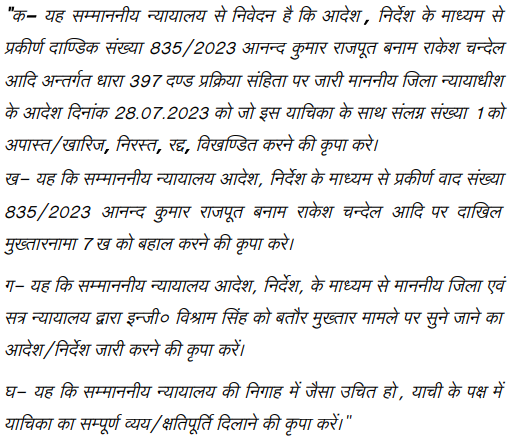
3. It has been submitted by Engr. Vishram Singh (petitioner in person) that he wants to appear as an Agent/Attorney to conduct and argue the case on behalf of Anand Kumar Rajpoot in Case Crime No. 04/2022 under Sections 504, 506 IPC, Police Station Swaroop Nagar, District Kanpur Nagar, Case No. 92145/2022 pending before learned Additional Chief Metropolitan Magistrate-II, Kanpur Nagar.
4. In the matter in hand one Rakesh Chandel who is an Advocate filed the case against Anand Kumar Rajpoot. As the said Advocate was an aggressive person, therefore, no Advocate agreed to contest on behalf of Anand Kumar Rajpoot. Accordingly, he wanted to engage Engr. Vishram Singh as Mukhtar/Attorney to conduct his case and moved an application 7-Kha with a prayer to appoint Engr. Vishram Singh as his Agent/Attorney to conduct and argue the case but the learned Sessions Judge, Kanpur Nagar, vide order dated 28.7.2023, had rejected the application on following grounds:
(i) That no Power of Attorney was executed by Anand Kumar Rajpoot in favour of Engr. Vishram Singh as the same was not kept in the file.
(ii) That no document was filed which could portray his legal knowledge nor any certificate which could exhibit education of law or its any branch.
(iii) It was also rejected on the ground that in the case in hand Engr. Vishram Singh was professing practice of law under the laxity of provisions by which a private person may be permitted to appear before the Court.
5. Engr. Vishram Singh has placed reliance upon a judgment of Hon'ble Supreme Court as rendered in A.C. Narayanan vs. State of Maharashtra, AIR 2014 SC 630 and Harishankar Rastogi vs. Girdhari Sharma, 1978 AIR SC 1019 wherein it has been held that: “a question for decision before the Hon'ble Supreme Court was whether a person who is not an advocate by profession can be permitted to plead on behalf of the petitioner. It has been held that it is open to a person who is party to a proceeding to get himself represented by non-advocates in a particular instance or case. Practicing a profession means something very different from representing some friend or relation on one occasion or in one case or on a few occasions of in a few cases. In the present instance, permission is sought for presentation through a non-advocate. It is absolutely clear that any one who is not an advocate, can not as of right, rise himself into this Court and claim to plead for another. Permission may however be granted by this Court taking the justice of the situation and several other factors into consideration for non-professional representation. This approach accords with the policy of the Criminal Procedure Code (I am concerned with a criminal proceeding here) as spelt out in Section 2(q). A pleader by definition, includes any person other than one authorized by law to practise in a court. If he is appointed with the permission of the court, to act in a particular proceeding. This Court's power may well be exercised in regulating audience before it in tune with the spirit of Section 2(q) of the Code.”
6. Simultaneously Section 32 of the Advocates Act, 1961 it provides that:
“Notwithstanding anything contained in this Chapter, any court, authority, or person may permit any person, not enrolled as an advocate under this Act, to appear before it or him in any particular case.”
7. Thus, the aforesaid provision gives power to the Court to permit non-advocates to appear in person in certain case. The said permission can be granted by the Court after considering certain factors such as the non-advocate's antecedents, their relationship with the party and the reasons for requesting the non-advocate's services and other relevant circumstances. The Court may grant permis
AI
Non-advocates may represent parties in court under specific circumstances, subject to judicial discretion and prior experience.

A power of attorney holder requires prior court permission to represent a party in court, emphasizing the distinct roles of licensed advocates and non-advocates in legal proceedings.

Right to appear before Court – Power of attorney holder cannot appear in Court on behalf of another, unless permitted by Court under Section 32 of Advocates Act, 1961.


A proclaimed offender cannot seek quashing of the FIR on the basis of a compromise, unless there are compelling circumstances such as being a minor, insane, or suffering from a disability.

The denial of permission to a Government Pleader to defend criminal cases against the Government within his district is justified to prevent conflicts of interest, while allowing exceptions for cases....


The main legal point established is that an advocate cannot act in the dual capacity of a power of attorney holder and an advocate, as it is contrary to the provisions of the Advocates Act, 1961.

A private individual can conduct prosecution in a Magistrate's Court under Section 302 of the CrPC, provided the court grants permission, distinguishing this from the role in Sessions Courts.



An indispensable Tool for Legal Professionals, Endorsed by Various High Court and Judicial Officers
Please visit our Training & Support
Center or Contact Us for assistance

Scan Me!
India’s Legal research and Law Firm App, Download now!


For Daily Legal Updates, Join us on :



 Back to top


