
 Back
Back





IN THE HIGH COURT OF ALLAHABAD
MANISH KUMAR, J.
Phool Chand And 2 Others - Petitioners
Versus
Deputy Director of Consolidation Dist. Ayodhya And Another - Respondents
WRIT B NO. 461 OF 2024.
Decided On : 01-05-2024
JUDGMENT
Manish Kumar, J.
Heard learned counsel for the petitioners, Sri. Hemant Kumar Pandey, learned Standing Counsel for the State and Sri. Durga Prasad, learned counsel for the respondent no. 2, who has filed the Caveat in the present writ petition.
2. This Court at the very beginning had asked learned counsel for the respondent that whether he wants to file any counter affidavit or is ready to argue the matter finally, he has submitted that he is ready to argue the matter finally without any counter affidavit.
3. The present writ petition has been preferred for quashing of the impugned revisional order dated 08.01.2024 passed by respondent no. 1/ Deputy Director of Consolidation, District Ayodhya in Revision No. 424/2014530423000029 (Hari Prasad v. Ram Chet) relating to village Jarahi, Pargana Amsin, Tehsil Sadar, District Ayodhya/Faizabad.
4. Learned counsel for the petitioners has submitted that the name of the petitioners have already been entered in the Khatauni of 1359 fasli and the petitioners have been in continuous possession of Khata Nos. 301 & 97.
5. It is further submitted that the second consolidation proceedings had started in 1980s and in the consolidation proceedings, the respondent no. 2 had filed an objection under Section 9-A(2) of the U.P. Consolidation of Holdings Act, 1953 (hereinafter referred to as the Act, 1953) claiming the co-tenancy either in full or in the ratio of 1/2:1/2 on Khata Nos. 301 & 97 situated at village Jarahi, Pargana Amsin, Tehil Sadar, District Ayodhya/Faizabad, on the basis of succession/co- tenancy as it is an ancestral property. The said claim was rejected by the Consolidation Officer by its order dated 25.01.1999. Against the order dated 25.01.1999, the respondent no. 2 had preferred an appeal, which was also dismissed on 14.07.2003. Against the appellate order dated 14.07.2003, the respondent no. 2 (Hari Prasad Maurya) had preferred a revision under Section 48 of the Act, 1953 which was allowed by the impugned order dated 08.01.2024 against which the present writ petition has been preferred.
6. It is further submitted that as per the pedigree which is mentioned in Para 6 of the writ petition which is not disputed by respondent no. 2, the petitioners are sons of Late Ram Chet meaning hereby that petitioners belong to the family of Late Lochan, the elder son of Late Sahai and respondent no. 2 (Hari Prasad) belongs to the family of Late Juravan, the second son of Late Sahai.
7. For convenience, the pedigree mentioned in para 6 of the writ petition is described hereinbelow:-
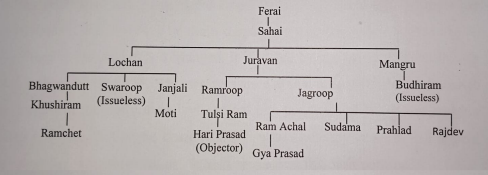
8. It is further submitted that the respondent no. 2 had filed an objection under Section 9-A(2) of the Act, 1953 and the same has rightly been rejected by the Consolidation Officer on the ground that after completion of earlier consolidation proceedings, the khataunis of 1359 fasli were prepared separately as far as the families of eldest son of Sahai to which the petitioners belong and the second son of Sahai to whom the respondent no. 2 belongs mentioning therein the khata numbers. The name of the father of the petitioners was entered in the khatauni of 1359 fasli and the names of predecessors of respondent no. 2 have been entered regarding different Gata numbers.
9. It is further submitted that after the entry in the khatauni of 1359 fasli in the revenue records, either the predecessors of the respondent no. 2 or the respondent no. 2 have never ever challenged the same and during the consolidation proceedings, which were started in 1980s, the objection was filed and it has rightly been rejected by the Consolidation Officer and upheld by the appellate court.
10. It is further submitted that the revisional court had ignored all these facts which has been mentioned in the order of the Consolidation Officer and passed an order in favour of the respondent no. 2 directing therein for entry of the name of respondent no. 2 in khata no. 301 & 97 as a co-tenure holder as it is an ancestral property.
11. It is furth
AI
The onus of proving property as ancestral lies with the claimant, requiring evidence of purchase from Joint Hindu Family funds, not merely acceptance of a family tree.

Living together does not imply joint ownership of property; independent possession negates jointness.

The burden of proof for exclusive property rights lies with the claimant, and mere entries in records are insufficient to establish ownership without supporting evidence.
The court emphasized the necessity of establishing evidence for claims of co-tenancy and inheritance, ruling that the Deputy Director's findings lacked sufficient support.
To establish co-tenancy rights, claimants must prove that the ancestral holdings have remained intact and unchanged; drastic changes negate such claims.
To establish co-tenancy rights in ancestral property, claimants must prove the unbroken identity of the holding over time, which the petitioners failed to do.
The revisional court exceeded its jurisdiction by altering the share of co-tenancy in ancestral property, which was affirmed by the appellate court.
The burden of proof lies with petitioners to establish their lineage and co-tenancy rights, which they failed to do, resulting in dismissal of the petition.
The burden of proof lies on the party asserting that property is joint family property, and mere existence of a joint family does not create a presumption of joint ownership.
The Revisional Authority must provide sound reasoning when reversing lower court findings; mere admissions without corroborating evidence are insufficient to establish claims of ownership.



An indispensable Tool for Legal Professionals, Endorsed by Various High Court and Judicial Officers
Please visit our Training & Support
Center or Contact Us for assistance

Scan Me!
India’s Legal research and Law Firm App, Download now!


For Daily Legal Updates, Join us on :



 Back to top


