
 Back
Back





IN THE HIGH COURT OF ALLAHABAD
AJIT KUMAR, J.
Manoj Kumar Rai - Appellant
Versus
State of U.P. and others - Respondents
Civil Misc. Writ Petition Nos. 32169, 37891, 32670, 50403, 50459, 37890, 25052, 19373, 15360, 18462, 42516, 52563, 53574, 61963 and 42514 of 2017
Decided on : 31-05-023
JUDGMENT :
Hon'ble Ajit Kumar, J.- Heard Sri Ashok Khare, learned Senior Advocate assisted by Sri Dharmendra Singh, learned counsel for the petitioners and learned Standing Counsel apperaing for the State respondents.
2. Learned counsel for the respective petitioners in the connected matters have adopted the arguments of Sri Ashok Khare, learned Senior Advocate.
3. The petitioners have envoked extraordinary jurisdiction of this Court under Article 226 of the Constitution of India asking for a judicial review of the decision taken by the State Government under its order dated 16.3.2017 to dispense with the services of all those drivers who were appointed in violation of the provisions contained under the U.P. Subordinate Services Selection Commission Act, 2014 and the Government Order dated 18.12.2014.
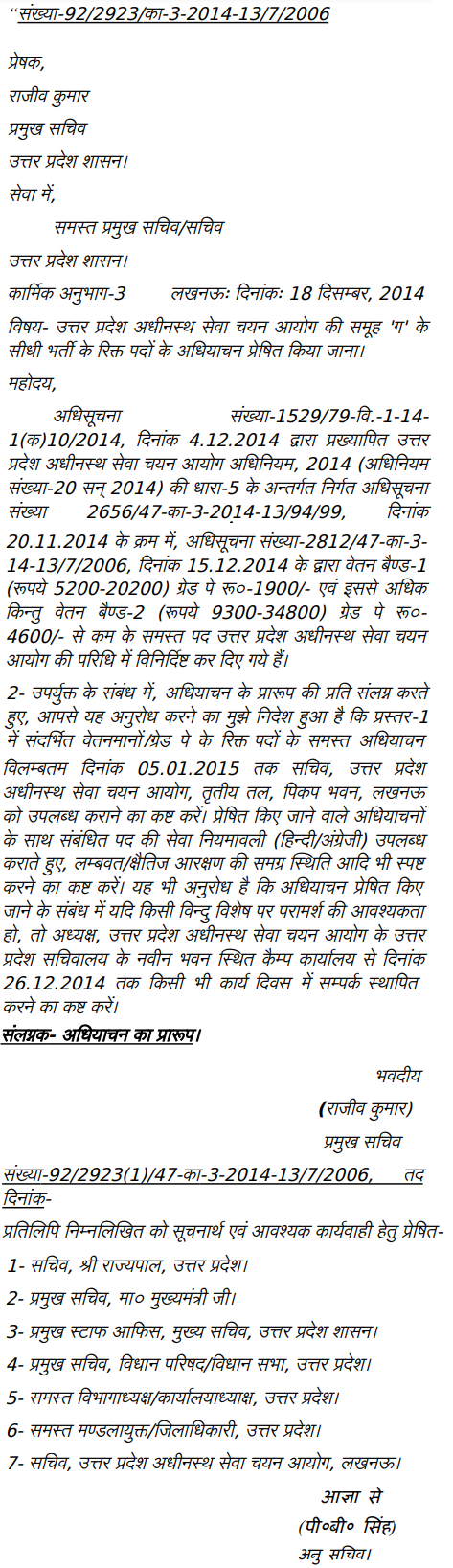
4. The reason assigned in the order impugned is that all such selections were made wholly illegally for want of authority and, therefore, appointments deserved to be cancelled. The Government Order that has been relied upon in the order passed by the Secretary to the State Government is the one which provided that all the posts falling in Group-C in the pay band of ''Rs.5200-20,200/-'' Grade Pay Rs. 1900 and above but below pay band of ''Rs.9300-Rs.34,800/-'', Grade Pay Rs. 4600/-, would fall within the purview of U.P. Subordinate Services Selection Commission created under the U.P. Subordinate Services Selection Commission Act, 2014 (Act No. 20 of 2014) notified by the State Government vide gazette notification dated 4.12.2014. The Government Order also provided for all the Chief Secretaries and the Secreteries of the Government of Uttar Pradesh to make requisition of all such available vacancies by 5.1.2015. Every details of reservation etc. both vertical and horizontal were also required to be taken note of. It is pursuant to the order passed on 16.3.2017 impugned in the writ petition that consequential order has been passed by the Director (Administration), Medical and Health Services, Uttar Pradesh, Lucknow on 3.4.2017.
5. Learned Senior Counsel appearing for the petitioners, has raised two fold arguments for assailing the order:
(I). The appointments to the post in question are governed under U.P. Government Department Driver Service (3rd Amendment) Rules, 2013 which have been framed under proviso to Article 309 of the Constitution and since the Rules are still in force, by no means of a Government Order, such rules can be overidden or repealed or even any provision thereof and hence the respondents were not justified in passing the order holding the appointments in question to be illegal only for reason that such posts were required to be requisitioned to the U.P. Subordinate Services Selection Commission under a Government Order dated 18.12.2014; and
(II). The petitioners were bona fide applicants against duly advertised vacancies and have been appointed after undergoing the selection process which was held as per the procedure prescribed under the Rules and, therefore, the services of the petitioner could not have been terminated by an executive fiat and that too without complying with the principles of natural justice.
6. Per contra, it has been argued by learned Standing Counsel that I). Once the State Government had enacted a law passed by a competent legislature to make selection as per the procedure prescribed therein and the fact that the Board had been constituted, the requisitioning of the vacancies to the Board was only a ministerial act and so the Recruitment Rules would be taken to have been superseded to the extent provided for under an Act passed by a competent legislature.
(II). It is also argued by learned Standing Counsel that since the power to make appointments on Group-C posts falling in a particular pay band and pay grade vested with the Commission constituted under the Act No. 20 of 2014, any appointment made by an authority upon a recommendation made by an authority other than the Commission, would be illeg

AI
Executive orders cannot override statutory provisions, and appointments made outside prescribed authority are rendered void ab initio.
The State's authority to cancel a selection process can be judicially reviewed on the touchstone of reasonableness, and the cancellation must be based on relevant factors and not mala-fide or arbitra....

Lt. Governor competent to frame recruitment rules for UT subordinate services under Article 309 proviso; cadre restructuring/abolition of posts is executive policy not amenable to judicial review abs....


Post of Senior Clerk/Assistant Treasury Accountant Qualifications - It is settled law that there is no legal right vested in candidates to be selected for appointment - Selected candidates have only ....

Point of Law : Court need not issue a writ merely because there is violation of the natural justice, not because it is not necessary to observe natural justice but because Courts do not issue futile ....


The appointment of an authorized controller under the U.P. Intermediate Education Act must adhere to principles of natural justice, requiring the decision-maker to provide a fair hearing and avoid bi....



An indispensable Tool for Legal Professionals, Endorsed by Various High Court and Judicial Officers
Please visit our Training & Support
Center or Contact Us for assistance

Scan Me!
India’s Legal research and Law Firm App, Download now!


For Daily Legal Updates, Join us on :



 Back to top


