
 Back
Back





IN THE HIGH COURT OF ALLAHABAD
SAURABH SHYAM SHAMSHERY, J.
Smt. Kela and another - Appellants
Versus
Jahangir Singh and others - Respondents
Civil Misc. Writ Petition No. 3538 of 1982
Decided on : 17-12-2024
JUDGMENT :
Hon'ble Saurabh Shyam Shamshery, J.-Heard Sri K.M. Garg, learned counsel for petitioners and Sri Syed Ashraf Ali, learned counsel for respondent No. 1.
2. In the present case, contesting original respondent has filed a Suit under Section 229-B of U.P.Z.A. and L.R. Act, 1950 (for short ''Act of 1950'') against original Petitioners-1 and 2 for declaration that he was a co-tenure holder in suit property with defendants. The Suit was dismissed vide order dated 23.6.1970. In said Suit, following 5 issues were framed :
''1. Whether plaintiff is co-tenure holder with defendants No. 1 and 2 in the land in suit?
2. Whether defendants No. 1 and 2 are sole sirdar in the land in suit?
3. Whether suit is barred under Order IX Rule 8 CPC?
4. Whether suit is barred by res-judicata?
5. What relief, if any, is the plaintiff entitled?''
3. Issues No. 3, 4 and 5 were not pressed and only issues No. 1 and 2 were decided. For reference, relevant part thereof is quoted below :
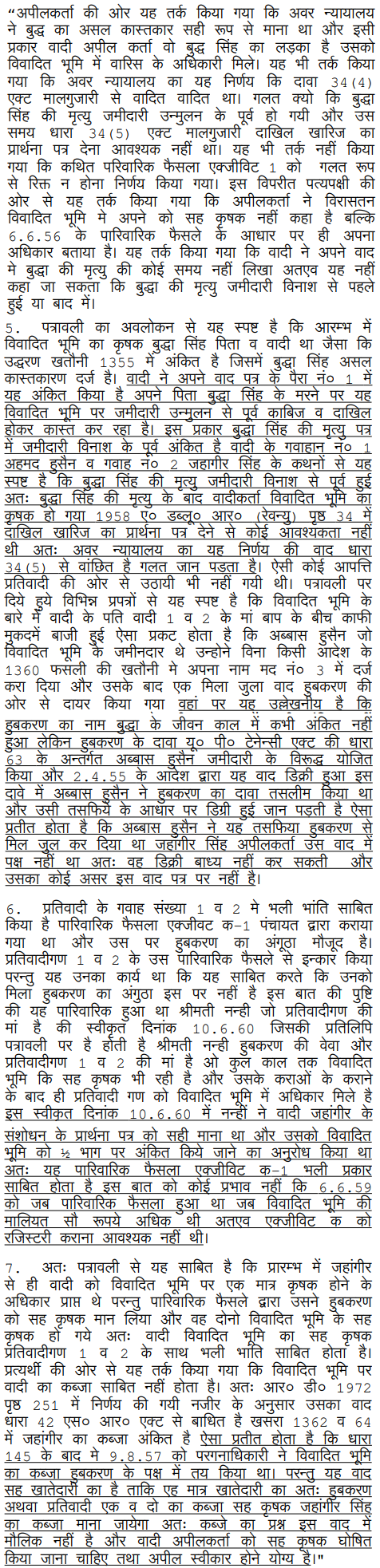
''The first point to be seen is whether plaintiff can acquire sirdari rights by succession as son of Budha because Budha was admitted as tenant of this land. In my opinion, Budha was tenant of this land and so far his death, plaintiff automatically became sirdar of this land. However, the plaintiff has not reported succession as required by U.P. Land Revenue Act and so the Court is precluded for taking cognizance of the case on this point because it is barred under Section 34(5) of U.P. Land Revenue Act. No doubt, the defendants have not taken any objection on this point but this being a legal point and so it has been taken. Plaintiff is said to have filed an application but there is no document to support it. Therefore, the claim of the plaintiff as sole sirdar of the land cannot be recognized. Besides has not pressed this point seriously but has raised his claim on the basis of the compromise and admission. The compromise is dated 6.6.1956. On this date, the Tenancy Act was in force. Therefore, this compromise as best can mean that the plaintiff recognized defendants No. 1 and 2 as co-tenant and defendants No. 1 and 2's father recognized the plaintiff as co-tenant. During the continuance of the Tenancy Act, this co-tenancy could not be recognized, in view of the bar created by Section 33 provisions of U.P. Tenancy Act because the Zamindar was not a party to it. Besides, the compromise was not recognized by Sri B.S. Kaushik, Judicial Officer vide his order dated 22.1.1966. It is placed on behalf of the plaintiff that this suit was withdrawn and so I think the point loses its significance. This compromise is Ex.Ka.-1. This compromise deed has been challenged by defendants No. 1 and 2 under the circumstances it was necessary for the plaintiff to have sent this document to some expert for the comparison of thumb mark of Hoop Karan deceased. As given in this document with the admitted document of Hoop Karan. This felicitation deed or compromise is silent about the land revenues payable on this land. This was necessary with a view to decide the valuation of this land coupled with the fact if it requires registration or not. This document was not produced by the plaintiff in case under Section 145 Cr.P.C. in between him and father of defendants No. 1 and 2. Therefore, this document cannot be treated as genuine and in case conferring any title on the plaintiff. The next point is the admission of Smt. Nanhi the then tenant of this land. It is a settled law that there is no admission against legal pleas. When co-tenancy cannot be conferred or recognized by act of parties in the form of compromise, it cannot be recognized on the basis of admission. Therefore, then admission plea will also not help the plaintiff. Therefore, in view of above discussion, plaintiff cannot become sirdar either by succession or by compromise or by admission. Apart from these facts plaintiff has any right after the death of Budha it was necessary for him to file a declaratory suit after reporting successi
AI
The court ruled that a plaintiff must establish rights through proper succession reporting and admissible evidence, and findings from criminal proceedings do not bind civil courts.


The settlement order, revenue records, and lack of evidence supporting adverse possession claims were crucial in establishing the plaintiffs' continuous possession and defeating the defendants' claim....

A recorded tenant's consent is essential for an unrecorded co-tenant to acquire Bhumidhari rights; absence of such consent invalidates claims to ownership.
The court established that property was self-acquired, not ancestral, and rejected claims of adverse possession and family settlement due to lack of evidence.

The court ruled that claims of joint ownership must be substantiated with evidence, and the applicability of Section 49 of the U.P. Consolidation of Holdings Act bars civil court jurisdiction in cons....

Family settlements may not require registration if agreed upon previously, as affirmed by established legal principles.



An indispensable Tool for Legal Professionals, Endorsed by Various High Court and Judicial Officers
Please visit our Training & Support
Center or Contact Us for assistance

Scan Me!
India’s Legal research and Law Firm App, Download now!


For Daily Legal Updates, Join us on :



 Back to top


