
 Back
Back





IN THE HIGH COURT OF JUDICATURE AT ALLAHABAD
SAURABH SHYAM SHAMSHERY, J.
Puranwasi - Petitioner
Versus
D.D.C. And Others - Respondents
Writ B. No. 1091 Of 1976
Decided On : 01-12-2023
| Table of Content |
|---|
| 1. substantive evidential requirements for land claim validation. (Para 1) |
| 2. factual overview of the consolidation dispute (Para 2 , 3 , 4 , 5 , 6 , 7 , 8) |
| 3. arguments against the appellate authority's findings (Para 9 , 10 , 11 , 12) |
| 4. court's analysis of evidence and authority errors (Para 14 , 15 , 16 , 17 , 18) |
| 5. final judgment and order (Para 19 , 20) |
JUDGMENT :
(Saurabh Shyam Shamshery, J.)
1. Heard Sri Kedar Nath Mishra, learned counsel for petitioner and Sri Sharad Chand Singh, learned A.C.S.C. for State.
2. The dispute is related to plot No.85 being area of 00.35 and 86 being area of 1.36 of Khata Khatauni No.42 situated in village Manga Kodar Tappa Nagva Tikar Pargana Silhat, Tehsil Sadar, District Deoria.
3. In basic year, when consolidation proceeding commenced, the name of petitioner was recorded as a tenant holder.
4. The opposite party No.3 has filed objection before the Consolidation Officer claiming co-tenancy rights to the extent of half share and also for partition by separation of chaks. It was claimed by original opposite party No.3-(Chhedi son of Khedu) and that Khedu was son of Phagu, however petitioner has disputed that Khedu and Puranwasi were not brother. Puranwasi was only son of Phagu.
5. In initial round, objection filed by respondents were rejected by the Consolidation Officer. The appeal thereof was partly allowed and Deputy Director of Consolidation by order dated 21.2.1972 remitted the case to Consolidation Officer to decide afresh.
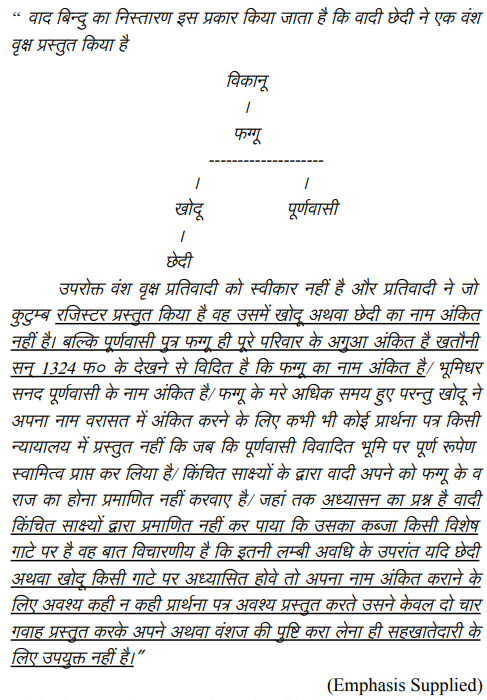
6. In second round of litigation, the Consolidation Officer has considered documentary and oral evidence fresh and rejected the case of original respondent No.3-(Chhedi) by order dated 26.05.1975 and relevant part thereof is reproduced hereinafter:-
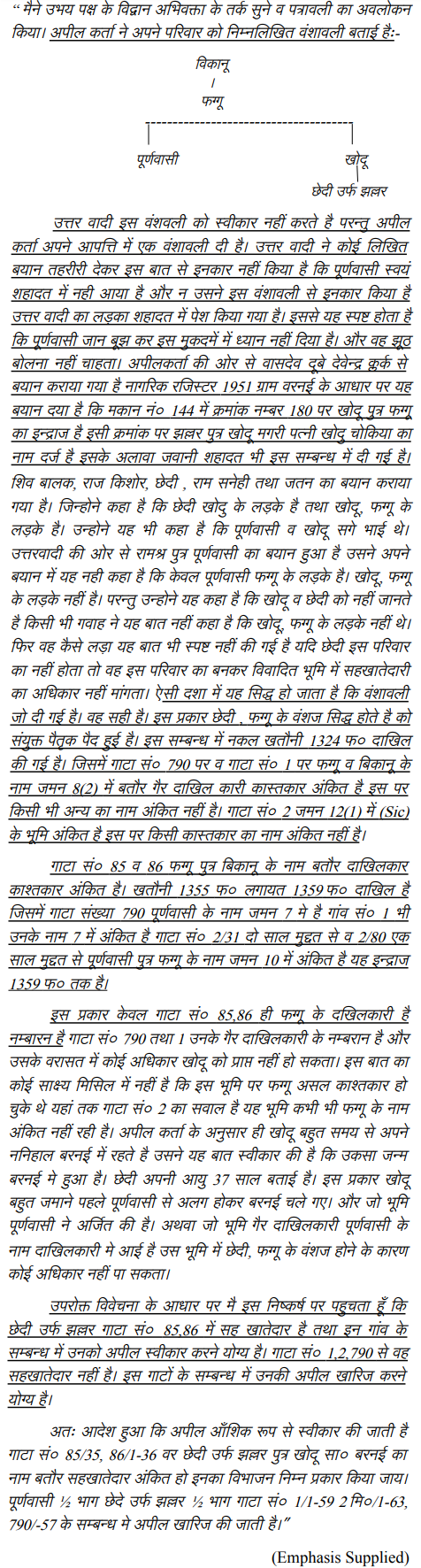
7. The original respondent No.3 thereafter filed an appeal which was allowed in part. The claim of contesting respondent was rejected qua to Khata Nos. 1, 2 and 790, however, his claim of co-tenancy in Khata Nos. 85 and 86 was allowed by declaring that respondent No.3 was son of Khedu and grand son of Phagu. It was held that respondent No.3 was brother of original petitioner. The relevant part thereof is reproduced hereinafter :-
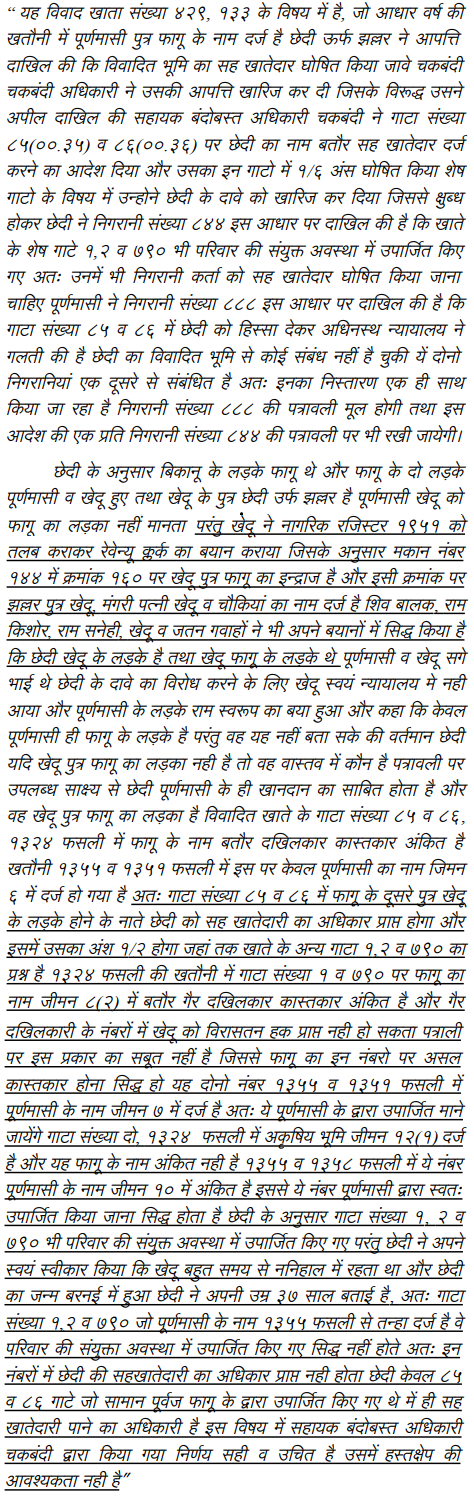
8. In the aforesaid circumstances, both parties referred revision petitions, however, both petitions were rejected by order dated 18.03.1976 and relevant part thereof is mentioned hereinafter :
(Emphasis Supplied)
9. Learned counsel for petitioner has submitted that the Consolidation Officer while considering the evidence led on issues framed, returned a specific finding and rejected the claim of contesting respondent as well as held that contesting respondent No.3 was not a part of petitioner’s family.
10. Learned counsel further submitted that number of documents were placed before Consolidation Officer in support of his claim which are part of order passed by him and that Consolidation Officer has rightly placed reliance on ‘Kutumb Register’, wherein contesting respondent’s name was not recorded and that for almost three decades, original respondent never tried to take any step to record his name in revenue records.
11. Learned counsel further submitted that Appellate Authority in a very cursory manner has shifted the entire burden on petitioner to prove that contesting respondent No.3 was not his brother. The original petitioner have discharged initial burden and it was on respondent No.3 to prove that he is part of pedigree of petitioner.
12. Learned counsel further submitted that Revisional Authority has committed same error. Both authorities have committed further error that on said evidence, claim of original petitioner was considered on three khatas but on same set of evidence they have erroneously accepted claim of contesting respondent and wrongly held contesting respondent to be co-tenant on Khata Nos. 85 and 86.
13. Since no one has entered appearance on behalf of respondents, therefore, Sri Sharad Chand Singh, learned A.C.S.C. for State has assisted the Court.
14. In pre
AI
The burden of proof in claims of co-tenancy rests on the claimant, and insufficient evidence can result in the rejection of such claims.
Continuity of occupancy and ancestral ties substantiate rightful claims to land; absence of legal basis in assertions of sole ownership invalidates challenges.

The burden of proof for co-tenancy claims lies with the claimant, and reliance on inadmissible evidence can invalidate such claims.
The burden of proof lies with petitioners to establish their lineage and co-tenancy rights, which they failed to do, resulting in dismissal of the petition.
The court emphasized the necessity of establishing evidence for claims of co-tenancy and inheritance, ruling that the Deputy Director's findings lacked sufficient support.

The onus of proving property as ancestral lies with the claimant, requiring evidence of purchase from Joint Hindu Family funds, not merely acceptance of a family tree.
Dismissal of prior suit for maintainability does not determine current rights, and failure to consider evidence results in perverse findings necessitating remand for proper adjudication.
The burden of proof lies on the party claiming co-tenancy, and long-standing revenue records cannot be disturbed without substantial evidence.
Living together does not imply joint ownership of property; independent possession negates jointness.
The burden of proof for exclusive property rights lies with the claimant, and mere entries in records are insufficient to establish ownership without supporting evidence.



An indispensable Tool for Legal Professionals, Endorsed by Various High Court and Judicial Officers
Please visit our Training & Support
Center or Contact Us for assistance

Scan Me!
India’s Legal research and Law Firm App, Download now!


For Daily Legal Updates, Join us on :



 Back to top


