
 Back
Back





IN THE HIGH COURT OF JUDICATURE AT ALLAHABAD (
Attau Rahman Masoodi, Ajai Kumar Srivastava-I, JJ.
Rajjan – Appellant
Vs.
State Information Commission U.P. Lko. Thru. Its Commissioner And Another - Respondent
WRIT - C No. - 4465 of 2025
Decided On :
| Table of Content |
|---|
| 1. failure of the information officer to provide requested information. (Para 1 , 2 , 3) |
| 2. arguments regarding the purpose of the right to information act. (Para 6 , 7 , 8) |
| 3. powers of the state information commissioner under the rti act. (Para 9 , 10) |
| 4. judicial interpretation of the rti act's objectives. (Para 11 , 12 , 13) |
| 5. court's directive for the commission to provide information and reconsider the appeal. (Para 14 , 15 , 16 , 17 , 18 , 19 , 20) |
JUDGMENT :
1. Heard learned counsel for the petitioner, Sri Shikhar Anand, learned counsel for State Information Commission i.e. respondent No.1 and learned Standing Counsel for the State.
2. The writ petition has come to be filed before this Court under Article 226 of the Constitution of India on the ground that the mechanism under the Right to Information Act, 2005, [hereinafter referred to as "Act, 2005"] in its entirety has failed to furnish the petitioner with the information as was prayed for initially before the Information Officer, who failed to provide the same. The appeal arising therefrom was also not decided within the statutory period of time, as a result of which the second appeal came to be filed before the State Information Commissioner registered as Appeal No.S 5/ A/ 0460 of 2024, which has finally culminated in a penalty order and consigned to record.
3. On a plain reading of the appellate order passed by the State Information Commissioner on 24.02.2025, it is gathered that the Information Officer, who was issued notice and summoned for providing the information prayed for by the petitioner, did not cooperate with the proceedings. He repeatedly failed to appear on the dates which were fixed for appearance. Due to the default on the part of the Information Officer in cooperating with the appellate proceedings, the penalty clause appears to have been invoked, and the appellate proceeding seems to have been decided with the imposition of a sum of Rs. 25,000/- (Rupees twenty five thousand), besides recommending a disciplinary action against the erring officer, i.e., the Information Officer.
4. On a perusal of the appeal instituted by the petitioner before the State Information Commissioner under Section 19(3) of the Act, 2005, it is clear that the following relief was sought:-
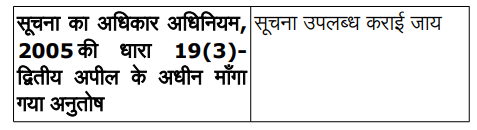
5. Essentially, the relief sought by the petitioner was for being provided the information prayed for.
6. Learned counsel for the State Information Commission has submitted that there is no mechanism for the appellate authority to procure the information asked for so as to be furnished to the aggrieved party. The penalty provisions alone are available to punish an erring officer. In the present case, the same procedure having been followed has resulted in the disposal of the appeal and the imposition of a penalty of Rs. 25,000/- (Rupees twenty five thousand), coupled with the recommendation of disciplinary action against the erring officer has been ordered by the State Information Commissioner on 24.02.2025.
7. Learned counsel for the petitioner, on the other hand, has argued that the purpose of the Act, 2005 is essentially to provide the information sought by the applicant. The very mechanism of proceedings under the Act, 2005 is intended for providing the information sought by a person, and in the event of being aggrieved, the mechanisms of first appeal and second appeal have been provided under the statutute.
8. The argument put forth by learned counsel for the petitioner appears to have force.
9. Sections 18 and 19 of the Act, 2005 operate in different arena as has been held by Hon’ble the Supreme Court in Chief Information Commissioner and another vs. State of Manipur and another , [(2011) 15 SCC 1] .
10. On a close scrutiny of the provisions of the Act, 2005, particularly Section 7 read with Section 19, sub- Section (5), (6), (8), (9) and (10), we are of the considered opinion that the State Information Commissioner enjoys wide powers regarding the discovery of information from the
AI
The Right to Information Act mandates that information must be provided to applicants, and the State Information Commission must actively ensure compliance rather than relying solely on penalties for....

The Right to Information Act mandates accountability for public officers in providing information, and penalties can be imposed for non-compliance.

Point of Law : Section 20 of Act deals with penalties.
The central legal point established in the judgment is that the concerned officer must be provided with a reasonable opportunity of being heard before any penalty is imposed upon them under Section 2....

The court established that the provisions of Section 20 of the Act, 2005 should be strictly construed, and the Commissioner must ensure that the conduct of the Information Officer was not bona fide b....

Imposition of penalty and compensation are distinct liabilities under the Right to Information Act, and relief can only be granted based on a legally protected right capable of being judicially enfor....

(1) There is clear distinction in between “Public Authority” within meaning of Section 2(h) and “Public Information Officer” within meaning of Section 2(m) of Right to Information Act, 2005.(2) Award....
Adherence to the principles of natural justice and compliance with the Right to Information Act, 2005, including the imposition of penalties and compensation, must be in accordance with the statutory....

The State Information Commission must actively ensure compliance with information requests under the RTI Act, rather than solely imposing penalties for non-compliance.



An indispensable Tool for Legal Professionals, Endorsed by Various High Court and Judicial Officers
Please visit our Training & Support
Center or Contact Us for assistance

Scan Me!
India’s Legal research and Law Firm App, Download now!


For Daily Legal Updates, Join us on :



 Back to top


