
 Back
Back





HIGH COURT OF JUDICATURE AT ALLAHABAD
CHANDRA KUMAR RAI, J.
Lalsa Yadav - Petitioner
Versus
Board of Revenue, Lucknow and Others – Respondents
Writ B. No. 4491 of 1999
Decided On : 17-02-2025
(A) U.P. Land Revenue Act, 1953 - Sections 33, 39, and 9-A(2) - U.P. Consolidation of Holdings Act, 1953 - Section 4(2) - Dispute over land lease and consolidation - The petitioner’s father was granted a lease for multiple plots, but only one was recorded. The Consolidation Officer ordered the name to be recorded, which was later contested. The Board of Revenue set aside the Additional Commissioner's order allowing the revision. (Paras 2, 4, 10, 14)
(B) Jurisdiction of Authorities - The Commissioner has the power to decide revisions on merit post-amendment, without needing to refer to the Board of Revenue. (Paras 11, 12)
Facts of the case:
The petitioner’s father was granted a lease for several plots, but only one was recorded. After his death, the petitioner and his brothers were recorded over the plot. A subsequent order by the Chief Revenue Officer to expunge their entry was contested. (Paras 2, 4)
Findings of Court:
The order of the Additional Commissioner was affirmed, and the impugned order by the Board of Revenue was set aside, confirming the petitioner’s rights over the land. (Paras 14, 15)
Issues: The main issues were the validity of the Board of Revenue's order and the jurisdiction of the Commissioner to decide the revision on merit. (Paras 4, 11)
Ratio Decidendi: The court held that the Additional Commissioner’s order was valid and that the Board of Revenue's remand was unnecessary, affirming the Commissioner’s jurisdiction to decide revisions post-amendment. (Paras 10, 14)
Result: Writ petition stands allowed.
| Table of Content |
|---|
| 1. petitioner's father granted lease (Para 4) |
| 2. petitioner argues for rights (Para 5 , 6 , 8 , 9) |
| 3. court considers arguments (Para 7) |
| 4. commissioner's jurisdiction affirmed (Para 10 , 11 , 12 , 13 , 15 , 16) |
| 5. writ petition allowed (Para 14) |
ORDER :
(Chandra Kumar Rai, J.)
Order on Civil Misc. Impleadment Application No.8/2024.
1. Heard learned counsel for the parties.
2. No ground for impleadment is made out.
3. The Application is rejected.
Order on Writ Petition.
1. Heard Mr. R.P. Yadav, learned counsel for the petitioner and Sri Tarun Gaur, learned standing counsel for the state-respondents.
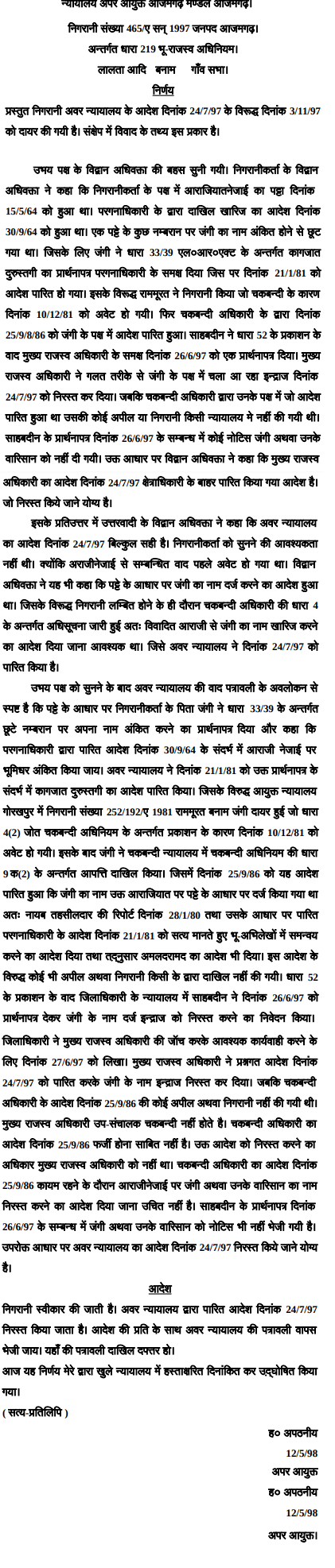
2. Brief facts of the case are that petitioner’s father- Jangi Yadav was granted lease of plot nos. 228, 117, 119, 120, 121 and 122. On the basis of the lease executed in favour of the petitioner’s father, his name was accordingly recorded in the revenue records in respect to plot no.228 only but the name of the petitioner’s father was not recorded over the remaining plots, accordingly, in the proceeding under Sections 33/39 of the U.P. Land Revenue Act, an order was passed by the revenue authority for recording the name of the petitioner’s father but later on the order was recalled. The village in question was brought under consolidation operation by way of notification issued under Section 4(2) of the U.P. Consolidation of Holdings Act, 1953 (hereinafter referred to as the “U.P. C.H. Act”) on 27.6.1981. Against the basic year entry, an objection under Section 9(A)2 of the U.P. C.H. Act was filed by the petitioner’s father in respect to plot in question. The Consolidation Officer vide order dated 25.9.1986, directed to record the name of the petitioner’s father- Jangi Yadav over the plot in question on the basis of lease executed in his favour. In para no. 8 of the writ petition, it is mentioned that no appeal and revision has been filed by gram panchayat/land management committee against the order of the Consolidation Officer dated 25.9.1986. In C.H. Form No.45, name of the petitioner’s father was recorded over the plot in question. Petitioner’s father expired in the year 1990 and after the death of the petitioner’s father, petitioner and his brothers have been recorded over the plot in question. An application dated 26.6.1997 was filed by one Sahabdin, a resident of village Sarai Haji before the District Magistrate/Deputy District Director of Consolidation with the prayer that the record of Case No.45, under Sections 33/39 of the U.P. Land Revenue Act be summoned and the entry made in favour of the petitioner’s father may be cancelled. The Chief Revenue Officer vide order dated 24.7.1997 directed to record the disputed plot in the name of the Gram Sabha. The petitioner challenged the order dated 24.7.1997 before this Court by way of Writ Petition No.34748 of 1997 which was dismissed by this Court vide order dated 20.10.1997 on the ground of alternative remedy. The petitioner challenged the order dated 24.7.1997 by way of revision before the Commissioner on 3.11.1997. The aforementioned revision was heard and allowed by the Addl. Commissioner vide order dated 12.5.1998, setting aside the order dated 24.7.1997 on the ground that the Consolidation Officer in the title proceeding has passed the order to record the name of the petitioner’s father over the plot in question and the order has attained finality. Against the order dated 12.5.1998, Sahabdin filed a revision before the Board of Revenue and the Board of Revenue vide order dated 17.8.1998 has set aside the order of the Additional Commissioner dated 12.5.1998, on the ground that in view of the provisions contained under the Act, the order passed by the Commissioner cannot be sustained as the Commissioner cannot allow the revision rather he can make reference to the Board of Revenue for allowing or dismissing the revision. Hence, this writ petition on behalf of the petitioner for the following reliefs:-
“1. Issue a writ, order or direction in the nature of certiorari, quashin
The Commissioner has jurisdiction to decide revisions on merit under the U.P. Land Revenue Act post-amendment, without needing to refer to the Board of Revenue.
The Board of Revenue must provide adequate reasoning in its orders; a cryptic order is unsustainable in law.

The court affirmed the principle that title objections must be decided on merit rather than based on previous compromises, ensuring fair opportunity for parties to present evidence.

Revisional jurisdiction under consolidation laws requires adherence to legal procedures, especially concerning time-barred claims and the provision of interim protection.
The court ruled that title objections under the U.P. Consolidation of Holdings Act must be decided on merit, emphasizing the need for proper jurisdiction and evidence rather than relying on alleged c....
The Deputy Director of Consolidation has the authority to decide revisions based on existing evidence and should not remand cases unnecessarily.
Failure to provide a hearing and frame issues as required by the U.P. Consolidation of Holdings Act renders the adjudication void.



An indispensable Tool for Legal Professionals, Endorsed by Various High Court and Judicial Officers
Please visit our Training & Support
Center or Contact Us for assistance

Scan Me!
India’s Legal research and Law Firm App, Download now!


For Daily Legal Updates, Join us on :



 Back to top


