
 Back
Back





IN THE HIGH COURT OF ALLAHABAD
Saumitra Dayal Singh, Gautam Chowdhary, JJ.
Mayank Parasari - Appellant
Versus
State of U.P. - Respondent
Criminal Appeal No. 8466 of 2022
Decided On : 06-02-2025
(A) Indian Penal Code, 1860 - Sections 302 and 452 - Arms Act, 1959 - Section 25(1) - Conviction for murder and related offences - Appellant convicted and sentenced to life imprisonment for murder, with fines imposed for other offences - Acquitted of one charge under Arms Act - Court emphasized the importance of ocular evidence and the credibility of witnesses, particularly the defence witness who contradicted the prosecution's narrative. (Paras 1, 21, 50)
(B) Burden of Proof - The prosecution must prove its case beyond reasonable doubt - The presence of reasonable doubt in the prosecution's case led to the acquittal of the appellant. (Paras 25, 52)
Facts of the case:
The appellant was convicted for the murder of Navdurgesh Mishra, shot at point-blank range in his home, with a history of prior altercations between the appellant and the deceased. The FIR was lodged shortly after the incident. (Paras 1, 2)
Findings of Court:
The court found the prosecution's case riddled with doubt, particularly due to the testimony of a defence witness who claimed the deceased committed suicide, leading to the conclusion that the prosecution failed to establish guilt beyond reasonable doubt. (Paras 25, 50)
Issues: The main issues included the credibility of eyewitnesses, the existence of motive, and the reliability of the prosecution's narrative versus the defence's account. (Paras 22, 50)
Ratio Decidendi: The court ruled that the prosecution's failure to confront a key defence witness with prior statements undermined its case, leading to the conclusion that the evidence presented did not meet the burden of proof required for conviction. (Paras 25, 50)
Result: Appeal allowed; conviction set aside.
JUDGMENT :
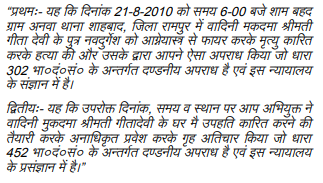
1. The instant appeal has arisen from the judgement and order dated 16.09.2022 passed by Shri Sanjeev Kumar Tiwari, Special Judge SC/ST (P&A) Act, Rampur, in Sessions Trial No. 84 of 2011, State vs. Mayank Parasari whereby the appellant has been convicted and sentenced to undergo rigorous life imprison for the offence under Section 302 IPC and to pay fine Rs. 50,000/- and in default of payment of fine to further undergo simple imprisonment of two years; to undergo rigorous imprisonment of five years and to pay fine Rs. 10,000/- for the offence under Section 452 IPC and in default of payment of fine to further undergo six months further simple imprisonment. In Sessions Trial No. 85 of 2011, State vs. Mayank Parasari, the appellant has been convicted and sentenced to undergo rigorous imprisonment of three years and fine Rs. 5,000/- for the offence under Section 25(1) Arms Act and in default of payment of fine to further undergo simple imprisonment of two months. The appellant has been acquitted of the offence under Section 27 Arms Act, 1959.
2. According to the prosecution story as narrated in the FIR lodged by Geeta Devi (P.W.-1 at the trial), on 21.08.2010 at about 6:00 PM, the deceased Navdurgesh Mishra, his wife Pushpa Devi (P.W.-2 at the trial) and his mother Geeta Devi (PW-1) were sitting inside their house. Their ‘Bataidar’ Bhurey Singh Diwakar (D.W.2 at the trial) was sitting outside their house. Just then the accused-appellant Mayank - a relative of Pushpa Devi entered that house carrying our country made pistol. He referred to the deceased, two earlier instances when allegedly the deceased had assaulted the accused - once during the former’s marriage celebration and another just 10-15 days earlier. The accused also proclaimed earlier, the deceased had been saved, but now he would not spare him. At this the accused drew his country made pistol to the head of the deceased, little above his ear and shot him from point-blank range. The deceased fell to the ground. The accused fled from the spot with the weapon of assault. That later occurrence was witnessed by Naval Kishore Mishra, Ram Kishore Mishra, Shree Pal Singh and other not named persons (not examined at the trial) and Bhurey Singh Diwakar (D.W.- 2 at the trial). Also, the FIR narrated a quarrel that had taken place earlier, between the accused and the deceased, at the latter’s marriage where the accused was beaten up by the guests of the deceased for reason the accused having fired a shot with a firearm. The Tehrir was written by Naval Kishore Mishra. PW-2 affixed her thumb impression to it. The Tehrir is dated 21.08.2010. It is Exhibit Ka-1. The FIR is also dated 21.08.2010, lodged at 08.05 P.M. It is Exhibit Ka-2. On 21.08.2010 itself, the S.H.O. recovered plain and blood-stained earth from the place of occurrence. The recovery memo is Exhibit Ka-21. The Panchayatnama was drawn on 21.08.2010 between 9.30 P.M. and 11.45 P.M. It is Exhibit Ka-5. On 22.08.2010, at 1.00 P.M., the dead body of the deceased was subjected to autopsy by Dr. Parag Agarwal (P.W.- 4 at the the trial). The Autopsy Report records the following ante-mortem injuries:
“1. Lacerated wound of 3 cm x 3 cm on right side of skull just above the right ear margins all inverted and blackening and tattooing present.
2. Lacerated wound of 4 cm x 4 cm on top of skull arterially margins and inverted wound about 7 cm above the right eyes.”
3. Also, the time of death was recorded “about within one day” and the cause of death “due to firearm injury or ante-mortem causing coma.” The Autopsy Report is Exhibit Ka-5.
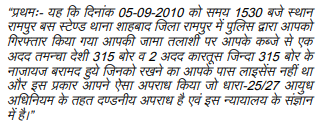
4. On 05.09.2010, the accused was arrested on information received from an informer. At that time a country made pistol with two live bullets were also recovered from his person. That memo of search and recovery is Exhibit Ka-17. Also, on 05.09.2010, the accused is claimed to have led to the recovery of the empty cartridge of the bullet used in the occurrence, from a Eucalyptus cultivation near a
The prosecution must prove its case beyond reasonable doubt, and failure to confront key witnesses undermines the credibility of its narrative.

The main legal principle established in the judgment is the importance of confronting witnesses with their previous statements to ensure a fair trial, as mandated by Section 145 of the Evidence Act a....

Prosecution must establish agreement and actions for conspiracy, which can be proved via circumstantial evidence; minor investigative flaws do not negate reliable witness testimony.

The judgment emphasizes the importance of thoroughly analyzing witness testimonies, considering contradictions, and ensuring strict compliance with the law in using police statements for contradictio....

(1) Every contradiction or omission is not a ground to discredit witness or to disbelieve his/her testimony.(2) Theory of last seen together is helpful to prosecution if deceased was seen in company ....

It is well settled that a statement recorded under Section 161 of Code of Criminal Procedure cannot be treated as evidence in criminal trial but may be used for limited purpose of impeaching credibil....

The importance of credible eyewitness testimony, reliable and clinching evidence, and the exclusion of every possible hypothesis except guilt in establishing guilt beyond reasonable doubt.

The use of statements recorded under Section 164 Cr.P.C. as evidence is limited to corroboration or contradiction, and in the absence of substantial evidence, such statements cannot sustain a convict....

Conviction under IPC S.342 r/w 34 upheld on corroborated testimony of confinement; S.504 r/w 34 set aside as abuse lacked provocation for breach of peace. Revisional jurisdiction limited, absent perv....

Conviction cannot be based only on the ground that the alleged accused has absconded.



An indispensable Tool for Legal Professionals, Endorsed by Various High Court and Judicial Officers
Please visit our Training & Support
Center or Contact Us for assistance

Scan Me!
India’s Legal research and Law Firm App, Download now!


For Daily Legal Updates, Join us on :



 Back to top


