
 Back
Back





IN THE HIGH COURT OF JUDICATURE AT ALLAHABAD
ASHWANI KUMAR MISHRA, PRAVEEN KUMAR GIRI, JJ.
Bindra Prasad Patel - Appellant
Versus
State Of UP And Others – Respondents
Special Appeal No. 41 of 2025
Decided On : 08-07-2025
| Table of Content |
|---|
| 1. contested claim for gratuity payment. (Para 1 , 2) |
| 2. legislative framework for teacher gratuity. (Para 3 , 4 , 5 , 6 , 7 , 8 , 9) |
| 3. arguments about applicability of gratuity act. (Para 10 , 12 , 15 , 16 , 17) |
| 4. interpretation of employment under gratuity act. (Para 18 , 19 , 21 , 22 , 24 , 29) |
| 5. conclusion on applicability of gratuity act to state employees. (Para 20 , 28) |
| 6. final ruling dismissing appeal. (Para 30) |
JUDGMENT :
(Ashwani Kumar Mishra, J.)
1. This intra court appeal arises out of a composite judgment passed by learned Single Judge in a bunch of writ petitions, including Writ-A No.5588 of 2023, whereby petitioner’s claim for payment of gratuity is rejected.
2. The petitioner-appellant in the present case was employed as Headmaster in a junior high school. He (petitioner) received National Teachers’ Award which entitled him to two years extension in service. The age of superannuation was otherwise 62 years under the applicable rules. As such, the appellant has superannuated on 31.3.2017 after availing session’s benefit at the age of 64 years. The writ petition came to be filed by the appellant with the prayer to direct the District Basic Education Officer, Prayagraj to release gratuity to him alongwith interest. It is this claim which came to be rejected by the learned Single Judge.
3. In order to appreciate the controversy raised in the matter it would be necessary to refer to the background in which the dispute has arisen. The State of Uttar Pradesh enacted U.P. Basic Education Act, 1972 (hereinafter referred to as the ‘Act of 1972’) primarily for establishing a Board of Basic Education (hereinafter referred to as the ‘Board’) and for matters connected therewith. The Board is a body corporate having perpetual succession and common seal and has the power to acquire and hold property. Its constitution and powers are specified in the Act of 1972. The ‘Board’ has established various educational institutions upto Junior High School level (hereinafter referred to as ‘Basic Institutions’). The appointment and conditions of service of the teachers of the Basic Institutions are governed by statutory service regulations, namely U.P. Basic Education (Teacher) Service Rules, 1981 (hereinafter referred to as the ‘Rules of 1981’). The Rules of 1981 contained no provision regarding payment of pension or gratuity.
4. Payment of pension to a teacher in a basic institution was earlier governed by the Triple Benefit Scheme, 1965 issued under the provisions of U.P. Retirement Benefit Rules, 1961. On 8.3.1978 a Government Order came to be issued by the State of Uttar Pradesh introducing new pension scheme in respect of teachers of educational institution established by the board. This Government Order expressly excluded death-cum-retirement gratuity to the teachers. It also denied benefit of family pension to the dependents of teachers after their death. This Government Order came to be amended vide Government Order dated 31.3.1982. Benefit of family pension was allowed to the dependents of teachers of basic institutions. However, death-cum-retirement gratuity, continued to be eluded to the teachers of basic institutions.
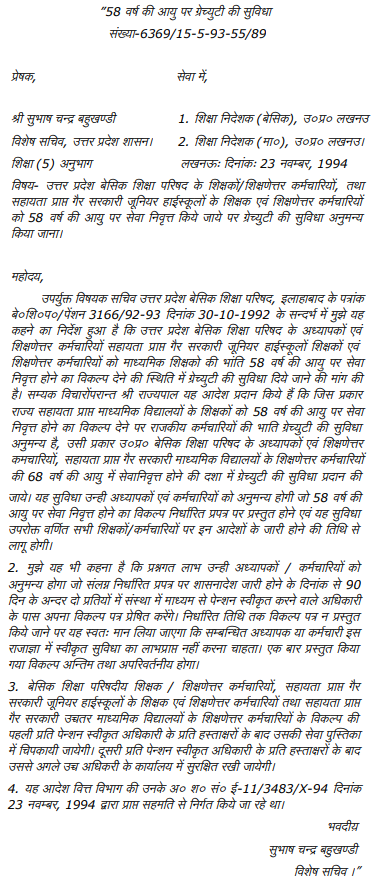
5. On 23.11.1994 a new government order was issued extending the benefit of gratuity to the teachers and other employees of basic institutions. This benefit, however, was dependent upon an exercise of option by the teacher/employee concerned to retire at the age of 58 years. The age of superannuation was otherwise 60 years. The Government Order dated 23.11.1994 is reproduced hereinafter:-
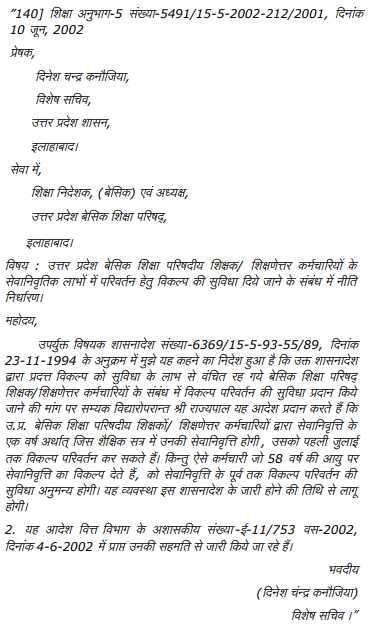
6. A subsequent Government Order came to be issued on 10.6.2001, permitting the teacher/employees of the basic institutions to revise the option to retire upto 1st July of the year of their superannuation. This Government Order was prospective and is reproduced hereinafter:-
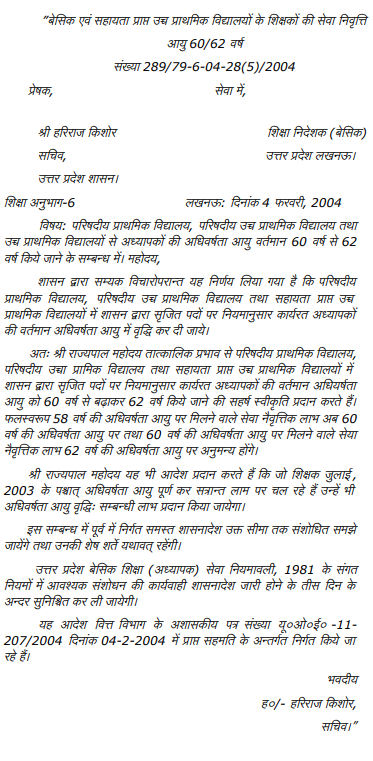
7. The age of superannuation of teachers/employees of basic institutions was enhanced to 62 years from erstwhile 60 years vide Government Order dated
AI
Teachers in basic institutions governed by state rules are not considered employees under the Gratuity Act, denying them gratuity benefits.


The main legal point established in the judgment is that the payment of gratuity for teachers in the Basic Education Department is governed by specific Government Orders, and petitioners must plead f....

The court established that the definition of 'employee' under the Payment of Gratuity Act includes the petitioner, entitling him to gratuity despite state claims of exclusion.

Benefits for Payment of Gratuity to Vocational Part-Time Teachers - Act does not draw a distinction between a fulltime employee/a part time employee/ad-hoc employee etc and does not speak of any spec....

The court held that the petitioner-institution is liable to pay gratuity and leave encashment to respondent-employees for their service period, as per the applicable rules and acts.

Employees of aided educational institutions are entitled to gratuity for their entire service period, as per the applicable rules and acts.
Part-time vocational teachers are entitled to gratuity under the Payment of Gratuity Act as they fall within the definition of 'employee' post-amendment, despite arguments regarding their temporary e....



An indispensable Tool for Legal Professionals, Endorsed by Various High Court and Judicial Officers
Please visit our Training & Support
Center or Contact Us for assistance

Scan Me!
India’s Legal research and Law Firm App, Download now!


For Daily Legal Updates, Join us on :



 Back to top


