
 Back
Back





IN THE HIGH COURT OF ALLAHABAD, LUCKNOW BENCH
CHANDRA KUMAR RAI, J.
Jagbhan Singh and Others - Appellants
Versus
Assistant Director of Consolidation and Others - Respondent
Writ – B No.1870 of 1981
Decided on : 25-07-2025
| Table of Content |
|---|
| 1. dispute over land ownership and consolidation process. (Para 2 , 3) |
| 2. arguments on adverse possession and ownership rights. (Para 4 , 5) |
| 3. evaluation of jurisdiction and evidence in land disputes. (Para 6 , 7 , 8 , 9 , 10) |
| 4. limitations on adverse possession against gaon sabha land. (Para 11 , 12 , 13 , 14 , 15) |
| 5. final judgment dismissing the writ petition. (Para 16 , 17) |
UDGMENT :
Chandra Kumar Rai, J.
1. Heard Mr. S.K. Vidyarthi, learned counsel for the petitioners, Mr. Ashutosh Kumar Rai, learned Addl. C.S.C. for the state-respondents and Mr. Achal Singh, learned counsel for the respondent-gaon sabha.
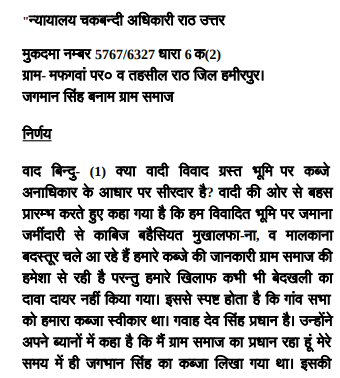
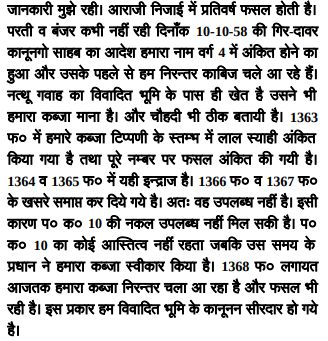
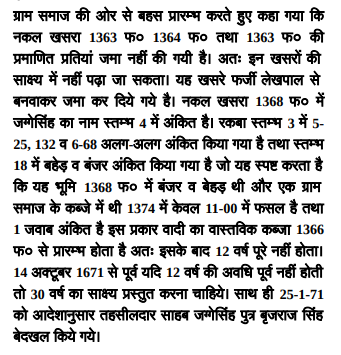
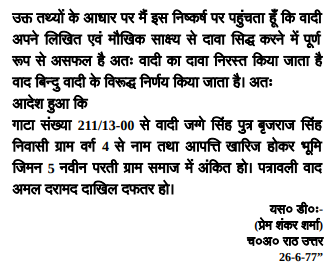
2. Brief facts of the case are that the dispute relates to khata no.602, plot no.211/13, situated in village Majhgawan, Pargana and Tehsil Rath, District Hamirpur. In the basic year of the consolidation operation, the aforementioned plot was recorded in the name of the petitioners under Shreni-IV. Against the basic year entry of the plot in question, an objection under Section 9 - A(2) of the U.P. Consolidation of Holdings Act, 1953 (hereinafter referred to as the “U.P. C.H. Act”) was filed by the petitioners with the prayer that petitioners should be recorded as Sirdar in place of Shreni-IV. The aforementioned objection filed by the petitioners, was registered as Case No.5767 before the Consolidation Officer. The Gaon Sabha filed his reply, denying the case of the petitioners. The petitioners adduced oral and documentary evidence in support of their case. One issue was framed before the Consolidation Officer as to whether the petitioners/objectors is entitled to be recorded as Sirdar on the basis of their adverse possession. The Consolidation Officer vide order dated 29.6.1977 rejected the claim of the petitioners/objectors and directed that plot in question should be recorded as Jaman-V/Naveen Parti Gram Samaj. Against the order of the Consolidation Officer dated 26.9.1977, appeal under Section 11 (1) of the U.P. C.H. Act was filed by the petitioners which was heard and dismissed vide order dated 30.7.1977. Against the appellate order dated 30.7.1977, revision under Section 48 of the U.P. C.H. Act was filed before the Deputy Director of Consolidation which was registered as Revision No.4616. The aforementioned revision was heard and dismissed vide order dated 13.10.1980. Hence, this writ petition for the following relief:-
“(i) Issue a writ of certiorari for quashing the orders dated 29.6.1976 and 13.10.1980 passed by Consolidation Officer as well as Assistant Director of Consolidation respectively.
(Annexure Nos. 1 & 2).”
3. This Court entertained the matter on 28.7.1981 and granted interim protection to the effect that operation of the impugned order dated 13.10.1980 shall remain stayed and the possession of the petitioners shall not be disturbed.
4. Counsel for the petitioners submitted that petitioners are in possession of the disputed plot since before the date of vesting, as such, the petitioners have matured their right and title in respect to the plot in question in view of the provisions contained under the Uttar Pradesh Zamindari Abolition and Land Reforms Act, 1950 (hereinafter referred to as the “U.P. Z.A. & L.R. Act”). He further submitted that title objection filed by the petitioners to record their names as Sirdar has been decided by the Consolidation Officer in arbitrary manner. He submitted that no documentary evidence was filed by the Gaon Sabha before the Consolidation Officer but the title objection of the petitioners has been dismissed without considering the oral and documentary evidence adduced by the petitioners. He submitted that the appellate and revisional jurisdiction have also been exercised in arbitrary manner. He submitted that the impugned orders passed by the consolidation authorities should be set aside and the petitioners' objection under Section 9 -A (2) of the U.P. C.H. Act should be allowed, directing the authorities to record the names of the petitioners over the plot in q
AI
Adverse possession claims are not applicable against gaon sabha properties, and the denial of such claims must be based on substantiated findings by consolidation authorities.

Failure to provide a hearing and frame issues as required by the U.P. Consolidation of Holdings Act renders the adjudication void.
Title objections under the U.P. Consolidation of Holdings Act must be filed within a reasonable time; excessive delays without sufficient cause render such objections inadmissible.
The revisional court exceeded its jurisdiction by altering the share of co-tenancy in ancestral property, which was affirmed by the appellate court.
Revisions involving the same parties and disputes must be consolidated for efficient resolution under the U.P. Consolidation of Holdings Act.


The Deputy Director of Consolidation has the authority to decide revisions based on existing evidence and should not remand cases unnecessarily.
Title disputes must adhere to procedural norms; failure to substantiate evidence can lead to dismissal of claims.
Revisional jurisdiction under consolidation laws requires adherence to legal procedures, especially concerning time-barred claims and the provision of interim protection.
The civil court's decree in an injunction suit cannot be enforced under the U.P. Consolidation of Holdings Rules, affirming the jurisdiction of consolidation authorities.



An indispensable Tool for Legal Professionals, Endorsed by Various High Court and Judicial Officers
Please visit our Training & Support
Center or Contact Us for assistance

Scan Me!
India’s Legal research and Law Firm App, Download now!


For Daily Legal Updates, Join us on :



 Back to top


