
 Back
Back





IN THE HIGH COURT OF ALLAHABAD
Chandra Kumar Rai, J.
Ajeet Singh - Appellant
Versus
D.D.C. - Respondent
Writ (B) No. 4766 of 1984
Decided On : 10-07-2025
| Table of Content |
|---|
| 1. dispute involves multiple title claims over consolidated land. (Para 2) |
| 2. arguments presented regarding procedural lapses in title claims. (Para 5 , 6) |
| 3. court observed no grounds for interference in original orders. (Para 7 , 8 , 9 , 10 , 11 , 12 , 13) |
| 4. writ petition dismissal confirms the consolidation authority's decisions. (Para 14) |
| 5. final ruling is for dismissal with no costs awarded. (Para 15) |
JUDGMENT :
Chandra Kumar Rai, J.
1. Heard Mr. R.C. Singh, learned Senior Counsel, assisted by Mr. Kamal Kumar Singh, learned Counsel for the petitioners; Mr. Vinod Kumar Upadhyay holding the brief of Mr. Sanjay Srivastava, learned counsel for respondent no. 4 and Mr. Ajai Kumar Baranwal, learned Standing Counsel for the State-respondents.
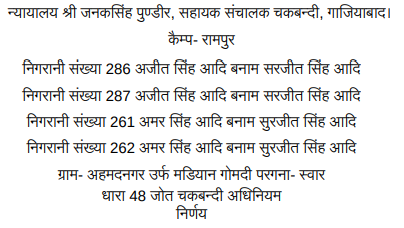
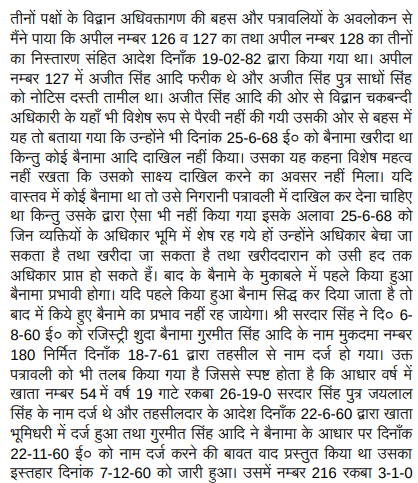
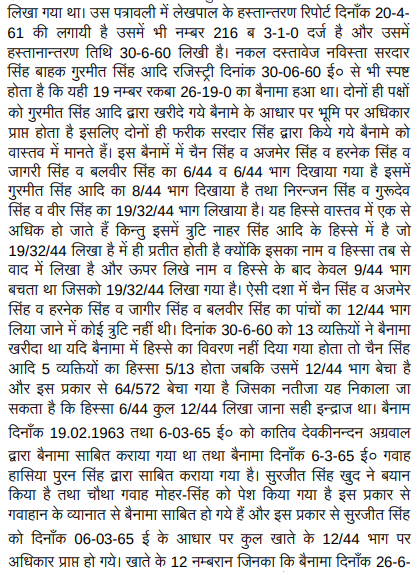
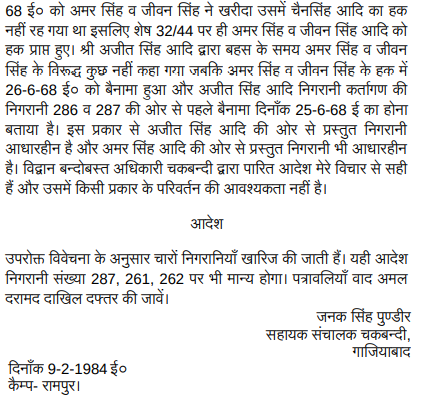
2. Brief facts of the case are that dispute relates to plots of khata no.54 situated in Village- Ahamadnagar alias Mohammadi, Tehsil-Suar, District - Rampur as mentioned in the order of the consolidation authorities. The names of Harmel Singh, Jageer Singh, sons of Santok Singh (respondent no. 7 & 8); Ajeet Singh, Kartar Singh, sons of Ajaib Singh (petitioners nos.2 and 3); Ajeet Singh, son of Sadho Singh (petitioner no.1), Bheem Singh, son of Ramnath Singh (respondent no.9) Bhagwandas, son of Jawaharlal (respondent no.5) were recorded over the aforementioned plots in the basic year of the consolidation operation. Against the basic year entry of the aforementioned plots, an objection under Section 9 -A(2) of the U.P. Consolidation of Holdings Act, 1953 (hereinafter referred to as the 'U.P.C.H. Act') was filed by Amar Singh and Jiwan Singh, sons of Saran Singh, on the basis of registered sale deed dated 26.06.1968 alleged to be executed in their favour in respect to 12 plots area 14-5-0 out of 19 plots area 26-19-0. Respondent no. 4/Surjeet Singh, son of Gunda Singh, also filed objection under Section 9 -A(2) of the U.P.C.H. Act on the basis of a registered sale deed dated 6.3.1965, alleged to be executed in his favour in respect to 12/44 share of the total 19 plots area 26-19-0. The Consolidation Officer vide order dated 2.12.1981, dismissed the objection filed by respondent no. 4/Surjeet Singh and allowed the claim of Amar Singh and Jiwan Singh for recording of their names on the basis of the sale deed dated 26.6.1968. Against the order of the Consolidation Officer dated 2.12.1981, three appeals were filed under Section 11 (1) of the U.P.C.H. Act before the Settlement Officer of Consolidation. Appeal No. 128 was filed by Surjeet Singh son of Indra Singh and Appeals No. 126 and 127 were filed by the respondent no.4. The Settlement Officer, Consolidation vide order dated 19.2.1982, allowed Appeals No. 126 and 127 filed by respondent no.4 and dismissed the appeal no.128 filed by Surjeet Son of Indra Singh modifying the order of the Consolidation Officer to the extent that name of respondent no.4/Surjeet Singh son of Gunda Singh shall be recorded as co-tenure holder to the extent of 12/44 share in Khata No.54 and remaining 32/44 share shall be recorded according to the order of the Consolidation Officer. Against the appellate order dated 19.2.1982, four revisions under Section 48 of the U.P.C.H. Act were filed before the Deputy Director of Consolidation, which were numbered as Revision Nos. 286, 287, 261, and 262 filed by Ajeet Singh/ Amar Singh. The aforementioned revisions were clubbed and heard together by the Assistant Director of Consolidation. All the abovementioned revisions were dismissed vide order dated 19.2.1984. Hence, this writ petition on behalf of the petitioners for following relief:-
"A: a writ, direction or order in the nature of certiorari quashing the impugned orders (Annexures 2 and 3) passed by opposite parties Nos.1 and 2.
B. a writ of mandamus commanding the opposite parties not to disturb the possession of petitioners over the plots in dispute.
C. Any other suitable writ, direction or order as this Hon'ble Court may deem fit and proper in the circumstances of
AI
Title disputes must adhere to procedural norms; failure to substantiate evidence can lead to dismissal of claims.

The Deputy Director of Consolidation exceeded jurisdiction by not considering the limitation and locus standi of the respondents in appeals under the U.P. Consolidation of Holdings Act.
The court upheld the necessity of procedural fairness in consolidation proceedings, emphasizing that all parties must be afforded the opportunity to present their case and evidence.
The Deputy Director of Consolidation has the authority to decide revisions based on existing evidence and should not remand cases unnecessarily.

Adverse possession claims are not applicable against gaon sabha properties, and the denial of such claims must be based on substantiated findings by consolidation authorities.
The finality of earlier orders under the U.P. Consolidation of Holdings Act must be respected, and due process must be followed in land record matters.
The court affirmed the Consolidation Officer's decision of equal shares based on the sale deed, rejecting reliance on abated proceedings in title disputes.
Revisions involving the same parties and disputes must be consolidated for efficient resolution under the U.P. Consolidation of Holdings Act.
Failure to provide a hearing and frame issues as required by the U.P. Consolidation of Holdings Act renders the adjudication void.



An indispensable Tool for Legal Professionals, Endorsed by Various High Court and Judicial Officers
Please visit our Training & Support
Center or Contact Us for assistance

Scan Me!
India’s Legal research and Law Firm App, Download now!


For Daily Legal Updates, Join us on :



 Back to top


