
 Back
Back





IN THE HIGH COURT OF JUDICATURE AT ALLAHABAD
SAURABH SHYAM SHAMSHERY, J
Sandeep Raizada and others - Petitioners
Versus
State of U.P. and others - Respondents
Writ A No.6954 of 2019
Decided on : 11-09-2025
| Table of Content |
|---|
| 1. historical employee service conditions (Para 1 , 2 , 3 , 4 , 5) |
| 2. establishment and evolution of service regulations (Para 6 , 7 , 8 , 9 , 10 , 11) |
| 3. framework of pension eligibility in governance (Para 12 , 13 , 14 , 15) |
| 4. arguments for pension based on appointment history (Para 24 , 25 , 26 , 28) |
| 5. counterarguments against pension eligibility claims (Para 30 , 31 , 32 , 33 , 34) |
| 6. court's examination of service conditions and pension rights (Para 46 , 47 , 48 , 49 , 50 , 51) |
| 7. outcome based on existing regulations (Para 59 , 60 , 61 , 62) |
| 8. final ruling on pension claims (Para 63 , 64) |
JUDGMENT :
SAURABH SHYAM SHAMSHERY, J.
Brief History of Roadways and it’s Employees in State of U.P.
1. In order to consider real controversy involved in present case, it would be necessary to mention few facts about history of roadways in State of Uttar Pradesh and for that the Court takes some details mentioned by Supreme Court in a judgment passed in the case of U.P. Roadways Retired Officials and Officers Association Versus State of U.P. And Another : (2024) 9 SCC 33 and other relevant facts from pleadings.
2. In 1947, Uttar Pradesh Roadways was created as a temporary department of State Government for providing public transport facilities and its employees were accordingly appointed temporarily.
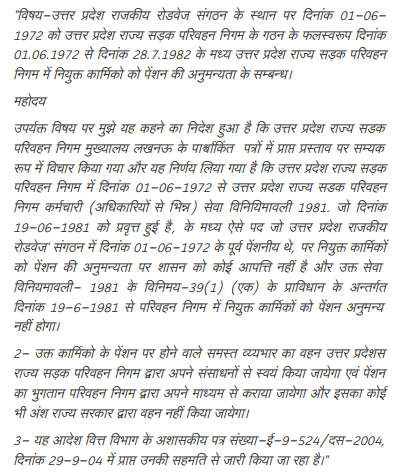
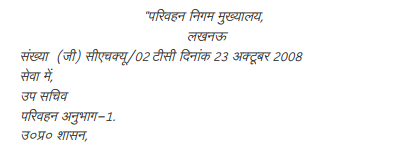
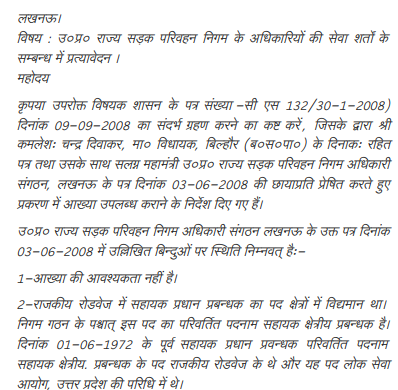
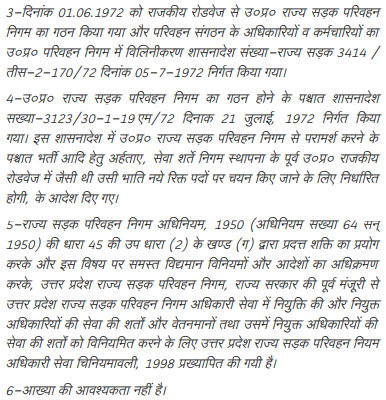
3. By a Government Order dated 16.09.1960 directions were issued on “Terms and Conditions of Service of Temporary Employees in the U.P. Roadways - Revisions of”. For reference said Government Order is reproduced hereinafter :-
“G.O. No. 3014 D/XXX- 135/59 dated Sept. 16, 1960 Subject: Terms and conditions of service of temporary employees in the U.P. Roadways - Revisions of.
I am directed to say that the question of revising the terms and conditions of service of the Roadways employee, which is a nationalized commercial undertaking and has to work in conditions different from those prevailing in regular government offices, has been under the consideration of Government for some time past.
The passenger and goods services have to run irrespective of the fact whether it is a Sunday or a festival. The schedule of passenger services run by the State Undertaking cannot be altered off an on. In order to keep the Roadways services going the maintenance and repairs of vehicles has to be attend to even at odd hours at the workshops. At present the conditions of service of the employees of the U.P. Government Roadways and the Central Workshop, Kanpur are governed by the various rules and standing orders of Government applicable to other temporary government servants under the rule making powers of the Governor. In view of the special service conditions of employees of the Roadways it seems necessary to evolve a new set of service conditions for its employees which may be compatible with the nature of work and functions of the organization. Accordingly, in super session of all previous orders on the subject, the Governor has been pleased to pass the following orders prescribed revised terms and conditions of service of temporary employees of the U.P. Roadways including those detailed in para 2 below. The revised terms and conditions of service shall be applicable to all future entrants in the Roadways organization and shall be enforced in the manner mentioned hereinafter in the case of temporary employee including those on the work charge strength and paid on monthly basis.
(1) All temporary employees except those referred to in para 2 shall get one day's rest in every period of seven days in accordance with the rules to be framed by Government. In case the employees is deprived of any of the days or rest, he shall be allowed within the same or following month compensation holidays of equal number of the days of rest so lost.
(2) They shall be entitled to get one days paid holidays for every 20 days of work performed by them during the previous calender year, subject to the condition that the employee has worked for a period of 240 days or more dur
AI
Pension entitlement derives from clearly established regulations, and claims based on superseded orders are invalid, reinforcing that pension is a right subject to existing service conditions.

(1) Pension is a right and not a bounty – It is a constitutional right for which an employee is entitled on his superannuation – However, pension can be claimed only when it is permissible under rele....


Power to control appointment and power to put restrictions are distinct and different from power to determine service conditions of officers and servants of Board.
The main legal point established in the judgment is that teachers at State-aided educational institutions in Uttar Pradesh are governed by the Applicable Rules and not the Government Employees Rules.....
Services rendered as muster roll employees are eligible for pension benefits under U.P. Retirement Benefit Rules, 1961, regardless of subsequent regularization dates.
The exclusion of service rendered by an employee on the work-charged establishment or daily wager from Section 2 of the U.P. Act No.1 of 2021 is hit by Article 14 of the Constitution of India for the....

The main legal point established in the judgment is that the appellants were entitled to the benefits of the Pension Regulations of 2002, and the denial of rights was not based on their failure to ex....



An indispensable Tool for Legal Professionals, Endorsed by Various High Court and Judicial Officers
Please visit our Training & Support
Center or Contact Us for assistance

Scan Me!
India’s Legal research and Law Firm App, Download now!


For Daily Legal Updates, Join us on :



 Back to top


