
 Back
Back





IN THE HIGH COURT OF ALLAHABAD, LUCKNOW BENCH
RAJNISH KUMAR, J
Kandhai – Appellant
Versus
Smt. Chameli Devi And Ors. – Respondents
Second Appeal No.403 of 2013
Decided on : 07-11-2024
| Table of Content |
|---|
| 1. ownership vs possession dispute (Para 3 , 4) |
| 2. interpretation of appurtenance (Para 6 , 14 , 15 , 16) |
| 3. concurrent findings of fact (Para 12 , 13 , 22) |
| 4. dismissal on misconceived grounds (Para 24) |
JUDGMENT :
Rajnish Kumar, J.
1. Heard Shri Utkarsh Yadav, Advocate holding brief of Shri M.P. Yadav, learned counsel for the appellant and Shri R.R Dev, learned counsel for respondent no. 1. None appeared for other respondents.
2. This second appeal under Section 100 of CIVIL PROCEDURE CODE has been preferred against the judgment and decree dated 23.10.2023, passed in Civil Appeal No. 36/2012; Kandhai versus Smt. Chameli and others by Additional District Judge Court No. 4, District Faizabad affirming the judgment and decree dated 10.02.2012 passed in R.S 334 of 2001; Smt. Chameli Devi versus Kandhai and others by Additional Civil Judge, Senior Division, Court No. 14, Faizabad.
3. Learned counsel for the appellant submits that there is no dispute with regard to ownership of the land in dispute in favour of respondent no. 1 as a will was executed by Ram Jas, in her favour. However, the possession is disputed because after the house on the southern part of the land in dispute fell, nothing was constructed on the same by respondent no. 1 and it cannot be said to be the appurtenant land of the house of the respondent no. 1, therefore, the injunction could not have been granted in favour of respondent no. 1 on the said land. Therefore, the judgment and decrees passed by the trial court and lower appellate court are not sustainable in the eyes of law and liable to be set aside. He relies on Subhawati and others versus Rajbali and others ; 1998 (16) LCD 777
4. Per contra, learned counsel for respondent no. 1 submits that the land in dispute alongwith the house constructed on A,B,C,D,E,F is in ownership and possession of respondent no. 1 on the basis of a will executed by her father Ram Jas and the appurtenant land thereto on the southern side was in possession of his father prior to abolition of Zamidari, therefore, it settled with him and continued to settle with respondent no. 1. Thus, she is the owner and in possession of the same. He further submits that merely because respondent no. 1 could not reconstruct the house on certain portion of land after the house had collapsed and became khandahar due to financial contraints, it cannot be said that respondent no. 1 is not in possession of the land in dispute and appurtenant land thereafter. The appeal has been filed on misconceived and baseless grounds. The substantial questions of law formulated by this court are not involved in this case. The appeal is liable to be dismissed with cost. He relied on a judgment rendered by a co-ordinate Bench of this Court in the case of Ramji and another versus Jagdish mallah and others ; 2004 (96) RD 568 .
5. I have considered the submissions of learned counsel for the parties, I have perused the records.
6. The following substantial questions of law have been formulated in this appeal:-
(1) Whether in view of Section 9 of U.P.Z.A and L.R Act, the appurtenant land shall be deemed settled with the plaintiff's father house which is in the form plain land?
(2) Whether the relief of Permanent Injunction can be granted in a joint co-tenancy of the plaintiff and respondent?
7. The suit for permanent injunction was filed by the respondent no. 1 against the appellant and the respondent nos. 2 and 3 claiming title and possession on the land in dispute on the basis of will executed by her father. The Pedigree of the parties, as disclosed in judgment and decree passed by the trial court, is as under:-
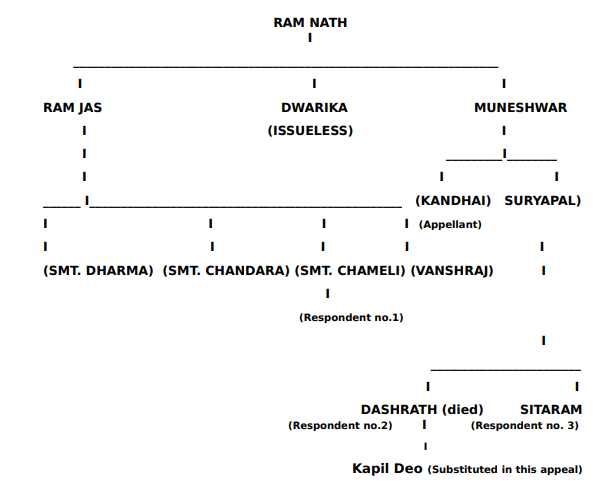
8. According to the aforesaid pedigree, the original tenure holder of the property of the parties including the property in dispute was Ramnath. He had three sons namely Ram Jas, Dwarika and Muneshwar. Dwarika died issueless, therefore, the property was divided between Ram Jas and Muneshwar (half each) after the death of Ramnath. Ram Jas executed a will of h
AI
A landowner retains ownership of appurtenant land despite physical deterioration of the building, as possession based on historical claims and will documentation is recognized under relevant statutor....

The court affirmed that land claimed as appurtenant must be essential for the beneficial enjoyment of the house, proven by long-term use, and clarified the distinctions between easementary rights and....
The appellate court can reverse trial court findings and consider all evidence in a permanent injunction suit, even after confirming some findings, if the trial court inadequately assessed the eviden....

Possession established prior to the abolition of zamindari can confer rights under Section 9 of the Uttar Pradesh Zamindari Abolition and Land Reforms Act, 1950, regardless of the validity of an unre....
The First Appellate Court must comply with procedural requirements and evaluate evidence from both parties; failure to do so renders its findings perverse.
The court upheld that an unregistered partition deed can provide context in disputes regarding possession, especially when substantiated by oral evidence of long-term use under Section 9 of the U.P. ....
Possession established under Section 9 of the U.P. Z.A. & L. R. Act, with admissibility of partition deeds for evidential purposes despite non-signatory status.
The court established that appurtenant land is defined by its beneficial use for a building, and that historical ownership and possession are critical in determining property rights, particularly in ....

The onus of proving exclusive possession after partition lies with the plaintiff, and findings must be based on evidence rather than conjectures and surmises.

Co-sharers can construct on their respective shares of joint land without infringing on others' rights; exclusive possession does not confer separate ownership until legally partitioned.



An indispensable Tool for Legal Professionals, Endorsed by Various High Court and Judicial Officers
Please visit our Training & Support
Center or Contact Us for assistance

Scan Me!
India’s Legal research and Law Firm App, Download now!


For Daily Legal Updates, Join us on :



 Back to top


