
 Back
Back





IN THE HIGH COURT OF ALLAHABAD
RAJNISH KUMAR, J.
Hriday Ram And Ors. – Appellants
Versus
Paras Nath And Anr. - Respondents
Second Appeal No. 352 of 2003
Decided On : 17-05-2024
CIVIL PROCEDURE - PROPERTY DISPUTE - CIVIL PROCEDURE CODE 1908, SECTION 100; UTTAR PRADESH ZAMINDARI ABOLITION AND LAND REFORMS ACT 1950, SECTIONS 7-AA, 9 - The court examined the substantial questions of law regarding the joint ownership and use of disputed land, interpreting the provisions of the Civil Procedure Code and the Uttar Pradesh Zamindari Abolition and Land Reforms Act. The court emphasized that the land in question, being appurtenant to the respondents' house, could not be claimed by the appellants as joint property. The court's decision was influenced by the historical context of property division and the legal definitions of appurtenance, ultimately affirming the lower courts' findings that the appellants had no rightful claim to the land in dispute.
Fact of the Case:
The appellants filed a suit for permanent injunction against the respondents, claiming joint ownership of a disputed land used as common abadi since their ancestors. The respondents contended that they had filled a pond on the land and had been in exclusive possession since before the abolition of Zamindari, asserting their rights under the Uttar Pradesh Zamindari Abolition and Land Reforms Act.
Finding of the Court:
The trial court dismissed the suit, finding that the appellants failed to prove joint ownership and that the respondents were the exclusive owners of the land. The appellate court upheld this decision, agreeing with the trial court's findings and reasoning.
Issues: 1. Whether the report of the Commissioner affects the appellants' right to use the disputed land. 2. Whether the lower courts erred in rejecting the defendants' admission of joint property without sufficient reasoning. 3. Whether the appellate court's decision was justified despite not re-examining evidence.
Ratio Decidendi: The court held that the land in dispute was not appurtenant to the appellants' house and that the historical context of property division indicated exclusive ownership by the respondents. The court reiterated that the appellants' claims lacked sufficient evidence to establish joint ownership.
Final Decision: The Second Appeal was dismissed, affirming the lower courts' judgments and findings without any order as to costs.
JUDGMENT :
(Rajnish Kumar, J.) :
1. Heard Shri Bajrang Bahadur Singh, learned counsel for the appellants and Shri Ved Prakash Yadav, learned counsel for the respondents.
2. This Second Appeal under Section 100 of the Civil Procedure Code 1908 has been filed for setting aside the judgment and decree dated 30.09.2003, passed by the Additional District Judge/Special Judge, E.C.Act, Court Room No.8, Sultanpur in Civil Appeal No.5 of 1998; Hriday Ram and others Versus Ram Kuber and others and the judgment and decree dated 11.11.1997 passed by the Civil Judge,( Jr.Div.), North, Sultanpur in Regular Suit No.949 of 1993; Hriday Ram and others Versus Ram Kuber and others.
3. This appeal was admitted to decide the following substantial questions of law:-
“1. Whether, the report of the Commissioner indicating that disputed abadi falls facing the house of the defendant, will it deprive the plaintiff appellant to use the abadi land as it was used by the common members of the family?
2. Whether, the claim based on the joint property and there is admission of the defendant that three Bhitoor and Ghhor are in existence, the courts below could reject such admission of the defendant without arising (which should be assigning) any cogent reason whatsoever?
3. Whether, the judgment of the learned appellate court is justifiable as he has said that there is no need to re-examine the evidence although the trial court has misread the evidence of D.W.2 who has given evidence with regard to jointness of the property?
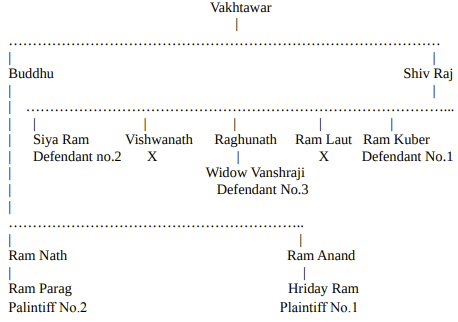
4. Learned counsel for the appellants submitted that the land in dispute was being used commonly by the plaintiffs-appellants (here-in-after referred as appellants) and the defendants/respondents (here-in-after referred as the respondents) since the time of their ancestors. It is coming from the common ancestors of the parties Bakhtawar. The partition had taken place between the two sons of Bakhtawar i.e. the predecessor-in-interest of the parties Buddhu and Shiv Raj except the land in dispute. The respondents tried to make construction on the land in dispute, therefore the appellants had to file the suit for permanent injunction for restraining the respondents from making any construction on the land in dispute or removing the Ghhor, Condore and Kharhi etc. of the appellants or cut the trees and Banskot etc. without partition. He further submitted that the joint ness of the property was not disputed by D.W.2, but the learned Trial court has misread the same and learned Appellate court without considering the same dismissed the appeal. The courts below have also failed to consider that there is admission of the respondents that three Bhithoor and Ghhor exists on the land in dispute. He further submitted that merely because the land in dispute is facing the house of the defendants does not deprive the appellants from using as his abadi because it was being used by their common members of family. On the basis of above learned counsel for the appellants submitted that the trial court as well as the appellate court have committed grave miscarriage of justice by recording erroneous and perverse findings without considering the evidence on record correctly and dismissed the suit as well as the appeal, therefore the same are liable to be set aside.
5. Per contra, learned counsel for the respondents does not dispute regarding their ancestors Buddhu and Shiv Raj. However he submitted that they are in possession on their properties since the time of their ancestors and the question of partition does not arise. The land in dispute was a pond situated on the northeastern side of the house of the respondents which was filled in by the respondents and they are in possession of the said land since prior to abolition of Zamindari. Thus they have got the right and entitlement over that land in dipsute under Section 7-AA of the Uttar Pradesh Zamindari Abolition and Land Reforms Act 1950 (here-in-after referred as the Act of 1950) and it is settled with them on
AI
The court established that appurtenant land is defined by its beneficial use for a building, and that historical ownership and possession are critical in determining property rights, particularly in ....

Co-sharers can construct on their respective shares of joint land without infringing on others' rights; exclusive possession does not confer separate ownership until legally partitioned.

A landowner retains ownership of appurtenant land despite physical deterioration of the building, as possession based on historical claims and will documentation is recognized under relevant statutor....


The court upheld that an unregistered partition deed can provide context in disputes regarding possession, especially when substantiated by oral evidence of long-term use under Section 9 of the U.P. ....
Possession established under Section 9 of the U.P. Z.A. & L. R. Act, with admissibility of partition deeds for evidential purposes despite non-signatory status.


In disputes regarding partition of joint Hindu family property, the burden of proof lies on the party asserting partition, and the presumption of jointness remains unless clear evidence to the contra....

The burden of proof in establishing joint family property and partition lies with the party alleging its existence. The court also emphasized the entitlement of daughters to share in joint Hindu fami....
In second appeals under CPC Section 100, no interference with concurrent findings of fact unless substantial question of law or perversity; co-sharers may develop joint property if partition not impo....



An indispensable Tool for Legal Professionals, Endorsed by Various High Court and Judicial Officers
Please visit our Training & Support
Center or Contact Us for assistance

Scan Me!
India’s Legal research and Law Firm App, Download now!


For Daily Legal Updates, Join us on :



 Back to top


