
 Back
Back





IN THE HIGH COURT OF ALLAHABAD
SAURABH SHYAM SHAMSHERY, J.
Alauddin And 2 Others – Petitioner
Versus
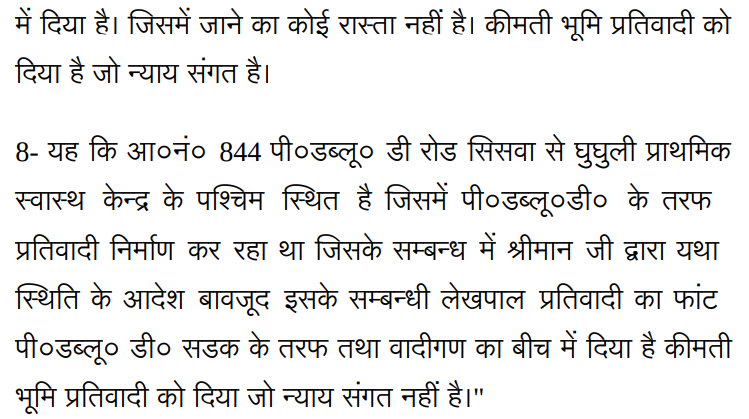
State Of U.P. And 10 Others – Respondent
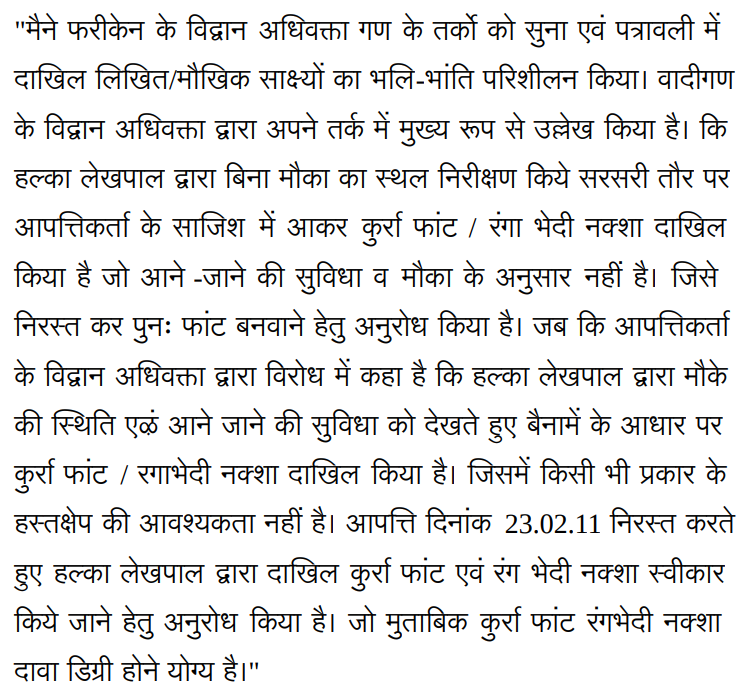
WRIT - B No. - 4722 of 2024
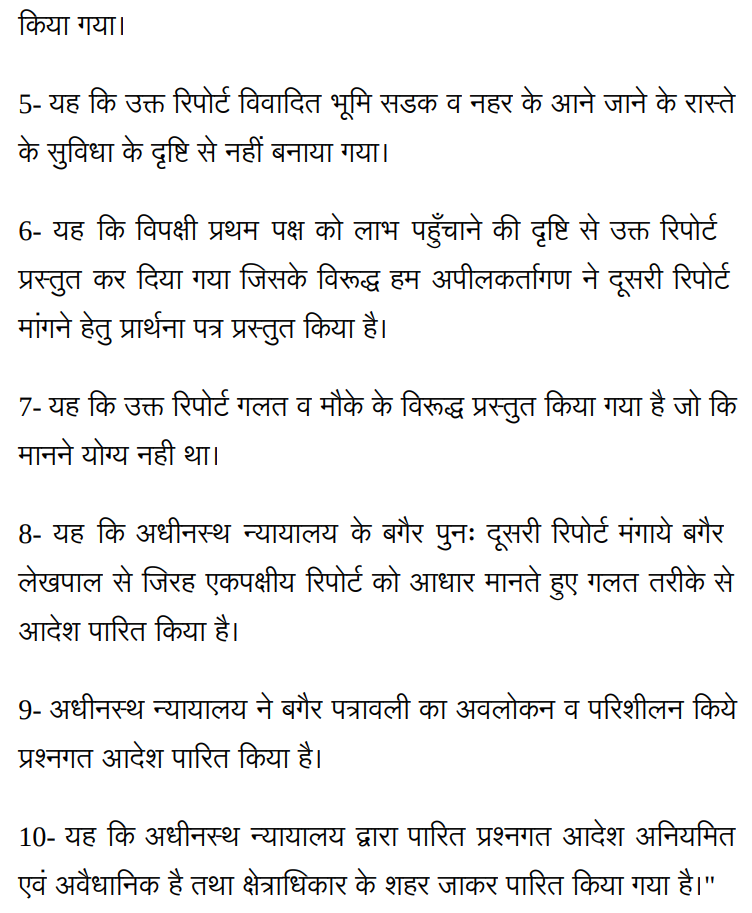
Decided on : 13-12-2024
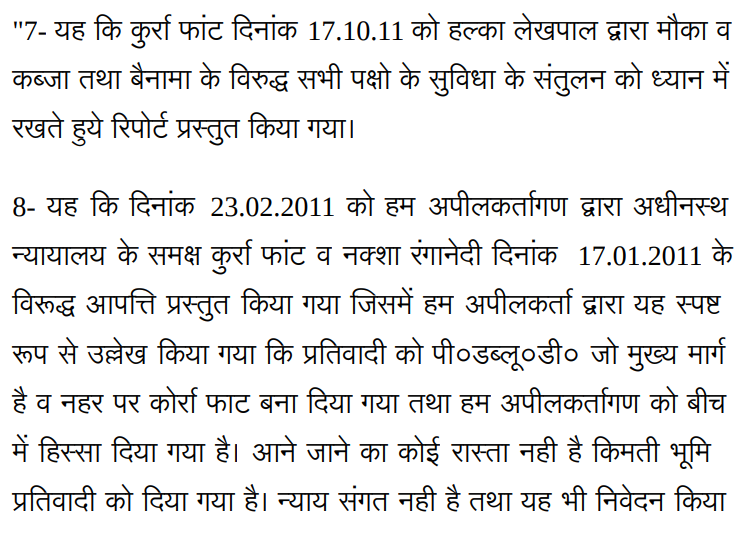
| Table of Content |
|---|
| 1. execution and succession of sale deeds (Para 2 , 3 , 4 , 5) |
| 2. procedures regarding kurrafat and objections (Para 6 , 7) |
| 3. filing of appeals and grounds raised (Para 8 , 9 , 10) |
| 4. substantial questions of law in appeals (Para 11 , 12) |
| 5. arguments on kurrafat and petitioners' entitlements (Para 13 , 14 , 15) |
| 6. court's observations on legal compliance (Para 19 , 20 , 21 , 22) |
| 7. remand for fresh consideration in accordance with law (Para 23) |
| 8. writ petition disposed with directions (Para 24) |
JUDGMENT :
Saurabh Shyam Shamshery, J.
1. Heard Sri Brijesh Shukla, Advocate holding brief of Sri Harish Kumar Tripathi, learned counsel for the petitioners, Sri Devesh Kumar Verma on behalf of respondent no.10, Sri Sudhir Bharti on behalf of Gaon Sabha and Sri A.K.Chaurasia, learned Additional Chief Standing Counsel.
2. One Mussamt Salami had executed a registered sale deed on 6.2.1984 in favour of her three sons-in-law namely:Iddan (father of petitioners), Fazil (father of respondent nos.6, 7 and 8) and Asgar, respondent no.9 of her entire shares of her land in question on due consideration.
3. Subsequently, Fazil has executed a sale deed on 3.8.1987 in favour of Fekani (mother of petitioners) of some part of the land in question.
4. After death of Fekani, names of the petitioner were entered in the revenue records as legal heirs.
5. The petitioner nos. 1 and 2 filed a partition suit under Section 176 of Uttar Pradesh Zamindari Abolition and Land Reforms Act, 1950 (hereinafter called the 'Act of 1950') on 5.12.2009 for partition of aforesaid part of land in dispute being a co-sharer.
6. In the said proceedings, Halka Lekhpal submitted a Kurrafat on 17.1.2011 and according to petitioners same were against the provisions of Rule 131 of Uttar Pradesh Zamindari Abolition and Land Reforms Rules, 1952 (hereinafter called the 'Rules of 1952'), as such they have filed objections on 23.2.2011. For reference, relevant part of objections are mentioned hereinafter:

7. Learned Trial Court vide order dated 31.3.2011 accepted Kurrafat submitted by the Halka Lekhpal and rejected objections filed by the petitioners. Relevant part thereof is mentioned hereinafter:
8. Petitioners being aggrieved by the aforesaid order filed an Appeal before Commissioner, Gorakhpur and relevant grounds taken therein are mentioned hereinafter:

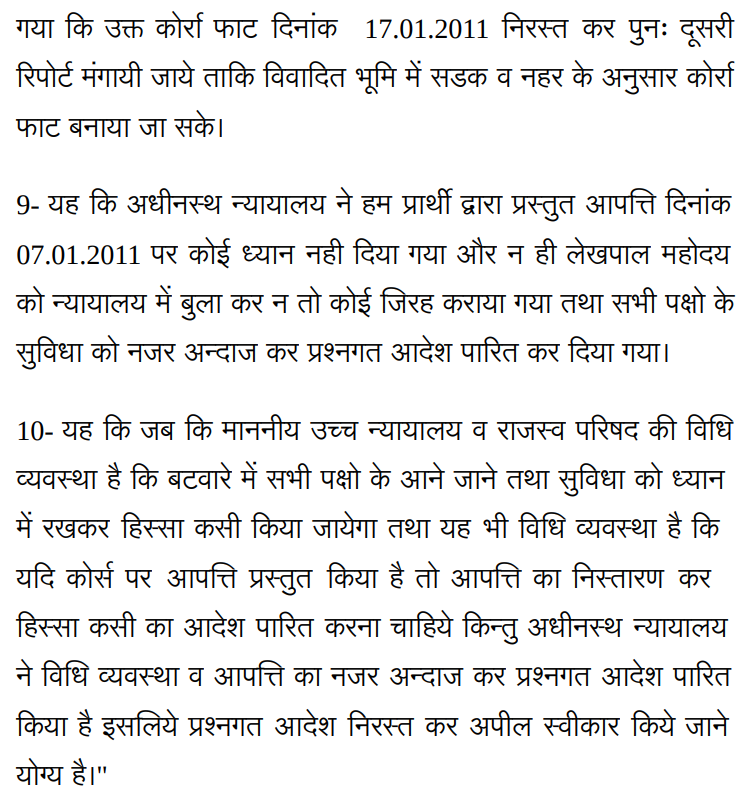
9. Petitioners have filed a written submissions and relevant part thereof is mentioned hereinafter:
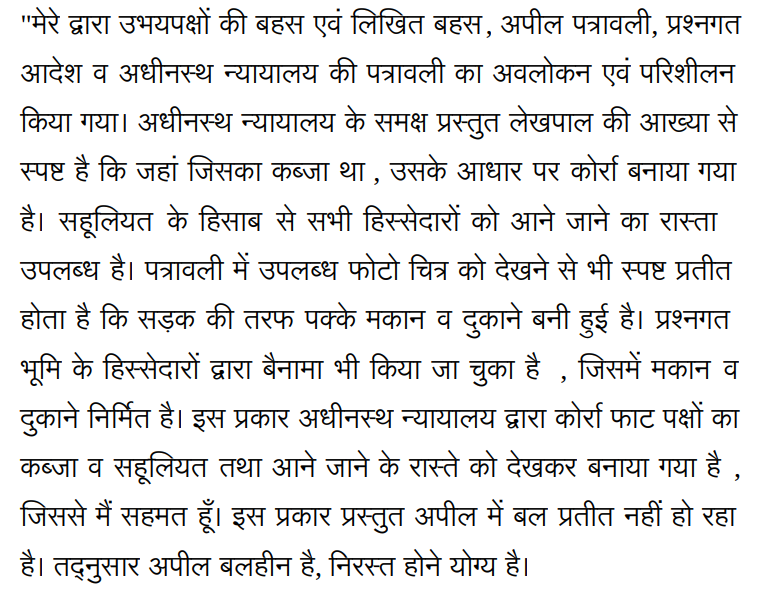
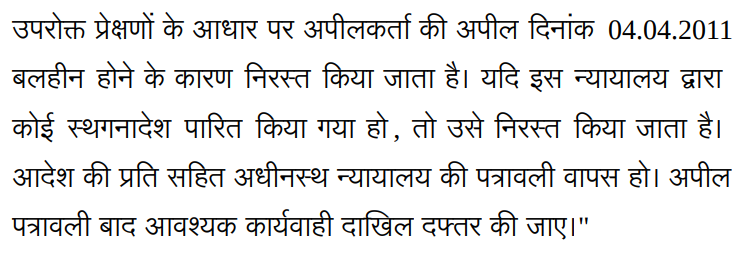
10. Commissioner, Gorakhpur dismissed the Appeal vide order dated 22.3.2018 and relevant part thereof is mentioned hereinafter:
11. In the aforesaid circumstances, petitioners filed a Second Appeal before the Board of Revenue wherein following substantial questions of law were raised:
"A. Whether, both the Courts below justified in passing impugned judgment and order in Uttar Violation of the law?
B. Whether, the Lower Appellate Court has justified the impugned order without recording his own finding with regard to grounds taken by the appellants that all the parties are entitled to obtain share equally upon the road side and the learned trial court has justified by passing impugned order against the law?"
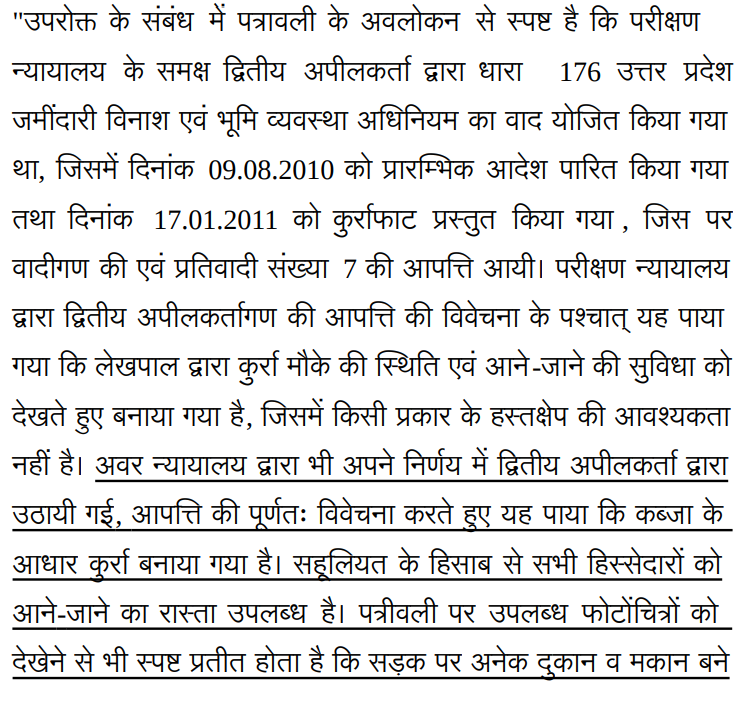
12. The Board of Revenue vide order dated 17.10.2024 dismissed the Second Appeal that no substantial questions of law was involved. Relevant part thereof is mentioned hereinafter:
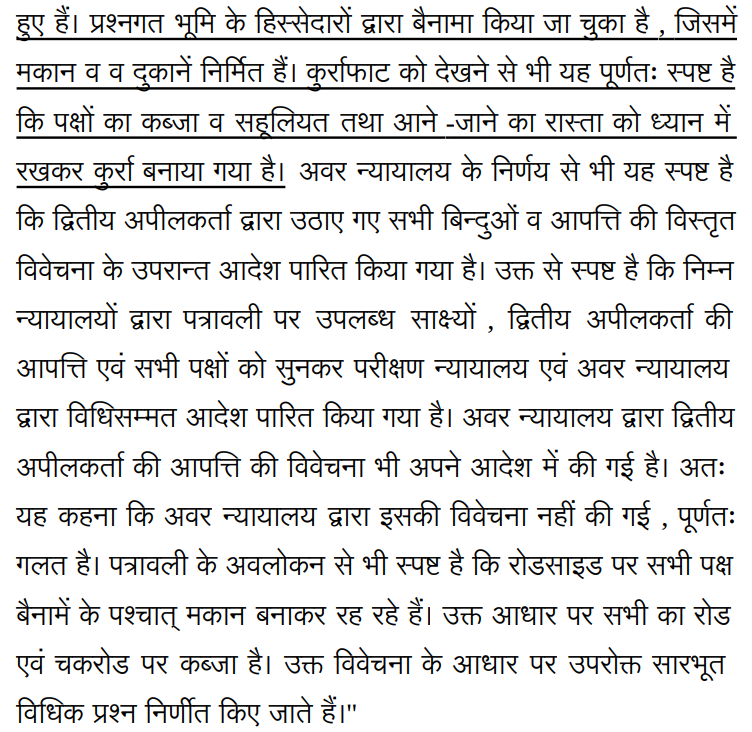
13. Learned counsel for the petitioners submitted that objections were filed to Kurrafat, however, it was rejected without any consideration on basis of objections. Report of the Lekhpal was accepted without considering that it was contrary to the provisions of Rule 131 of the Rules, of 1952.
14. Learned counsel for the petitioners further submitted that all the parties ought to have been given equal share on the P.W.D. Road which was admittedly not granted only on a ground that land has been sold and there are constructions, without specific area and the objections were illegally rejected.
15. Appellate Court and Board of Revenue have failed to consider specific
AI
Failure to comply with procedural rules in partition cases necessitates reconsideration to ensure equitable distribution in accordance with legal principles.
The central legal point established in the judgment is the requirement to adhere to the principles of Rule 109 of U.P. Revenue Code Rules 2016 in the preparation of kurra, and the necessity to consid....

A party's acceptance of a report without timely objection precludes later challenges, establishing principles of estoppel in land partition disputes.
The court upheld the finality of the land partition decree, confirming that all procedural safeguards were adhered to in preparing and confirming the Kurra, thus denying the petitioners' claims again....

The main legal point established in the judgment is that land on the road should be divided amongst all the co-sharers in proportion to their share in the total land holding, as per the Haryana Land ....

Effective and accurate computation of land shares based on historical records is essential in property disputes, with courts emphasizing error correction in previous decrees.
Claims regarding land share must be substantiated by proper procedural evidence; entries in consolidation forms alone do not establish finality in disputes.



An indispensable Tool for Legal Professionals, Endorsed by Various High Court and Judicial Officers
Please visit our Training & Support
Center or Contact Us for assistance

Scan Me!
India’s Legal research and Law Firm App, Download now!


For Daily Legal Updates, Join us on :



 Back to top


