
 Back
Back





IN THE HIGH COURT OF JUDICATURE AT ALLAHABAD
SHEKHAR B. SARAF, PRAVEEN KUMAR GIRI, JJ.
Ahmad Ali Khan - Appellant
Vs.
State Of Uttar Pradesh And Others - Respondent
WRIT-C NO.61072 OF 2012
Decided On : 25-09-2025
| Table of Content |
|---|
| 1. factual background of the writ petition. (Para 1 , 2) |
| 2. petitioner's contentions on agreement to sale. (Para 3) |
| 3. respondent's objections to the sale. (Para 4) |
| 4. court's observation on registration refusal. (Para 5 , 6 , 10) |
| 5. cantonment land registration requirements and rules. (Para 7 , 12 , 13) |
| 6. legal implications of agreements to sell on government land. (Para 15 , 16 , 18) |
| 7. principles governing title transfer. (Para 21 , 25 , 26) |
| 8. final observations and order of dismissal. (Para 27) |
JUDGMENT :
PRAVEEN KUMAR GIRI, J.
This is a writ petition under Article 226 of the Constitution of India, wherein the writ petitioner has made the following prayers :
“(a) issue writ, order of direction of in the nature of CERTIORARI calling for the records and quashing the objection raised by respondent no. 3 dated 26.10.2012 (Annexure-1 to the present writ petition)
(b) issue writ, order or direction in the nature of MANDAMUS commanding the respondent no.3 to register the instrument presented in his office by the petitioner on 26.10.2012 for registration of agreement-to-sell with respect to property described as Bungalow No.132, Survey No.56, British Calvary (B.C) Lines, Bungalow Area, Meerut Cantt.”
FACTS
2. The factual matrix of the present writ petition is delineated below :
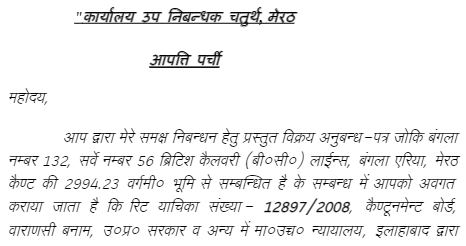
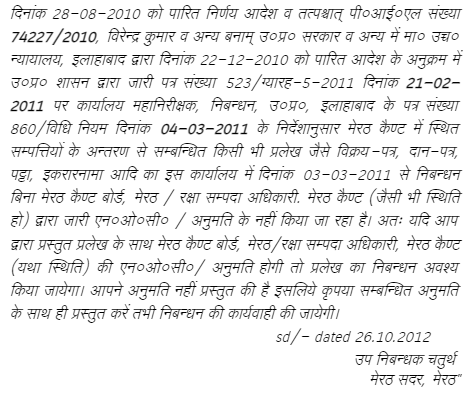
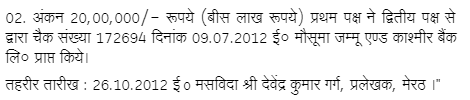
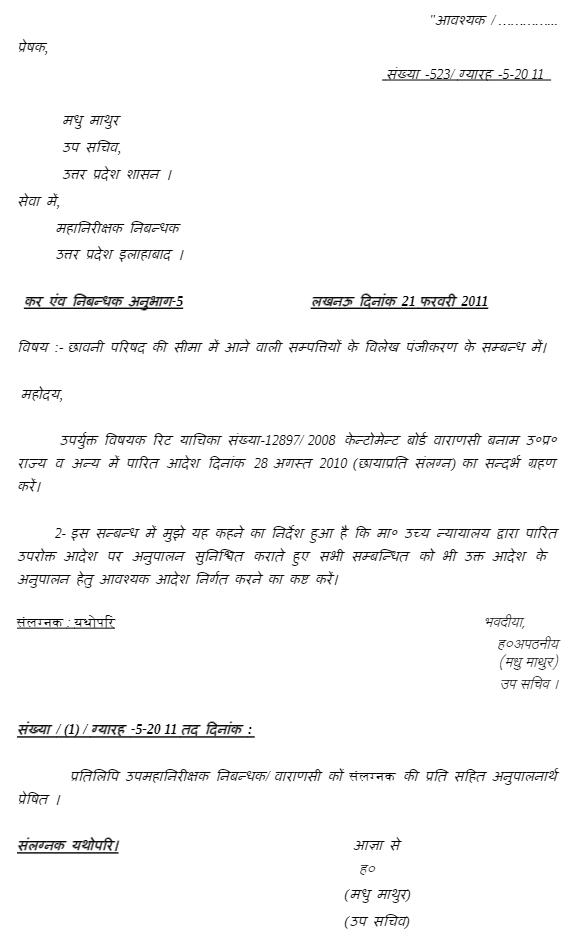
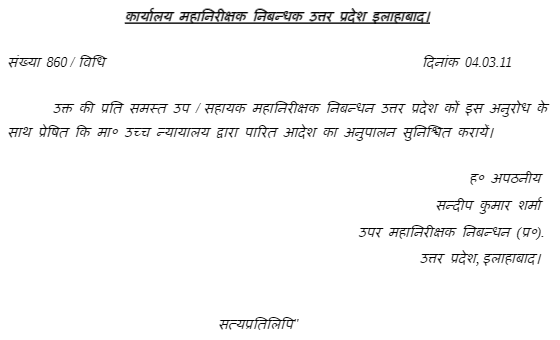
(a) The Sub Registrar, IV, Sadar, Meerut vide order dated October 26, 2012 made objections in registering the agreement to sale entered into by the petitioner, Ahmad Ali Khan, with Sri Ajay Gupta and Smt. Parul Gupta in respect of a property known as Bungalow No.132, Survey No.56, British Calvary (B.C.) Lines, Bungalow Area, Meerut Cantt. relying upon the decision of this Court in Writ C No. 12897 of 2008 (Cantonment Board, Varanasi vs. State of U.P. and others) decided on 28.10.2010, PIL No. 74227 of 2010 ( Virendra Kumar and Others Vs. State of U.P. and Others ) decided on 22.12.2010 and the Circular issued by the government of Uttar Pradesh dated 21.02.2011. The objection/letter dated October 26, 2012 is quoted below :
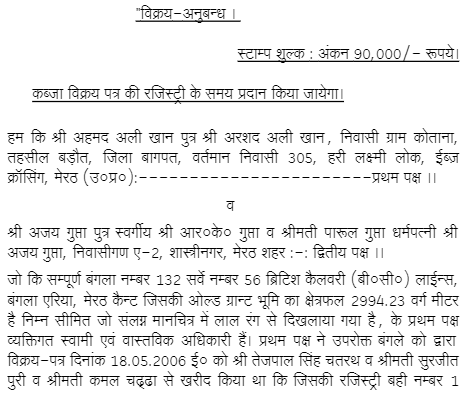
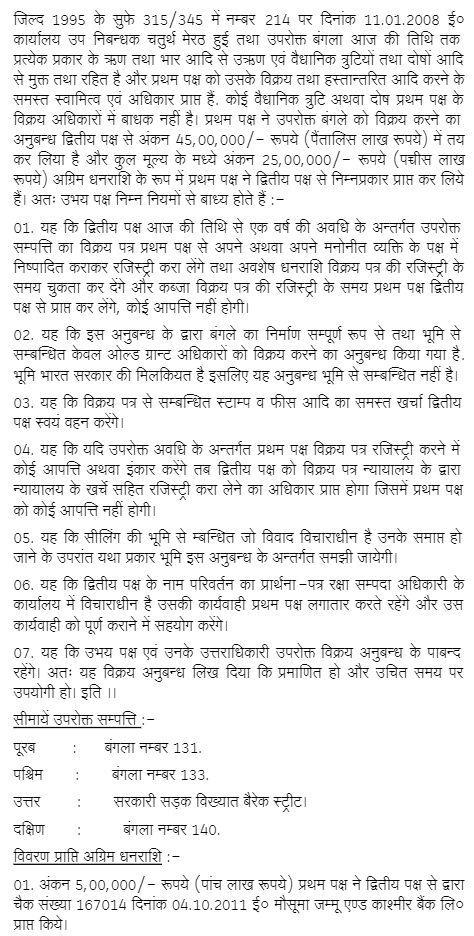
(b) The petitioner has entered into an agreement to sale of a property belonging to the Union of India situated in Cantonment area and controlled by Cantonment Board. The petitioner itself has admitted this fact in the agreement to sale. The agreement to sale in question is being quoted below :
CONTENTIONS OF THE PETITIONER
3. Learned counsel appearing on behalf of the petitioner has made the following submissions :
a. The petitioner had purchased the old grant rights for Bungalow No.132, Survey No.56, British Calvary (B.C.) Lines, Bungalow Area, Meerut Cantt vide sale deed dated 18.05.2006 executed by Sri Tejpal Singh Chatrath, Smt. Surjeet Puri and Smt. Kamal Chaddha who were the recorded holders of occupancy right with respect to the aforesaid Bungalow. The petitioner entered into an agreement to sale with Sri Ajay Gupta and Smt. Parul Gupta on 26.10.2012 for total consideration of Rs.45.00 lacs out of which the petitioner has accepted Rs.25.00 lacs as advance payment. Petitioner had applied for registration of the said agreement to sale on which objections were raised by the Sub Registrar.
b. There is no provision in the Registration Act, 1908 enabling the Sub Registrar to deny the registration of any deed, therefore, he cannot deny registering the agreement to sale in favour of a third person by the petitioner.
c. The petitioner is in possession of the aforesaid Bungalow and as per the agreement to sale, the possession will be delivered to the vendees at the time of execution of the sale deed. As per the agreement to sale, the time period for execution of the sale deed has been fixed to be one year.
d. The agreement to sale is only with respect to the superstructure upon the land and there is no agreement to sale with respect to the land. In fact, the petitioner has admitted in the agreement to sale that the land is in the ownership of the Central Government and the agreement to sale does not include the land and as such agreement to sale
AI


The main legal point established in the judgment is the binding effect of the settlement between the parties, the waiver of the right to seek re-employment by the workmen, and the entitlement of the ....

A lockout is justified if it is declared in response to an illegal strike or a strike that is in breach of a settlement or award.

The combination of eyewitness testimonies, recovery of the weapon used, and forensic examination results can establish guilt in criminal cases, even based on circumstantial evidence.


The conviction of an accused person under Section 27(3) of the Arms Act is not permissible in law if the accused is also charged with committing murder under Section 302 of the Indian Penal Code.

The court can enhance compensation based on the deceased's income and family dependency, and adjust the multiplier used by the Tribunal if found unjustified.



An indispensable Tool for Legal Professionals, Endorsed by Various High Court and Judicial Officers
Please visit our Training & Support
Center or Contact Us for assistance

Scan Me!
India’s Legal research and Law Firm App, Download now!


For Daily Legal Updates, Join us on :



 Back to top


